
TikTok Shop Affiliate Program for Brands: How It Works
The affiliate program lets creators promote your products in videos and LIVE and earn a commission you set. For a brand it is a distribution system you design, not a media buy.
The TikTok Shop affiliate program lets creators promote your products in videos and LIVE streams and earn a commission, set by you, on every sale they drive. For a brand, it is a distribution system you design, not a media buy. You decide who gets product, what they earn and what they are allowed to say. The quality of those three decisions sets the results.
This guide is for a brand that owns its product and inventory and wants the program to produce GMV, not just activity. GMV, gross merchandise value, is the total order value that goes through your shop.
How does the TikTok Shop affiliate program work?
A creator who is part of the affiliate program can add your product to their showcase, make content that links to it, and earn your commission when a shopper buys through that content. You pay commission only when an order completes. You also pay for the sample you sent and the time you spend managing the relationship.
Eligibility rules, commission limits and fees change often. We do not quote them here. Check Seller Center for the current requirements for your category and market.
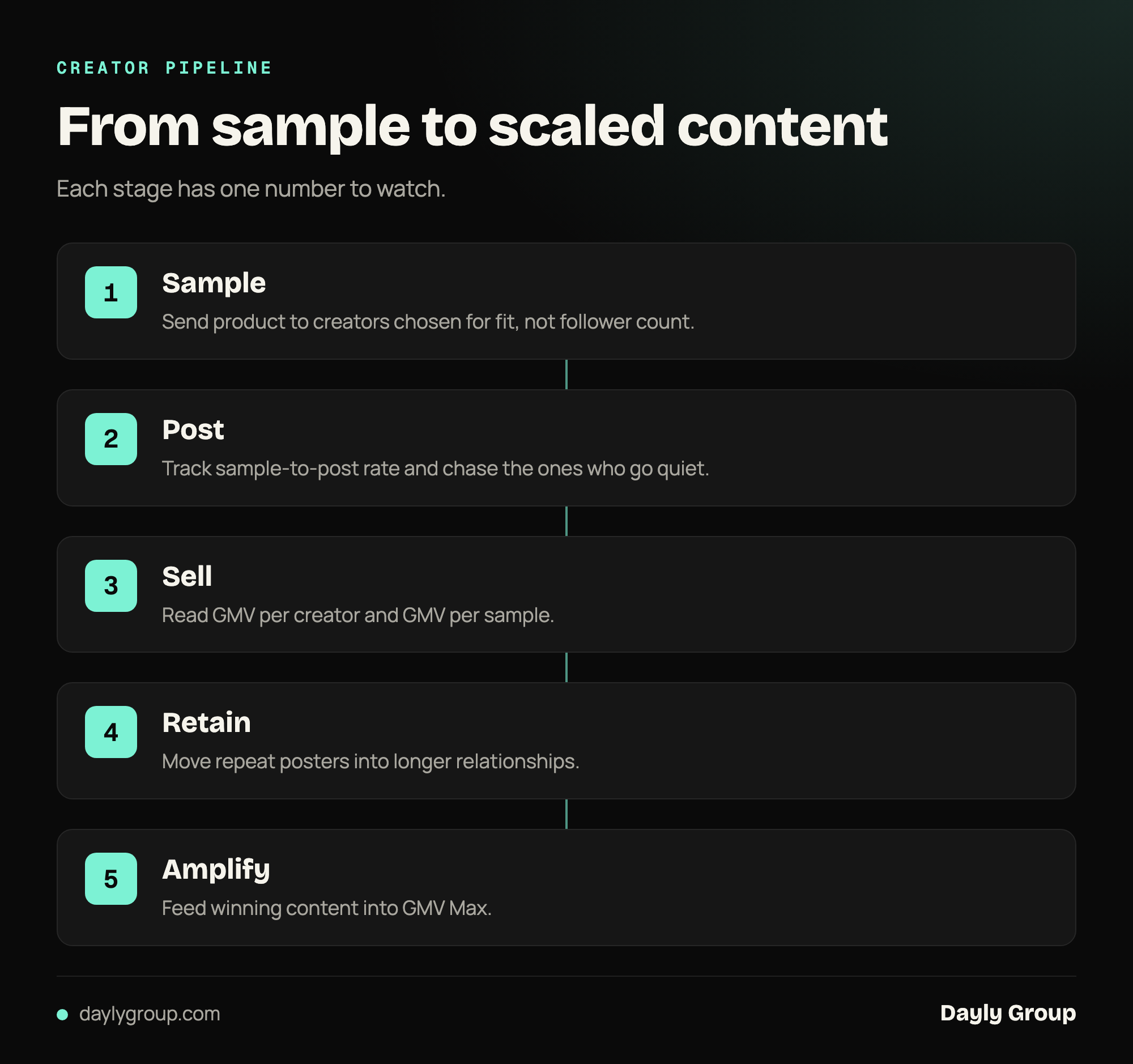
Think of it as a sales channel with its own supply chain. Samples go out, content comes back, some content sells, and the best creators are worth keeping. The rest of this post is how to run that chain well.
What is the difference between open and targeted collaboration?
Open collaboration makes your product available to any eligible creator who wants to promote it. Targeted, or invite-only, collaboration lets you pick specific creators, offer them terms and approve them one by one. Names, options and rules for these modes change, so confirm the current set in Seller Center.
Our view is that you need both, for different jobs:
- Open collaboration gives you breadth. It lets creators you never contacted find your product, and it surfaces surprises. The cost is less control over who represents you.
- Targeted collaboration gives you precision. You choose creators whose audience matches your buyer, set better terms for the ones you want, and brief them properly.
Start open at a sensible commission so you have a base, and run targeted outreach for the creators you want most. Do not wait for creators to find you.
How do you set the commission rate?
Set commission from your margin, not from what looks competitive. Commission is a trade. A higher rate attracts better creators and more of their attention. It also squeezes the margin on every sale. A lower rate protects margin and may leave you with only creators who cannot sell anything else.
Model it before you set it. Here is an illustration with round numbers. Replace every figure with your own.
- Order value: $100
- Product cost: $35
- Platform referral fee: use your category rate from Seller Center
- Creator commission: your decision
- Shipping and packaging: your actual cost
What remains is the contribution you have to work with before samples and ads. If that number is thin at a 15% commission, raising to 20% to win a creator may push the order underwater once you add GMV Max spend later. Know the ceiling before you start negotiating.
Practical rules we use:
- Know your break-even commission, the highest rate where a sale still earns contribution after all other costs.
- Set the open rate below that ceiling with room to spare.
- Reserve a higher tier, still under the ceiling, for creators who prove they sell.
- Revisit the rate when your cost or price changes.
If you want the broader cost view, see what a TikTok Shop sale really costs and whether TikTok Shop is profitable for DTC brands.
How should you use samples?
Selection matters more than volume. A small share of creators drive most of the GMV on a shop, so who gets a sample matters more than how many samples go out. Sending product to everyone who asks is the most common way brands burn budget and learn nothing.
A sample strategy that works:
- Pick for fit. Does the creator's audience match your buyer? Do they make content in your category, or at least in an adjacent one where your product makes sense?
- Check past content. Look for creators who sell through content, not only collect views. A video with high views and no purchases is not a good sign.
- Send enough that a few can break out. You need a spread of creators so that the winners show up. You do not need a flood.
- Track GMV per sample. This is your real cost of testing. If a batch of samples produced no sales, change the selection before you send more.
Product choice matters too. Seed the hero SKU first, the one with the clearest demonstration. Do not spread samples across a full catalog and hope something sells.
What should a creator brief include?
A good brief is short and specific. It tells the creator what to show, not what to say word for word. A creator who reads like a script performs worse than one who talks the way their audience expects.
Cover these:
- What to show. The problem, the product in use, the moment the result is visible.
- Hook options. Two or three angles to try, not one mandatory opening.
- Must-have details. Name, key benefit, offer, how to buy.
- Claims you can and cannot make. Be explicit. Claims have to match your category rules on the platform. If your product is in health or wellness, use "supports"-style language only and never promise a result. Check Seller Center for the rules in your category.
- Compliance basics. Required disclosures for paid or gifted content, and no competitor comparisons you cannot back up.
The brief protects the creator and you. Most compliance problems start with a creator who was never told what they could not say.
What do you do about creators who take samples and never post?
Expect some to disappear. The question is how to keep it from becoming a pattern.
- Set the expectation up front. The invitation should say a post is expected, and within what window.
- Follow up once, politely. A short message after the product arrives, with the brief attached.
- Track sample-to-post rate. This is the share of sampled creators who publish. If it is low, the problem is usually selection or the brief, not the creators.
- Stop sending to non-posters. If a creator took a sample and never posted, they do not get a second one.
- Do not chase with cash. Do not pay people to post, buy, or review in ways the platform does not allow. Incentivized reviews and any tactic that evades platform rules put your shop at risk.
The cleanest fix is better selection. A creator who has posted for similar brands, answers messages and shows consistent output is a better bet than someone with a bigger following and no record of follow through.
How do you keep winning creators posting?
One post rarely makes a shop. The winners are the creators who post repeatedly, and that is where the program compounds.
When a creator's video sells, move quickly:
- Thank them and ask for more. Offer a new angle or a second product.
- Offer better terms. A higher commission tier under your ceiling for proven sellers.
- Share what worked. Tell them which hook or demonstration performed.
- Send the next product early. Give them first access to new items.
Track repeat posters as a metric. They are your retention base. A shop with a handful of reliable repeat creators is far more stable than one that restarts the pipeline every month.
How does affiliate content feed GMV Max?
Affiliate content becomes the raw material for paid. GMV Max is TikTok's automated ad campaign type that promotes your products toward a target you set, using the content available to it. It needs a base of content that already sells.
That is why the order matters: creators first, GMV Max after. Winning affiliate videos give GMV Max something proven to amplify. Without that base, spend goes to weak creative and you pay to learn what the affiliate program could have told you for the cost of a sample. Set the GMV Max target from your margin, not from a revenue goal. We cover it in GMV Max explained.
Which metrics should you track?
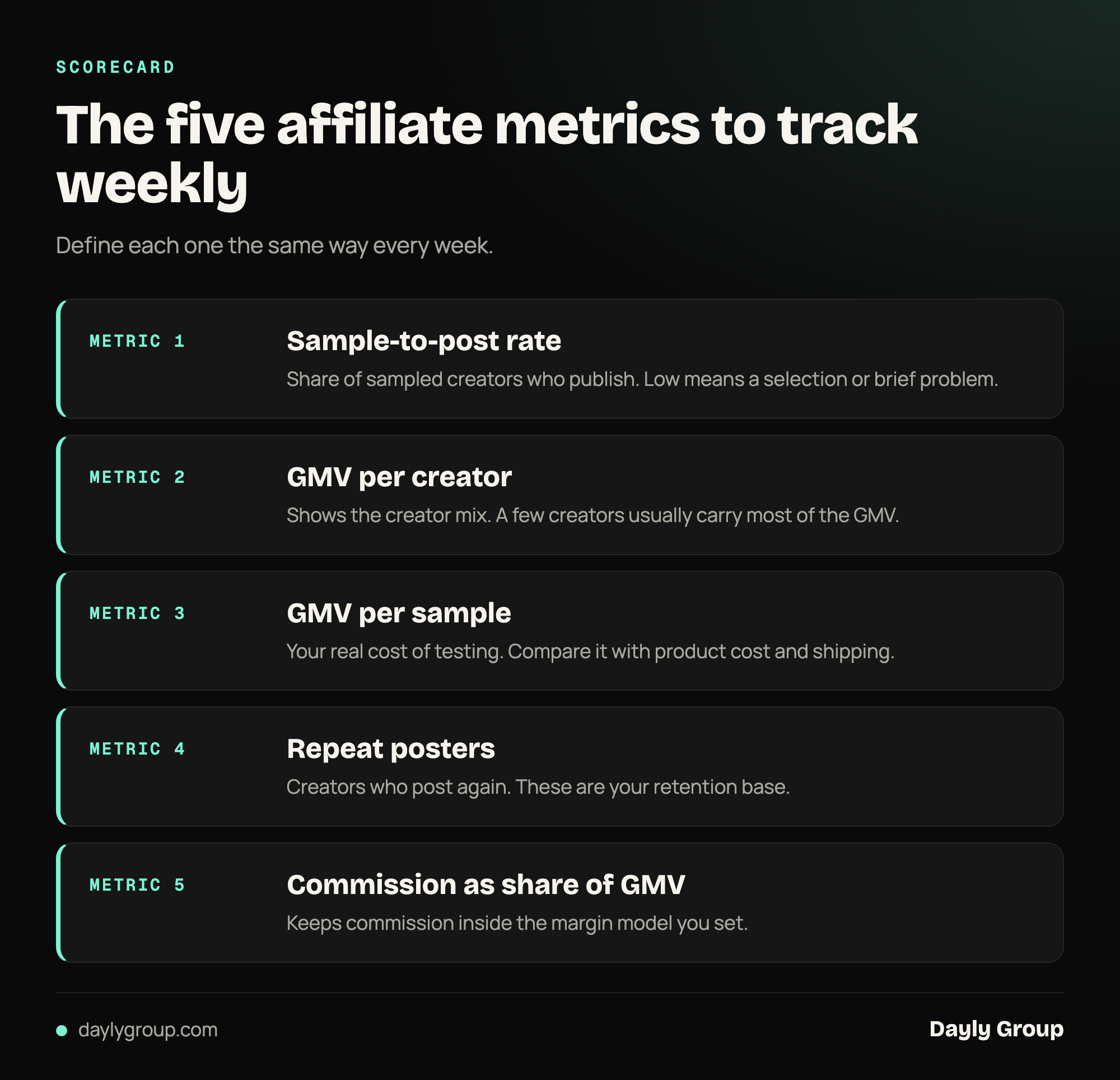
Track five numbers every week, defined the same way each time:
- Sample-to-post rate. Share of sampled creators who publish.
- GMV per creator. Shows the mix. Expect a few creators to carry most of it.
- GMV per sample. Your cost of testing, against product cost and shipping.
- Repeat posters. Creators who post more than once.
- Commission paid as a share of GMV. Keeps the program inside your margin model.
Read them together. High sample-to-post with low GMV per creator means fit is off. Low sample-to-post with strong GMV from a few means you have a small base that works and need to find more like them.
What should you never do?
- No incentivized reviews. Do not offer money, free product or other rewards in exchange for reviews.
- No claims outside your category rules. Especially for health, skincare and supplements.
- No fake engagement or anything that evades platform rules.
- No paying creators around the commission system in ways the platform does not permit.
Shop standing is worth more than any one campaign.
For the wider picture, see what a TikTok Shop agency does and, if you are adding TikTok Shop to an Amazon business, how to launch your Amazon brand on TikTok Shop. You can also compare the channels in TikTok Shop vs Amazon for DTC brands.
FAQ
Q: What is the TikTok Shop affiliate program? A: The TikTok Shop affiliate program lets creators promote a brand's products in videos and LIVE and earn a commission on each sale. The brand sets the commission and decides which creators receive samples. It works as a distribution system rather than a media buy.
Q: How much commission should a brand pay TikTok Shop affiliates? A: Set it from your margin. Work out the highest commission at which a sale still earns contribution after product cost, platform fees and shipping, then set your open rate below it. Check Seller Center for current limits and fees.
Q: How many samples should a brand send to creators? A: Enough that a few creators can break out, but selection matters more than volume. A small share of creators drive most of the GMV on a shop. Track GMV per sample and change who you send to before you increase how many.
Q: What if a creator takes a sample and never posts? A: Follow up once, then stop sending that creator product. Track your sample-to-post rate, and if it is low, fix selection and the brief. Do not pay creators in ways the platform does not allow.
Q: Do affiliate videos help GMV Max? A: Yes, as raw material. GMV Max promotes your products using available content, so a base of affiliate videos that already sell gives it something proven to amplify. Build the content first and add GMV Max after.
Q: Can a brand run the affiliate program in-house? A: It can, if someone owns outreach, sampling, briefs and reporting every week. The work is steady and operational. Compare the options in TikTok Shop agency vs in-house.
If you want to see how your creator program would compare with top sellers in your category, we build a free TikTok Shop Gap Report before the first call.
Keep reading
Book a free Gap Analysis. We'll tell you what's leaking, what's scaling, and where the next 30% lives.
Book a Gap Analysis →