What Does a TikTok Shop Agency Actually Do? The Full Scope
A TikTok Shop agency runs the commerce engine around your shop: setup, catalog, creators, content, paid amplification and reporting. Here is each function, what good output looks like and what you still own.
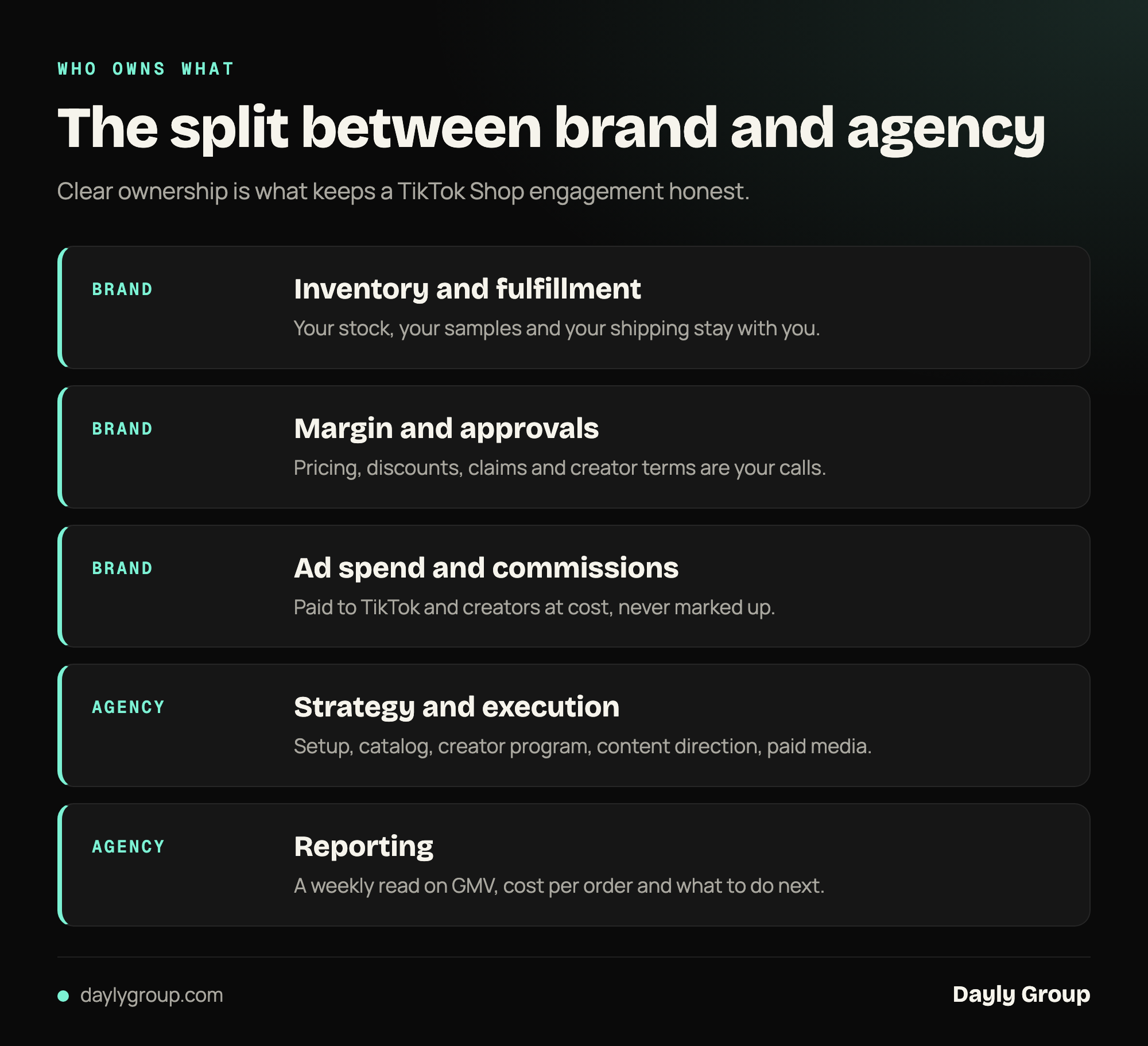
A TikTok Shop agency runs the commerce engine around your shop. That means setup and compliance, catalog and offers, creator and affiliate acquisition, content, paid amplification through GMV Max and Spark Ads, and reporting. It does not own your inventory, fulfillment, margin decisions or ad spend. Those stay with the brand.
This post walks through each function, what good output looks like, and what you still own. It ends with a realistic first three months, described as work done rather than results promised. If you are comparing models first, read TikTok Shop agency vs in-house.
How does the TikTok Shop engine work?
The engine is a loop: creators make content, content reveals winners, paid media amplifies the winners, and reporting decides what to repeat. Each function feeds the next, so a gap in one starves the rest.
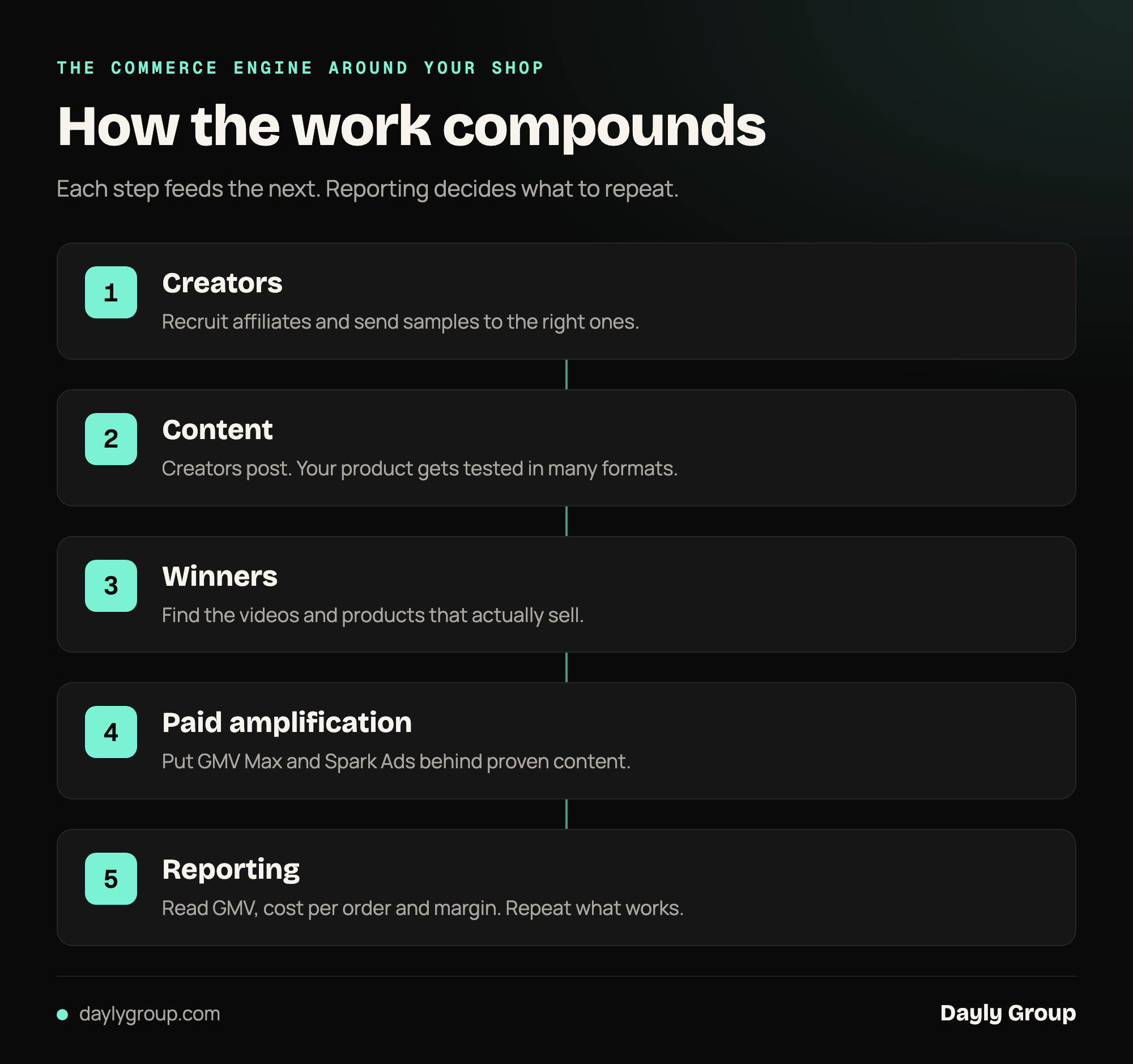
GMV means gross merchandise value, the total value of orders the shop sells. Everything below is aimed at growing GMV at a cost per order and contribution margin you can live with. Contribution margin is what is left of each order after product cost, platform fees, commissions and ad spend. We sell GMV and profit, not views, and the reporting should reflect that.
What happens in setup and compliance?
Setup and compliance means getting the shop approved, correctly configured and safe to scale. Good output is a shop that is live, free of policy problems, and ready for creators and ads to send traffic into it.
The work typically includes:
- Shop registration, verification and account structure.
- Connecting fulfillment, returns and shipping settings with your operations.
- Reviewing product categories and claims against TikTok's rules, so listings are not removed later.
- Setting up the ad and affiliate permissions that later functions depend on.
Compliance matters most for regulated categories. If you sell health, wellness or skincare products, claims must follow TikTok's category rules
, and copy should use "supports" language rather than results promises.
What you still own: legal and regulatory sign-off on your claims, your business documents, and the decision about which products to list.
What does catalog and offer work involve?
Catalog and offer work turns your products into listings that convert shoppers who arrive from a video. Good output is a small set of hero SKUs with clean titles, strong images, clear variants and an offer that makes sense for the channel.
A hero SKU is the product you lead with, the one most likely to win attention and repeat purchase. Most shops should not list everything at once. The agency helps choose what leads, how bundles and pricing are structured, and how listings read for someone who found the product in a feed rather than in a search. Our post on how products rank in TikTok Shop search covers the search side.
What you still own: pricing and discount decisions, margin floors, and the final approval of any listing change. Price consistency across channels is your call, and it should be made deliberately.
How does creator and affiliate acquisition work?
Creator and affiliate acquisition means finding creators who fit your product, inviting them into your affiliate program, and deciding who receives samples. Good output is a growing roster of active creators who are posting, not just a long list of accepted invitations.
An affiliate is a creator who earns a commission when shoppers buy your product through their content. The key judgment here is selection. A few creators tend to drive most GMV, so who gets a sample matters more than how many samples go out. Good teams track GMV per sample and creator mix, and they learn quickly which creator types move your category.
For the program mechanics, see the TikTok Shop affiliate program for brands.
The work includes outreach, negotiating commission terms within limits you set, following up on samples that were sent but not posted, and keeping a record of what each creator produced.
What you still own: the product samples themselves, the commission ceiling, and approval of any creator terms or brand-safety exclusions.
What does the content function cover?
The content function keeps a steady flow of videos about your product in market. Good output is content velocity: enough new posts, in enough formats, that you learn what works instead of betting on one video.
Most of this content comes from creators, supported by a content brief that explains what to show, what to say, which claims to avoid and what the offer is. The agency shapes direction and feedback. It does not fake enthusiasm or script every word, because the videos that sell usually sound like a real person using the product.
Winning creative is the term for the videos that reliably produce orders. The agency's job is to spot it early, tell you why it works, and brief the next round around it.
What you still own: brand guidelines, claim approvals, and any content that uses your own footage, founder or team members.
How does paid amplification work?
Paid amplification puts ad spend behind content that has already shown it can sell. Good output is paid media that scales proven videos at a cost per order that clears your margin, not spend started before there is anything worth scaling.
Two tools do most of the work. GMV Max is TikTok's automated campaign type for Shop. It decides where to show your products and creative to find buyers, so it performs best when it has a base of good content and clean product data. Spark Ads put an existing creator or brand post behind paid reach, with permission from the creator.
Our view is that targets should come from your margin, not from a revenue goal. If a product earns a thin margin, the target is set accordingly, even if that means slower growth. The timeline logic matters too: content flows in weeks, and GMV Max needs a base of content before it has much to work with.
Read more in GMV Max explained.
What you still own: the budget. Ad spend is paid by the brand at cost, and you set the ceiling and the target cost per order.
What does reporting look like?
Reporting turns activity into decisions. Good output is a weekly read that tells you GMV, orders, cost per order, contribution margin, which creators and videos produced, and what the team will do next.
A useful report answers four plain questions. What sold? What did it cost to sell? Which creators and content are worth more investment? What are we changing this week? Anything that only shows views, followers or impressions has missed the point.
What you still own: access to your own data. You should be able to see the shop, ad accounts and creator records without asking permission.
What does a TikTok Shop agency not do?
A TikTok Shop agency does not hold your inventory, run your fulfillment, absorb your ad spend or promise outcomes. Knowing the boundary protects both sides.
- Inventory and fulfillment. Stock, packing, shipping and returns stay with you or your logistics provider. The agency flags stock risk, but it cannot ship an order.
- Ad spend and commissions. The brand pays TikTok and creators directly, at cost. An agency that marks these up or blends them into a fee is hiding something.
- Margin decisions. The agency recommends. You decide what discounts and commissions the business can afford.
- Promised outcomes. No one controls what shoppers buy. Be wary of anyone who promises a GMV figure or a date for your first sale.
- Your product. If the product is not ready for the channel, the right agency says so rather than burning budget.
For a checklist of warning signs when hiring, see TikTok Shop agency red flags.
What does the first three months look like?
The first three months follow four phases of work: audit and setup, creator seeding and content, finding winners, then amplifying them. These describe inputs, what gets done, rather than outcomes you should expect.
Phase 1: Audit and setup. Review the shop against top sellers in your category, fix compliance and catalog problems, choose hero SKUs, and agree margin-based targets. At Dayly this starts with a free Gap Report, built before the first call.
Phase 2: Creator seeding and content. Recruit affiliates, send samples to the creators most likely to produce, brief them, and start the weekly rhythm of follow-ups and content review. Content begins to flow over the following weeks.
Phase 3: Find winners. Read what the content is doing. Identify the videos and products that convert, drop what does not, and brief the next round around what is working.
Phase 4: Amplify. Once there is a base of proven content, bring in GMV Max and Spark Ads behind it, with spend capped to your cost-per-order target. Reporting continues weekly and drives every decision.
These phases overlap, and the timing varies by category, product and how fast approvals move. Treat them as an order of operations, not a schedule.
Does it work in practice?
It can, and the clearest honest answer is one example, not a promise. One example is The Period Company, a feminine-care brand doing $3M+ a year elsewhere with no TikTok Shop presence, built from a cold start. In its first 12 months it produced $622K in Shop GMV across 33.5K orders, and it was built to roughly $80K a month as of October 2026.
About two thirds of that GMV came through GMV Max, so it was a paid-driven result built on content, not luck. This is one brand, results vary by category and product, and the figures come from Seller Center.
You can see how we present results on our case studies page.
FAQ
Q: What does a TikTok Shop agency do? A: A TikTok Shop agency runs the commerce engine around your shop: setup and compliance, catalog and offers, creator and affiliate acquisition, content, paid amplification through GMV Max and Spark Ads, and reporting. It does not own your inventory, fulfillment, margin decisions or ad spend.
Q: Does a TikTok Shop agency pay for ad spend and creator commissions? A: No. A TikTok Shop agency does not pay for them. The brand pays ad spend and creator commissions at cost, and sets the budget ceiling. Be cautious of any agency that blends these costs into a fee or marks them up.
Q: What does a TikTok Shop agency need from the brand? A: A TikTok Shop agency needs product samples, accurate inventory, approvals on claims and pricing, access to your shop and ad accounts, and a named decision maker. Slow approvals are one of the most common reasons a launch stalls.
Q: Can a TikTok Shop agency promise results? A: No. A TikTok Shop agency cannot promise outcomes. It controls the work it does, not what shoppers buy. It can commit to a plan, clear reporting and margin-based targets, but any promise of a specific GMV figure or timeline should be treated as a red flag.
Q: How does a TikTok Shop agency engagement usually start? A: A TikTok Shop agency engagement usually starts with an audit of the shop against top sellers in its category. At Dayly that is a free Gap Report, built before the first call, showing the GMV your shop is missing and a ranked list of first moves.
If you want to see what this scope would look like for your shop, request the free TikTok Shop Gap Report. It shows where your shop stands against top sellers and ranks the first moves. You can also read about how to choose a TikTok Shop agency.
Keep reading
Book a free Gap Analysis. We'll tell you what's leaking, what's scaling, and where the next 30% lives.
Book a Gap Analysis →