
TikTok Shop vs Amazon for DTC Brands: Which Channel Fits Which Product
Amazon captures demand that already exists. TikTok Shop creates demand through creators, then captures it at checkout. Here is how to decide which one leads for each product.
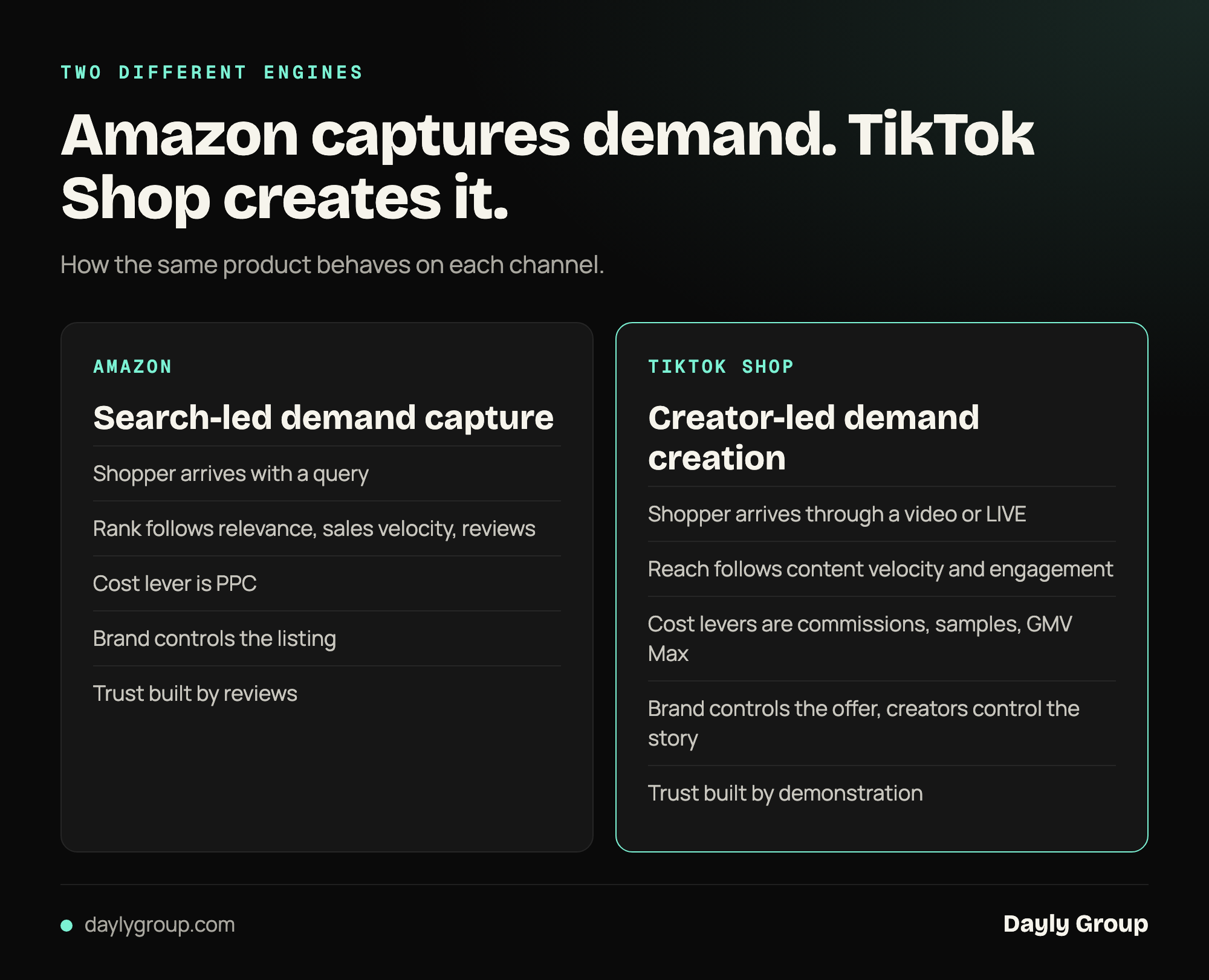
Amazon and TikTok Shop are different engines. Amazon captures demand that already exists: a shopper types a query and your listing competes to answer it. TikTok Shop creates demand: a creator shows your product in a short video or LIVE, and the shopper buys without ever searching. Most DTC brands should run both, but not the same way.
We run both channels, so this is a view from the operator's side, not a pitch for one over the other. For most $3M+ brands the real question is which channel leads for which product, and what each one needs from you.
How does a shopper arrive on each channel?
On Amazon the shopper arrives with intent. They search "magnesium glycinate" or "stainless steel water bottle", scan the results and compare. Your job is to be the obvious answer on a page built for comparison.
On TikTok Shop the shopper arrives with attention, not intent. They were watching something else. A creator shows a problem and a product, and the buy button is one tap away. Your job is to make the product impossible to scroll past, then make checkout frictionless.
That difference drives everything else in this post. Amazon rewards the brand that is easiest to find and easiest to trust on a results page. TikTok Shop rewards the brand that is easiest to understand in fifteen seconds of video.
What drives rank and visibility?
On Amazon, visibility follows relevance, sales velocity and reviews. Your listing has to match the query, convert the click, and keep converting. Rank is a position on a page that shoppers actively search, and it moves with listing quality, price, availability and PPC support. We cover the mechanics in our Amazon listing optimization guide.
On TikTok Shop, visibility follows content. The more good videos exist about your product, and the better they hold attention and convert, the more the platform has to work with. We call that content velocity: the steady flow of fresh, sellable creator content. There is no keyword ranking to defend. There is a stream of content to keep feeding. Our view is that brands treat this as a media problem when it is a supply problem. If content stops, discovery slows.
What are the main cost levers?
On Amazon, the main lever is PPC. You pay for clicks on Sponsored Products, Brands and Display to buy visibility on the keywords that matter. The numbers to watch are ACoS and TACoS, which we explain in Amazon ACOS vs TACoS. If you want the Amazon side run properly, that is what our Amazon PPC service is for.
On TikTok Shop, the levers are different:
- Creator commissions. A percentage of each sale that you set and pay to affiliate creators.
- Samples. Free product sent to creators. It is a real cost and should be tracked per creator.
- GMV Max. TikTok's automated ad campaign type that promotes your products across the platform toward a target you set. GMV, gross merchandise value, is the total order value that goes through your shop.
- The platform referral fee. A percentage of each order. Check Seller Center for your category's current rate.
Here is the structural difference. Amazon PPC is paid on clicks, whether or not they convert. Much of TikTok Shop's creator cost is paid on sales, because commission only goes out when something sells. Samples and ad spend still happen up front, so it is not free. But the shape of the risk is different, and your margin model has to reflect it. We break down the full math in what a TikTok Shop sale really costs.
What does the brand control?
On Amazon, you control the listing: title, images, A+ content, price, and the ad structure around it. You do not control who else is on the page. Competitors bid on your terms, and the marketplace owns the customer relationship.
On TikTok Shop, you control the product page, the offer and the briefs you give creators. You do not fully control the story. Creators make the content in their own voice, and the best performers rarely read like ads. You can guide them with a clear brief and clear claims rules. You cannot script them. Brands that want total message control tend to struggle here. Brands that give creators room inside clear guardrails tend to do better.
Which products fit which channel?
Product fit is the deciding factor, and it is more useful than any channel-level comparison.
Amazon fits utility staples and comparison-shopped items. Products people search for by name or category, compare on specs and reviews, and replace on a schedule. Think consumables, accessories, replacement parts and anything where the shopper already knows what they want.
TikTok Shop fits visual, demonstrable, impulse-friendly products. Products where a result is visible, a before and after is easy to film, or the item is giftable and easy to say yes to. If the benefit is obvious on camera, creators can sell it without a script.
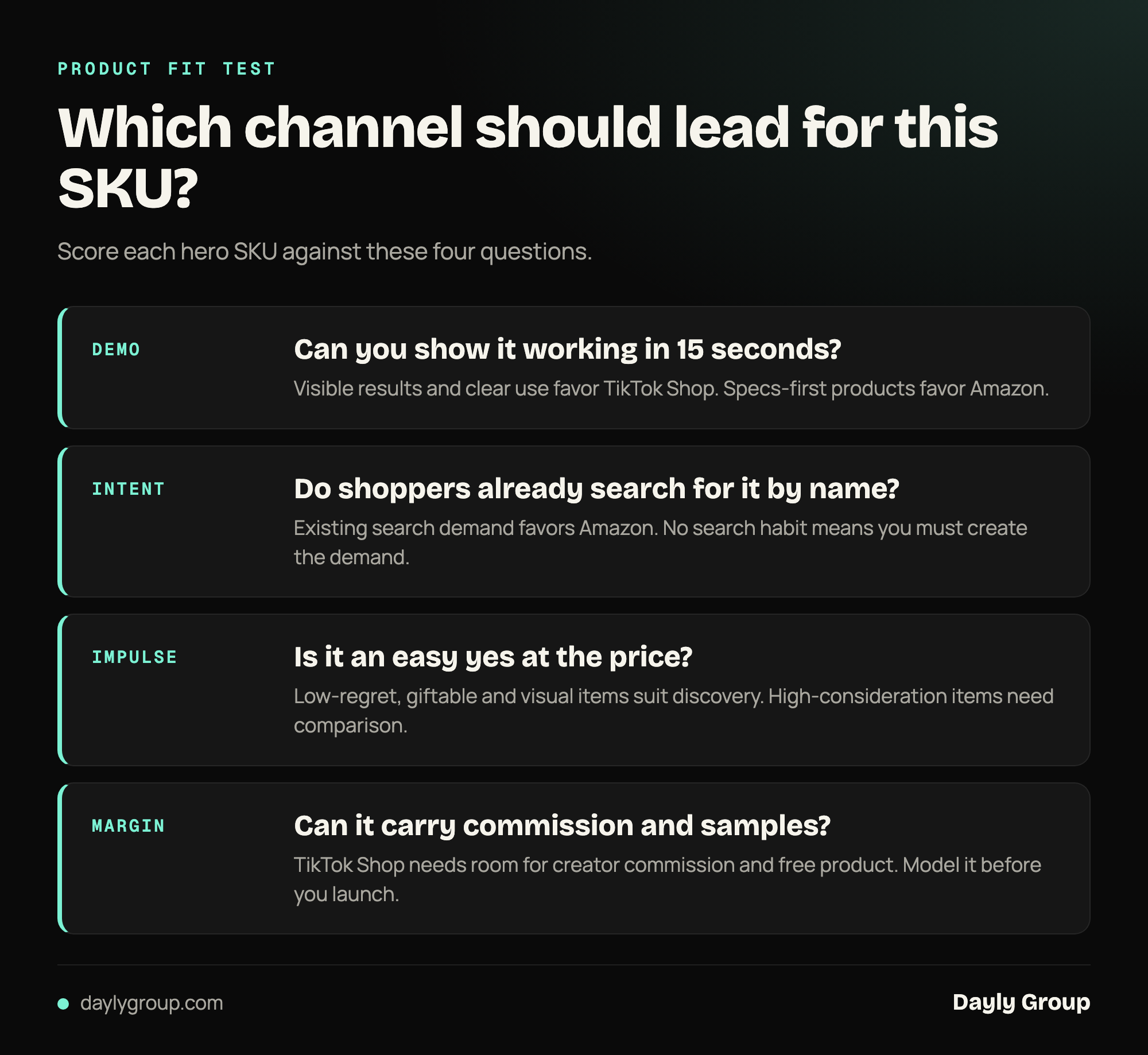
A quick test, which the diagram below summarizes:
- Can you show it working in fifteen seconds?
- Do shoppers already search for it by name?
- Is it an easy yes at the price, or does it need long consideration?
- Can the margin carry commission and free samples?
Yes to the first and third, no to the second, points to TikTok Shop leading. The reverse points to Amazon. Mixed answers point to running both.
If your product is in a health or wellness category, remember that claims must follow TikTok's category rules on both channels. Use language that supports, never language that promises a result.
How do reviews and trust compare?
On Amazon, trust is built by reviews and ratings. A listing with strong, recent reviews converts better, and a thin review profile is a real ceiling. Reviews accumulate slowly and are hard to replace.
On TikTok Shop, trust is built by demonstration and social proof. A creator showing the product in use does the work a review does on Amazon, and the shop also shows ratings. Many shoppers decide before they read a single review. That makes it easier to launch a new product here, but the trust is thinner. A bad product gets exposed faster because the creator content shows it plainly.
One consequence: strong Amazon reviews help your TikTok Shop credibility, but they do not substitute for good content. And good content does not repair a weak review profile on Amazon.
How fast do you get feedback?
TikTok Shop gives faster signal. Within weeks of sending samples you can see which creators posted, which videos sold, and which angles hold up. That speed is useful because you can test messages before you commit paid budget.
Amazon feedback is slower and more structural. Rank moves over weeks, reviews build over months, and a listing change takes time to read cleanly because other variables move at the same time.
Timelines apply to inputs, not outcomes. Content can flow in weeks. What it sells is something you have to measure, not assume.
How does each handle repeat customers?
Amazon is better at repeat purchase for staples. Subscribe and Save, Prime convenience and search habits all favor a product people reorder. A shopper who liked your product will often search for it by name next time.
TikTok Shop is better at first purchase and weaker at habit. A shopper buys on impulse, and the repeat depends on whether you capture them afterward through the product experience, packaging and the rest of your funnel. Do not assume repeat behavior transfers. Measure it by cohort.
What are the operational demands?
Both channels punish stockouts. The shape is different.
Amazon rewards steady, predictable inventory. A stockout hurts rank, and rebuilding it takes time. Fulfillment is often FBA or your own warehouse, with strict inbound rules.
TikTok Shop can spike. A single creator video can move more units in a day than a normal week, and you have to be able to ship them on time and within the platform's fulfillment standards. Check Seller Center for current requirements. Underplanning inventory is the most common operational mistake we see on a shop that starts to work. Plan it before the spike, not after.
When should you lead with Amazon, TikTok Shop, or both?
Our view is simple, and it is a framework, not a rule.
Lead with Amazon when:
- The product is a staple people search for by name.
- You are early on Amazon, with weak reviews or listings that are not yet converting.
- The margin is thin and cannot carry commission plus samples.
Lead with TikTok Shop when:
- The product is visual and easy to demonstrate.
- Search demand is small because the category is new or the product solves a problem people do not yet name.
- You already have the unit economics and inventory to absorb a spike.
Run both when the product is proven on Amazon and also demonstrable. This is where most $3M+ DTC brands with a hero SKU end up. Each channel can feed the other: TikTok content can send shoppers to search for your brand, and Amazon reviews and sales history give your shop credibility. We do not promise a lift in either direction. Whether TikTok Shop activity moves your Amazon numbers is something you have to track with branded search, Amazon Brand Analytics and Attribution. We discuss the evidence in whether TikTok Shop helps Amazon sales.
If you already send outside traffic to Amazon, the logic will feel familiar. Our Amazon external traffic strategy covers how off-platform sales support rank on Amazon, and TikTok Shop is one more source to measure in that picture.
For the launch sequence from an Amazon base, read how to launch your Amazon brand on TikTok Shop. To understand how creator distribution works on the shop side, see our guide to the TikTok Shop affiliate program for brands.
FAQ
Q: Is TikTok Shop better than Amazon for DTC brands? A: Neither is better in general. Amazon is better at capturing existing search demand, and TikTok Shop is better at creating demand for visual, demonstrable products. The right answer depends on the product, its margin and where you are on each channel. Most brands with a proven hero SKU run both.
Q: Can TikTok Shop replace Amazon for a DTC brand? A: Usually not. A TikTok Shop is a discovery channel built on creator content, while Amazon serves shoppers who already search. Replacing a working Amazon business with TikTok Shop swaps a steady search stream for one that depends on constant content. We treat TikTok Shop as a second engine, not a substitute.
Q: Which products do best on TikTok Shop compared with Amazon? A: Products that are easy to demonstrate, visually clear and easy to say yes to tend to fit TikTok Shop. Staples that people search for by name and compare on specs tend to fit Amazon. Run the four question fit test on your hero SKU before choosing where to lead.
Q: Does selling on TikTok Shop hurt Amazon sales? A: It should not by default, but you have to manage it. Inconsistent pricing, stockouts and mixed messaging can hurt both channels. Whether TikTok Shop also helps Amazon is something to track, not assume, using branded search and Amazon Brand Analytics.
Q: Is TikTok Shop cheaper than Amazon PPC? A: It is structured differently, not automatically cheaper. Much of the creator cost is commission paid on sales, but samples, ad spend and the platform referral fee still apply. Model contribution margin per order on each channel before you compare.
Q: How long does it take to see results on TikTok Shop? A: Content can start flowing within weeks, and that gives you fast signal on what sells. What it sells, and how soon, depends on your product, offer and creator mix, so we do not put a timeline on the outcome. GMV Max works best once a base of winning content exists.
If you want to see how your shop compares with top sellers in your category, we build a free TikTok Shop Gap Report before the first call.
Keep reading
Book a free Gap Analysis. We'll tell you what's leaking, what's scaling, and where the next 30% lives.
Book a Gap Analysis →