
TikTok Shop Agency vs In-House Team: How to Decide
In-house wins when TikTok Shop is a large, permanent share of revenue and you can hire and manage specialists. An agency wins when you need several specialisms at once and speed. Here is the decision rule.
An in-house team wins when TikTok Shop will be a permanent, large share of your revenue and you can hire and manage specialists. A TikTok Shop agency wins when you need several specialisms at once, you want to move quickly, and the channel has not yet proven how big it will be. Many brands should do both, in sequence.
The rest of this post gives you the roles the work requires, the costs that do not appear on a spreadsheet, and three questions that settle the decision. For the agency side of the buying process, see how to choose a TikTok Shop agency.
What roles does a real TikTok Shop operation need?
A real TikTok Shop operation needs six jobs covered: a lead, ads and GMV Max, creator outreach, sampling and logistics, listings and catalog, and reporting. GMV, short for gross merchandise value, is the total order value the shop sells. The work looks like one channel, but it is six different skill sets.
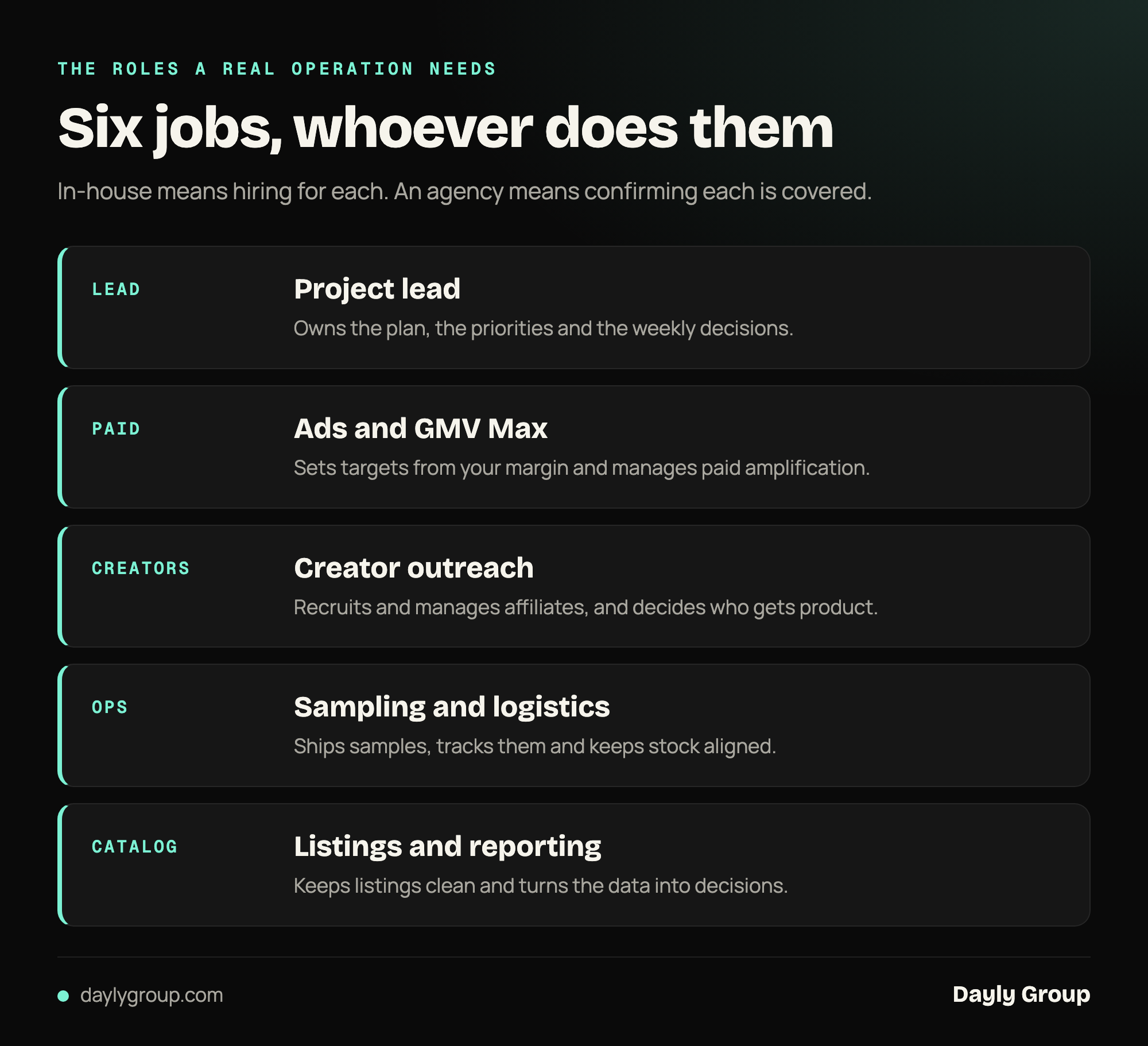
Here is what each role does.
- Lead. Owns the plan, sets priorities and makes the weekly calls on where effort goes. Without this role, the other five drift.
- Ads and GMV Max. GMV Max is TikTok's automated paid campaign type for Shop. This person sets targets from your margin, feeds it the right products and creative, and reads the results honestly. Spark Ads, which put a creator's post behind paid reach, sit here too.
- Creator outreach. Recruits affiliates, negotiates commission terms, and manages relationships. An affiliate is a creator who earns a commission on sales of your product.
- Sampling and logistics. Decides who gets product, ships it, tracks what arrives and what gets posted, and flags stock problems before they hurt the shop.
- Listings and catalog. Keeps titles, images, variants, offers and compliance in order so a shopper who clicks can actually buy.
- Reporting. Turns shop data into decisions: GMV, cost per order, contribution margin, and which creators and videos are producing.
In a small operation one person might cover two of these. Nobody covers all six well. That mismatch between the work and a single hire is the heart of the in-house question.
When does an in-house team win?
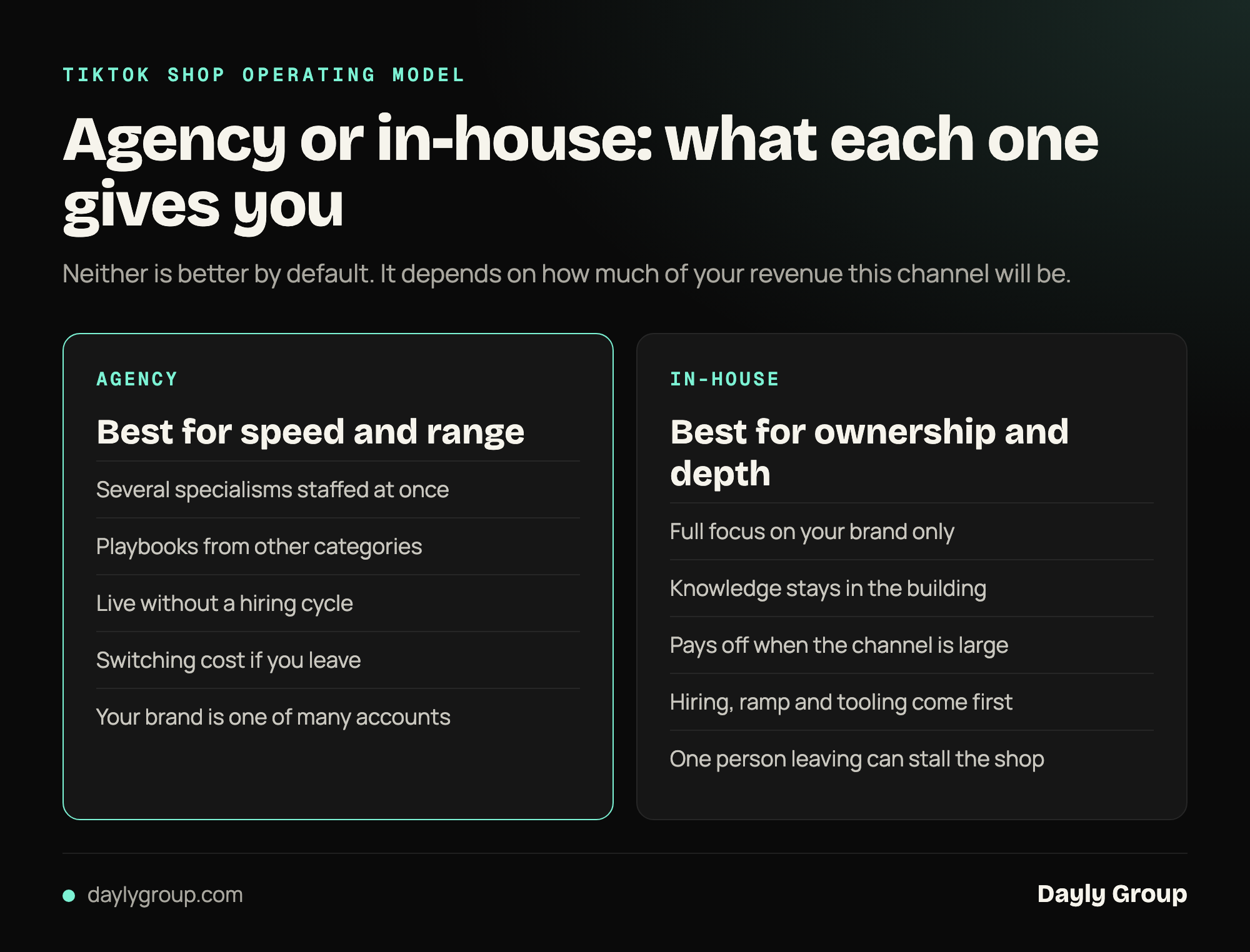
An in-house team wins when the channel is large and permanent enough to justify dedicated people, and when you have someone senior who can direct and audit the work. The upside is focus, institutional memory and speed of internal decisions.
In-house tends to be the right call in these conditions:
- TikTok Shop is, or clearly will be, a significant share of your revenue, not an experiment.
- You can hire at least two or three of the roles above and keep them.
- A leader on your side understands the channel well enough to tell good work from busy work.
- Your product, creative and inventory decisions are tightly coupled to the channel, so proximity matters.
Brands that fit this profile often start with an agency and move in-house later. That is not a failure of the agency. It is the plan working.
What are the hidden costs of building in-house?
The hidden costs of in-house are hiring, ramp, tooling, single points of failure and a thin view of what works elsewhere. None of them show up when you compare a salary to a retainer, and together they decide whether the team performs.
- Hiring. TikTok Shop is young enough that few people have run it at scale. Good candidates are scarce, and you are partly hiring on potential. Budget real time for searching, interviewing and being wrong once.
- Ramp. Even a strong hire needs time to learn your product, your margin structure and your approvals. During that time the shop runs below its potential.
- Tooling. Creator discovery, sample tracking, reporting and content workflows need software and processes. Someone has to choose, buy and maintain them.
- Single points of failure. If your one creator-outreach person leaves, the relationships, the notes and the unwritten rules leave with them. Small teams carry this risk constantly.
- No pattern recognition across categories. A team that runs one brand sees one brand's results. It cannot tell whether a slow month is your problem or a platform-wide shift, and it has not seen what a fix looks like in a similar category.
- Management load. Someone on your side has to direct specialists in a channel they may not know deeply. That is a real cost in senior attention.
When does an agency win?
An agency wins when you need several specialisms covered at once, you want the system running without a hiring cycle, and you do not yet know how large the channel will be. You are paying to borrow capacity and experience rather than build it.
The case is strongest in these situations:
- You are launching or restarting TikTok Shop and need setup, catalog, creators, content and paid media working together from the start.
- The channel is promising but unproven, so committing to full-time headcount would be a guess.
- You have an ecommerce team already stretched across Amazon, your own site and retail.
- You want someone who has seen the same problem in other categories and can say what usually happens next.
An agency is also a useful check on your assumptions. Our view is that the best ones tell you plainly when a product is not ready for the channel, rather than starting spend anyway.
What are the hidden costs of using an agency?
The hidden costs of an agency are switching cost, shared attention and dependence. They are smaller than the in-house costs for many brands, but they are real, and a good partner will discuss them before you ask.
- Switching cost. If you leave, creator relationships, content libraries and campaign structures need to transfer cleanly. Ask in advance what you own and in what format it comes back to you.
- Shared attention. Your brand is one of several accounts. The question is not whether that is true, because it always is, but how the agency protects your priority and who specifically works on your shop.
- Dependence. If the agency holds all the knowledge, you are exposed. A healthy engagement leaves you better informed each month, with reporting you can read yourself.
- Less brand intimacy. An agency will not know your product the way your team does. You will need to feed it product detail, claims constraints and margin context.
Some costs stay with you whichever route you pick. Inventory, product samples, margin decisions and approvals belong to the brand. Ad spend and creator commissions are paid at cost by the brand under either model. For a closer look at how those line items work, read TikTok Shop fees and the true cost of a sale.
How should you decide? Three questions
Three questions settle most cases. Answer them honestly and the model usually becomes obvious.
1. How big and how permanent will this channel be? If TikTok Shop will be a large, lasting part of your revenue, in-house starts to make sense. If you are still testing what it can be, renting capacity is the lower-regret choice. A profitability check before you commit to headcount is worth the hour.
2. Can you hire and manage the roles? You need to be able to find, pay, keep and direct at least the core of the six roles. If you cannot name the person who would audit a GMV Max campaign, you are not ready to run that function alone.
3. How fast do you need the system running? A hiring plan takes time before it produces anything. If you want creator seeding and content moving soon, an agency compresses the start. If the timeline is relaxed, building carefully is a legitimate option.
Score yourself. Large and permanent, able to hire and manage, and no rush points to in-house. Uncertain size, thin bench and a need for speed points to an agency. Mixed answers usually point to the hybrid below.
Does a hybrid model work?
Yes. A hybrid works well: the agency builds the system, and your team owns it over time. This is often the best structure, because it matches who does the work to how much you know at each stage.
In the early phase, the agency stands up setup, catalog, creator program, content flow and paid media while you learn what the channel does for your brand. As results become clear, you hire an owner and the most important specialists, and the agency's role narrows or ends.
Two things make this work. First, you need a named person on your side from the start, even if they are part time, who learns as the work happens. Second, you should ask what knowledge transfer you get. Specifically:
- Will you own the shop account, ad accounts and creative assets at all times?
- Will creator lists, outreach history and sample tracking be handed over in a usable format?
- Is the reporting documented well enough that a new hire could read it on day one?
- What does a handover look like if you decide to take it in-house?
An agency that answers these clearly is confident in its work. One that gets vague is telling you something.
How does this compare with the Amazon decision?
The logic is similar to Amazon, but the stakes differ because TikTok Shop is newer and its role in your mix is less settled. If you have already weighed this for Amazon, our post on in-house vs an Amazon agency covers the same trade-offs. We run both channels, so we see where a decision on one affects the other.
Our approach to TikTok Shop is covered on our TikTok Shop service page.
Whichever way you go, set the targets from your margin. Sell GMV and profit, not views. A team or partner that cannot explain your contribution margin per order is not ready to run your paid spend.
FAQ
Q: Is a TikTok Shop agency better than an in-house team? A: Neither is better by default. A TikTok Shop agency is usually the better fit when you need several specialisms at once and want to move quickly. An in-house team is usually better when the channel is a large, permanent share of revenue and you can hire and manage specialists.
Q: What roles does an in-house TikTok Shop team need? A: A full in-house TikTok Shop team covers six jobs: a lead, ads and GMV Max, creator outreach, sampling and logistics, listings and catalog, and reporting. Small teams combine some of these, but each still has to be done by someone with the right skills.
Q: What are the main downsides of hiring a TikTok Shop agency? A: The main downsides of a TikTok Shop agency are switching cost, shared attention across clients and dependence on the partner's knowledge. You reduce all three by owning your accounts, naming a point person on your side, and agreeing on reporting and handover terms before you start.
Q: Can I start with an agency and move in-house later? A: Yes. Starting with an agency and moving in-house later is a common and sensible path. The agency builds the system while you learn the channel, then you hire an owner. Ask early what knowledge transfer you will receive so the move is clean.
Q: Who pays for ad spend and creator commissions? A: Under either model, the brand pays ad spend and creator commissions at cost. They are not part of an agency's service. Inventory, samples and margin decisions also stay with the brand, so budget for them separately.
If you want a clear read on where your shop stands before deciding who runs it, request the free TikTok Shop Gap Report. It compares your shop with top sellers in your category, shows the GMV you are missing, and ranks the first moves. See also what a TikTok Shop agency actually does.
Keep reading
Book a free Gap Analysis. We'll tell you what's leaking, what's scaling, and where the next 30% lives.
Book a Gap Analysis →