
TikTok Shop Agency Red Flags: 9 Warning Signs Before You Sign
Nine warning signs in a TikTok Shop agency pitch, each with the one question that tests it on a live call.
The biggest red flag in a TikTok Shop agency is reporting activity instead of commerce. If the proof is plays, views and creator counts rather than GMV, cost per order and contribution margin, the agency is measuring what is easy to show. The nine signs below are ones you can test on a call, and each comes with the question that does it.
GMV is gross merchandise value, the total order value through the shop. Contribution margin is what is left of each order after product cost, platform fee, shipping and creator commission. If an agency cannot talk in those terms, it cannot tell you whether it is making you money.
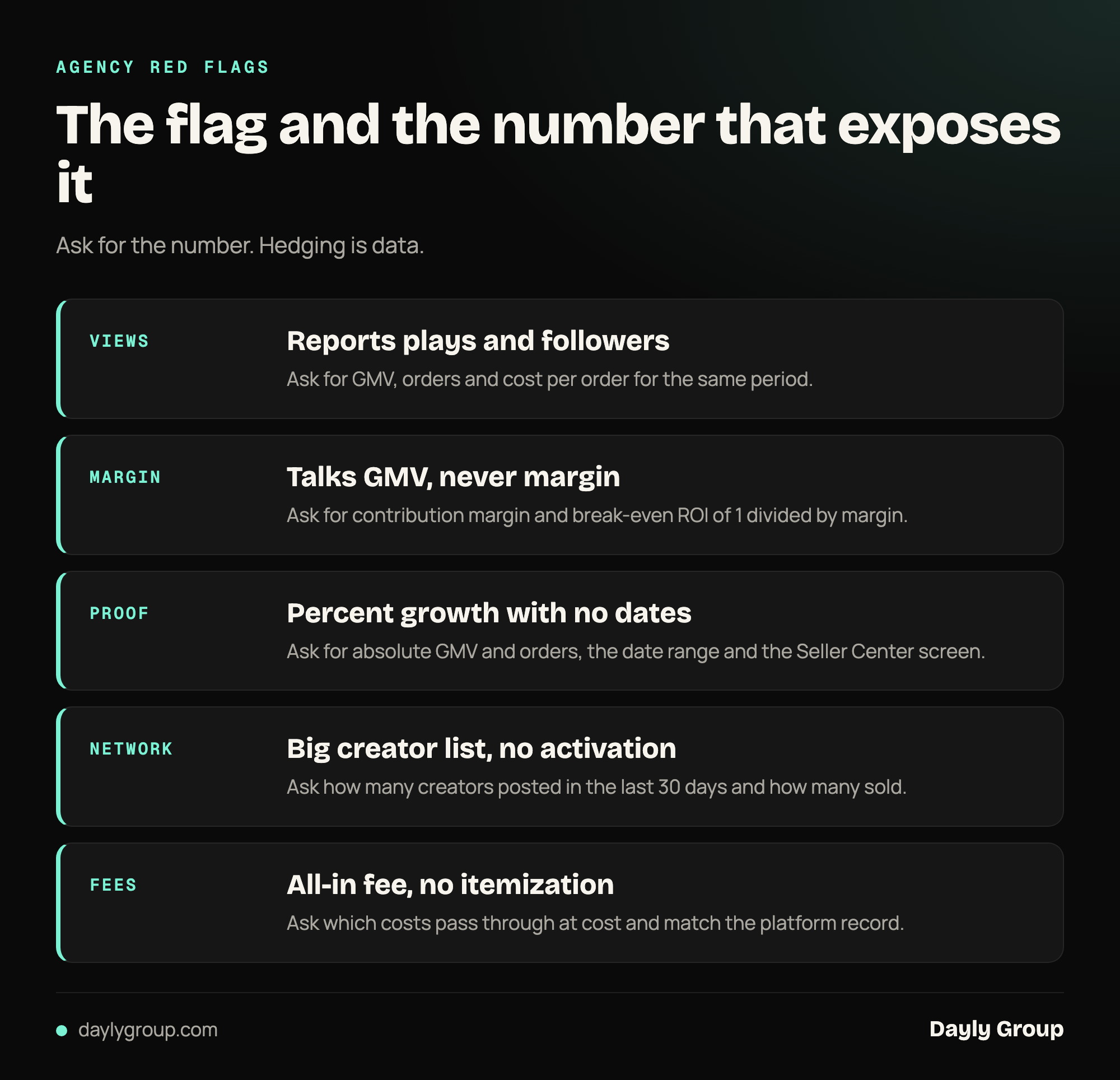
1. They report plays and views instead of GMV and cost per order
Views describe attention. They do not describe sales. An agency that leads with plays, followers and engagement is showing you the part of the funnel that is cheapest to move.
- Why it matters: a video with a large audience and no orders costs you samples and time, and tells you nothing about profit.
- Test it on a call: "Show me last month's report from a comparable brand. What was GMV, orders and cost per order?" If the first slide is views, you have your answer.
2. They talk GMV but never mention contribution margin
GMV is a revenue number. A program can grow GMV and lose money on every order, through discounting, heavy sampling or ads that cost more than the sales are worth. The check is margin.
- Why it matters: break-even ROI on ads is 1 divided by your contribution margin before ads. At a 40% margin that is 2.5. A GMV Max target set from a revenue goal ignores this entirely.
- Test it on a call: "How will you set our GMV Max target?" A good agency asks for your cost of goods and your margin. A weak one asks what revenue you want.
3. Their case studies have no date range or absolute numbers
"+300% in one quarter" is not a result. It has no baseline, no dollar figure and no way to check. Percent growth from a tiny base is easy to produce.
- Why it matters: you cannot compare a percentage to your own goals, and you cannot tell whether the brand was starting from nothing or from a base.
- Test it on a call: "What were the absolute GMV and order counts, over what dates, from what starting point? Can I see the Seller Center screen?" Real results survive that question.
For a sense of what a checkable result looks like, our approach is to give absolute numbers, a date window and a plain note that results vary.
4. They promise a result or a date
No one can promise GMV, ROAS or a date for the first sale. Platform rules change, creators decide whether to post, and product-market fit is yours to prove. A promised outcome is a sales line, not an operating plan.
- Why it matters: an agency that promises an outcome has either not run many programs or is quoting the best case.
- Test it on a call: "What do you commit to on inputs, and what do you refuse to promise on outcomes?" A good answer talks about content volume, creators activated and samples shipped on a schedule. Timelines apply to inputs. Content flows in weeks, and GMV Max needs a base of content first.
5. They sell a big creator network with no activation data
A creator directory tells you how many names are in a database. It does not tell you how many creators posted, sold or are active now. The number that matters is activation: how many creators posted a product in the last 30 days, and how many of those drove sales.
- Why it matters: a few creators usually drive most GMV, so a large list can hide a very small active group.
- Test it on a call: "How many creators posted in the last 30 days for a brand like mine? How many produced orders?" Ask for the date range.
A close cousin is outreach by volume. Software that sends the same template to every eligible creator produces a big "requests sent" number, but creators get dozens of these a day and mostly ignore them. Requests sent is activity, not a result.
- Test it on a call: "Show me three outreach messages from last week, and the reply rate, post rate and sales that came from them."
6. Reporting is a monthly PDF with no live data access
A PDF is a story the agency chose to tell. Live access to the Shop and ad accounts is the facts. A monthly report that arrives after the money is spent is a record, not a control.
- Why it matters: you cannot catch a bad week if you only see a good month.
- Test it on a call: "Will I have owner access to the Shop and ad accounts? Which metrics do I get weekly?" The list should include GMV, cost per order, GMV per sample, creator mix and contribution margin.
7. Fees are opaque or carry hidden markups
If you cannot tell what you pay for the work, what you pay for media and what you pay for creators, you cannot compare quotes. Two places hide markups: a media or buying fee layered on top of ad spend, and creator pay billed above what the creator received.
- Why it matters: a markup is a second fee you did not negotiate.
- Test it on a call: "Which costs pass through at cost? Will every ad dollar and creator payout match the platform record?" We cover the structures in how much a TikTok Shop agency costs.
8. They have no plan for who gets a sample
Samples are product you ship free to creators. They cost inventory and shipping. Without a selection rule, you will fund a lot of free product that never turns into a post.
- Why it matters: who gets a sample matters more than how many go out, because a few creators drive most of the GMV. An agency that measures samples sent, not GMV per sample, is measuring effort.
- Test it on a call: "How do you choose recipients, what do you do when someone takes a sample and never posts, and what is your GMV per sample for a comparable brand?"
9. One playbook for every category and margin
A brand with a 70% gross margin and a hero SKU can afford a different program than one with a thin margin and a long catalog. Category rules differ too. Health, wellness and beauty claims must follow TikTok's category rules, and a generic script can get listings or videos removed.
- Why it matters: the same sampling volume and GMV Max target can be profitable for one brand and a loss for another.
- Test it on a call: "What would you do differently for our category and margin than for the last brand you onboarded?" A strong answer is specific. A weak one repeats the standard package.
What do the best agencies report instead?
They report commerce. Every number connects to an order or a margin. The contrast is simple:
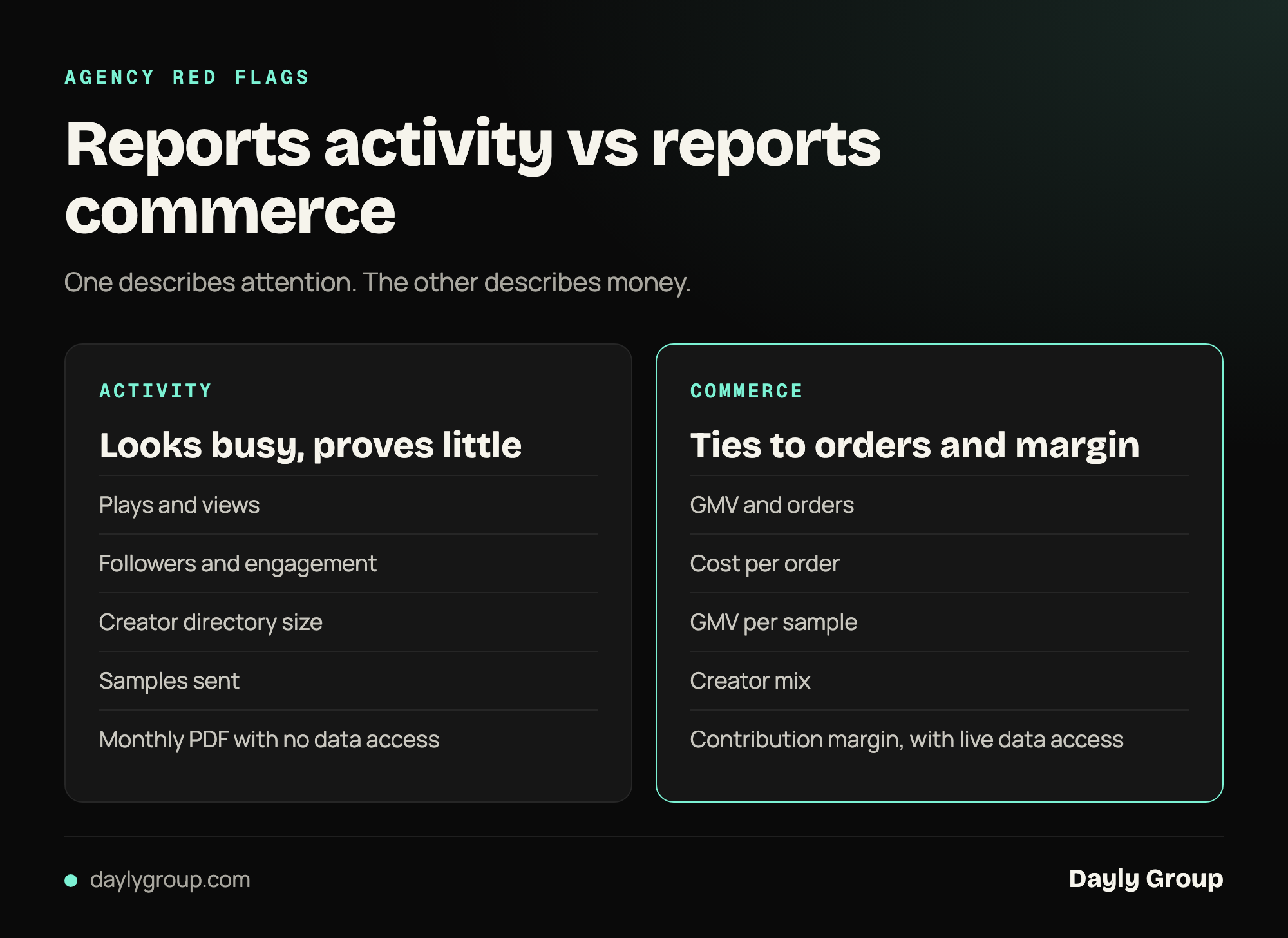
If a pitch has three or more of these flags, move on. If it has one or two, use the test question and listen to how the answer is given. Hedging is data.
To go deeper on what to ask, read our 12 questions to ask before you sign. For the program itself, see what a TikTok Shop agency does, and for what we offer, see our TikTok Shop service.
How do you score an agency against this list?
Count the flags, then weight them. One flag is a question to ask. Three is a pattern. The heaviest ones are the promised outcome, the missing contribution margin and the markups, because they change what you pay and what you believe you bought.
Run it in this order on the first call. Ask for a dated Seller Center screen before you hear any case study. Ask how they set a GMV Max target before you hear any strategy. Ask what is passed through at cost before you hear any price. These three answers sort most agencies in twenty minutes.
Be fair about it. A good agency will have a weak answer on one or two of these, because every operation has gaps. What you are testing is whether they name the gap plainly or talk around it. An agency that says "we do not have live dashboard access for every client yet, here is what you get instead" is more trustworthy than one with a smooth answer to everything.
Also hold yourself to the same list. If you cannot give an agency your margin, your return rate and your inventory depth, no agency can set a sensible target for you. The best results come from brands that bring their numbers to the first call and expect the same back.
FAQ
Q: What are the biggest red flags in a TikTok Shop agency? A: The biggest TikTok Shop agency red flags are reporting plays and views instead of GMV and cost per order, case studies with no dates or absolute numbers, promised outcomes or dates, and fees with hidden markups. Test each one by asking for a dated Seller Center screen.
Q: Can a TikTok Shop agency promise results? A: No TikTok Shop agency can honestly promise GMV, ROAS or a date for the first sale. Outcomes depend on the product, the creators and platform rules. An agency can commit to inputs: content volume, creators activated and samples shipped on a schedule.
Q: How do I know if an agency's creator network is real? A: Ask a TikTok Shop agency how many creators posted in the last 30 days for a comparable brand, and how many drove orders. Directory size is not activation. A real network shows posting and sales data with a date range.
Q: Why do TikTok Shop agency case studies often mislead? A: TikTok Shop agency case studies often show percentage growth without a baseline, a date range or absolute numbers. A small starting base makes any percentage look large. Ask for GMV, orders and the Seller Center screen.
Q: What should a TikTok Shop agency report each week? A: A TikTok Shop agency should report GMV, cost per order, GMV per sample, creator mix and contribution margin weekly, with live access to the Shop and ad accounts. Plays and followers describe attention, not commerce.
If you want a baseline before you talk to anyone, request the free TikTok Shop Gap Report.
Keep reading
Book a free Gap Analysis. We'll tell you what's leaking, what's scaling, and where the next 30% lives.
Book a Gap Analysis →