
How Much Does a TikTok Shop Agency Cost? What You're Actually Paying For
The agency fee is the smallest line on the bill. The real cost is the fee plus samples, creator commissions and ad spend, judged against cost per incremental order and contribution margin.
A TikTok Shop agency fee is usually the smallest line in the budget. What you actually pay is the fee plus product samples, creator commissions and ad spend. The right way to judge it is cost per incremental order and contribution margin, not the fee alone. A cheap agency that burns samples and ad budget costs more than an expensive one that doesn't.
The rest of this post shows how agencies charge, what passes through at cost, where markups hide, what moves the price, and a worksheet you can run on your own numbers before the first call.
What does a TikTok Shop agency actually charge for?
An agency charges for the work of running the shop: setup and compliance, catalog and offers, the creator and affiliate program, content, paid media and weekly reporting. It does not pay for the media, the product or the creator payouts, and that gap is where most budgets go wrong. The full stack:
- Agency fee. The work.
- Samples. Product you ship free to creators, plus the shipping.
- Creator commissions. The percentage of each sale that goes to the creator affiliate who drove it. Affiliate means a creator who earns a commission on sales of your product.
- Paid creator collaborations. Flat fees you pay a creator for a post, when you choose to.
- Ad spend. Mostly GMV Max, TikTok's automated campaign type that spends against your product feed and content to drive Shop sales. GMV is gross merchandise value, the total order value that goes through the shop.
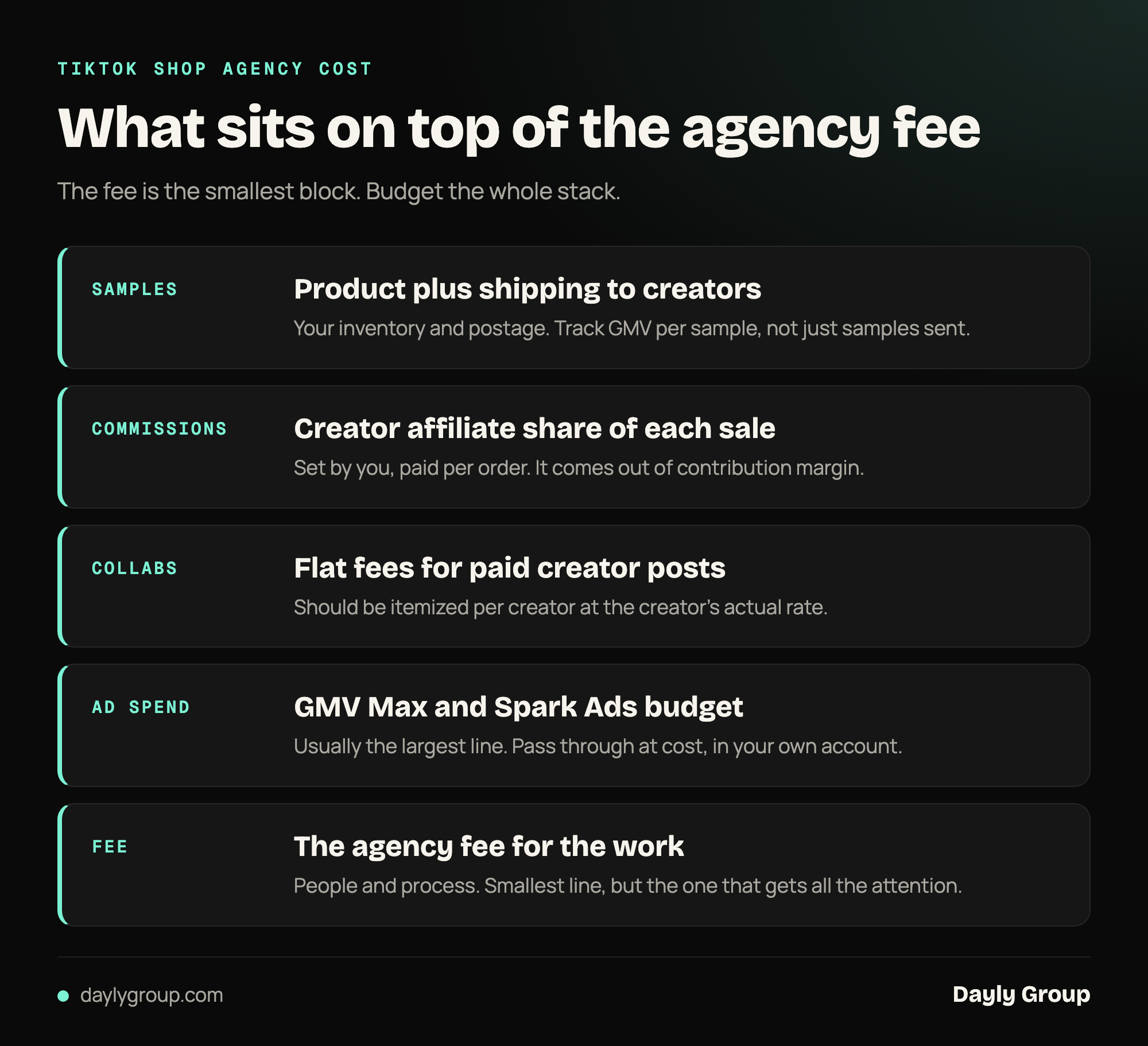
A quote that names only the fee answers the wrong question.
What are the three common ways TikTok Shop agencies charge?
Agencies charge a monthly retainer, a percentage of GMV or sales, or a smaller base fee plus bonuses tied to growth. Each rewards a different behavior, so pick the structure for the behavior you want, not the sticker price. We quote no rates here, because rates vary with scope.
Monthly retainer
A flat monthly fee for a defined scope. The agency is paid the same whether the shop sells a little or a lot.
- Aligns for: you, on predictability.
- Where it bends: nothing in the fee pushes volume. The incentive is to retain you.
- Ask for: a written scope, a reporting standard and an exit path.
Percentage of GMV or sales
The agency earns a percentage of what the shop sells.
- Aligns for: growth in gross sales.
- Where it bends: GMV is not profit, and on TikTok Shop many brands are at break-even or a loss on the channel once commission, discounts, samples and ad spend are counted. A percentage of GMV then pays the agency on revenue that may not exist as margin. It rewards volume even when the volume loses money, such as heavy discounting, over-sampling or a loose GMV Max target, and it can pay for sales that would have happened anyway.
- Ask for: what counts as billable, whether returns come out, and whether sales from your existing audience are excluded.
Smaller base plus growth bonuses
A modest base fee plus bonuses for each additional block of GMV the agency adds above an agreed baseline, usually up to a ceiling.
- Aligns for: both sides, because the base covers real work and the bonus rewards growth the agency caused.
- Where it bends: a vague baseline. If you cannot say what GMV would have been without the agency, you cannot say what the bonus is for.
- Ask for: the baseline in writing, a worked example, the ceiling, and a margin floor so a bonus is not paid on growth that loses you money.
Our view: a percentage of sales is the hardest structure to defend when most brands are not yet profitable on the platform. We prefer a flat retainer sized to scope, or a modest base with bonuses for added GMV against a clear baseline and a ceiling. Whatever the structure, it fails when reporting cannot separate profitable orders from unprofitable ones.
What should be a pass-through at cost?
Ad spend, samples, creator commissions and paid creator collaborations should pass through at cost, meaning you pay the actual amount with no agency markup. The agency's compensation belongs in the fee, in plain sight.
- Ad spend goes to TikTok. Bill it to your own ad account, or invoice it at exactly the platform's charge.
- Samples are your product and your postage. Ask who tracks what shipped.
- Creator commissions are set by you in the affiliate program and come out of each order. Check Seller Center for how they settle.
- Paid creator collaborations are flat fees, itemized per creator at the creator's actual rate.
Where do hidden markups live?
Hidden markups live in two places: media or "buying" fees layered on top of ad spend, and creator pay billed above what the creator received. Both can be written into a contract. Neither is acceptable without disclosure.
Check four things before you sign:
- A media fee. A percentage on top of ad spend, on top of the management fee, means you pay twice for the same work.
- Resold ad credit. Buying ads through the agency's account can mean a markup on every dollar and no ownership of the account history.
- Marked-up creator pay. If "creator cost" arrives with no itemization, ask for the creator's payout record.
- Bundled content fees. Content is real work. It should be a line item with a deliverable count.
The test: "If I added up every TikTok invoice and every creator payout, would it match what you billed me?" A clean agency says yes and shows you. Hesitation tells you what you need to know.
What drives the price up or down?
Five things drive scope and therefore price: SKU count, the size of the creator program, ad spend, content volume, and whether LIVE and creator community management are included. More of any of them means more work. Most of the variation between quotes comes from scope differences, not from one agency being greedy and another generous.
- SKU count. Every product needs a listing, offers, compliance review and creative angles. Many programs start with a hero SKU, the product that carries the sale, and add others once it works.
- Creator program size. Recruiting, vetting, sampling, briefing and following up is the labor-heavy part.
- Ad spend. More spend means more campaign management and creative testing. It also changes what a percentage-based fee costs you.
- Content volume. Content velocity is how fast new creative reaches the shop. It feeds both organic and GMV Max.
- LIVE and community. Hosting LIVE sessions and managing a creator community are separate workloads. If a quote says "full service" and skips them, ask.
Compare scope line by line before you compare price.
How do you compare the cost to what it produces?
Compare total cost to incremental contribution margin, not to GMV. Contribution margin is what is left of each order after product cost, platform referral fee, shipping and creator commission. If the contribution from the new sales is bigger than the fee plus all pass-throughs, the program pays. If not, it does not, regardless of how large the GMV chart looks.
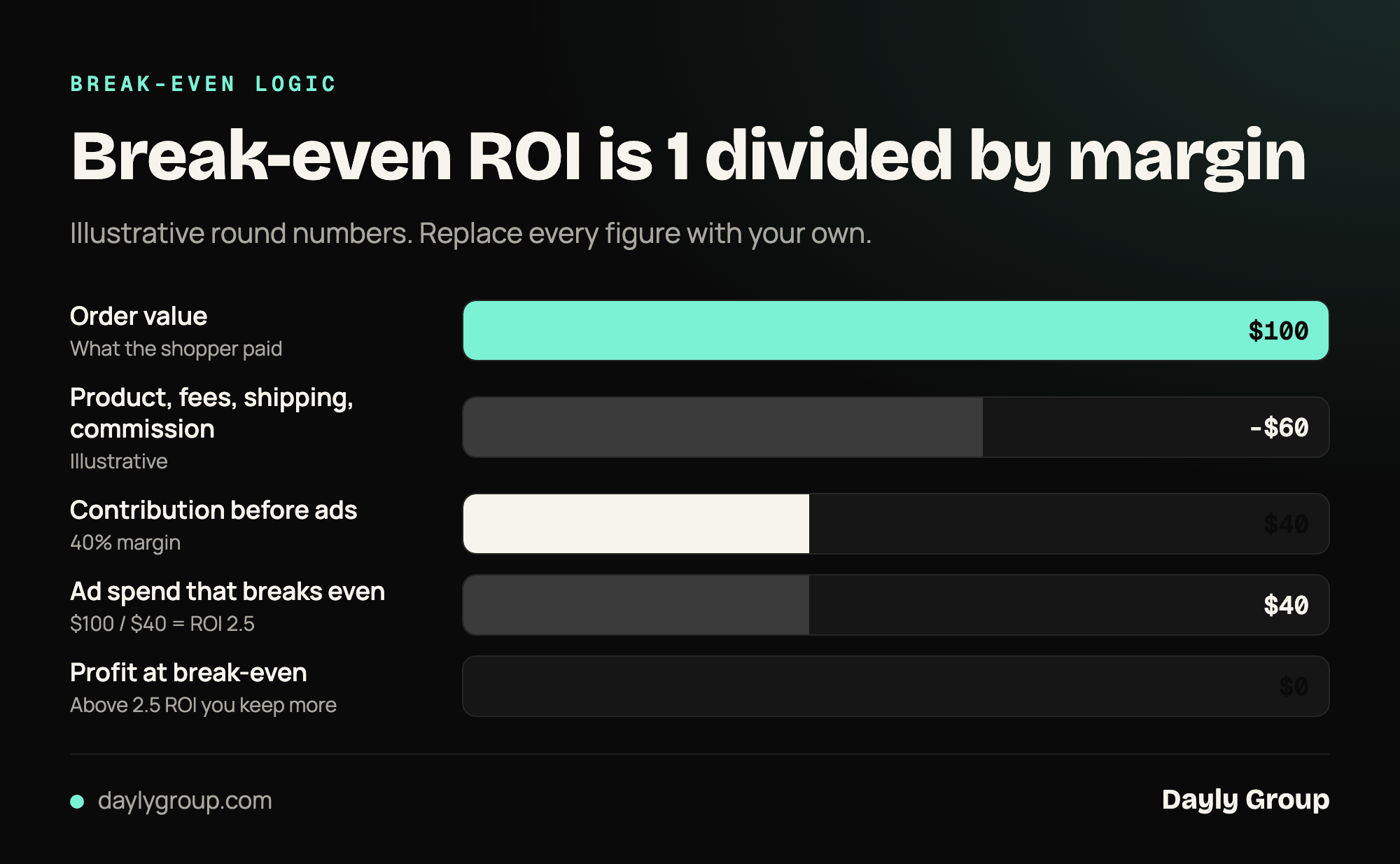
$100 of GMV is not $100 of profit. Seller Center charges a referral fee, a percentage of each order that varies by category, so check it for your category's current rate. Take out product cost, shipping and commission, and what remains is contribution before ads. Break-even for ad spend comes from one formula:
Break-even ROI = 1 / contribution margin before ads.
ROI here means attributed revenue divided by ad spend. At a 40% contribution margin before ads, break-even is 1 / 0.40 = 2.5. Below 2.5 the ads lose money. Above it they make money. That is why we set GMV Max targets from the brand's margin, not a revenue goal.
What is a worksheet you can run before you sign?
Five steps. Every figure below is illustrative, with round numbers. Replace each with your own.
- Start with incremental GMV. The GMV you expect the program to add that you would not have had otherwise. Be conservative. Say it is $100K a month in the illustration.
- Apply contribution margin before ads. After product cost, platform referral fee, shipping and creator commission. At 40%, that is $40K of contribution.
- Subtract ad spend. Say $15K. Now $25K is left.
- Subtract samples. Product cost plus shipping for the month. Say $4K. Now $21K is left.
- Compare to the fee. That $21K is the most the agency fee can be before the program loses money in that month. Any quote above it is a loss on these assumptions. Any quote well below it leaves real profit.
Run it three ways: conservative, expected and a bad month. If it only works in the expected case, the margin for error is thin.
Two refinements. A creator program takes time to build. Content flows in weeks, and GMV Max needs a base of content first, so judge early months on inputs (creators activated, content produced, samples shipped) and later months on cost per order and contribution. And if you suspect a halo on your Amazon or DTC sales, track it separately and keep it out of the worksheet. Our post on whether TikTok Shop helps Amazon sales covers how.
For the per-order math, see the true cost of a TikTok Shop sale.
What should you get in writing?
Get the fee, scope, pass-through rules, reporting standard and exit terms in writing. Ask for seven items:
- The fee structure written as a formula, with a worked example on your numbers.
- A scope list that says what is in and out, including LIVE, creator community and content production.
- A statement that ad spend, samples, creator commissions and creator fees pass through at cost, with no media or buying fee.
- Ad accounts and the Shop in your name, with you as owner and admin.
- Weekly reporting on GMV, cost per order, GMV per sample, creator mix and contribution margin. Creator mix is the share of GMV that comes from each creator, which tells you whether a few creators drive most of it.
- Ownership of content, creator relationships and data if you leave.
- An exit clause with a notice period and a plain statement of any fees owed after you give it.
12 questions to ask before you sign turns these into a call script. The red flags post covers warning signs in a proposal, and agency vs in-house covers the hiring comparison.
What does Dayly charge?
We scope it from the Gap Report, so we don't publish a rate card. The report is built before the first call: your shop against top sellers in your category, the GMV it is missing and ranked first moves. See what is included in our TikTok Shop service.
FAQ
Q: How much does a TikTok Shop agency cost? A: A TikTok Shop agency costs the management fee plus pass-throughs: samples, creator commissions, paid creator collaborations and ad spend. The fee is usually the smallest line. Judge the total against cost per incremental order and contribution margin, and use the worksheet above with your own numbers.
Q: Is a retainer or a percentage of GMV better for a TikTok Shop agency? A: A TikTok Shop agency retainer gives you a predictable cost but no built-in push for volume. A percentage of GMV aligns with gross sales but pays on revenue that may not be profit, which matters when many brands are at break-even on the platform. A smaller base plus bonuses for added GMV against a written baseline, with a ceiling and a margin floor, can balance both.
Q: What costs should pass through to me at cost? A: With a TikTok Shop agency, ad spend, samples, creator commissions and flat creator fees should pass through at cost. Ask for the invoices or payout records that match each line. A media fee on top of ad spend, or creator pay billed above what the creator received, is a markup.
Q: What is break-even ROI on GMV Max? A: Break-even ROI on GMV Max equals 1 divided by your contribution margin before ads. At a 40% margin that is 2.5. Below it the ads lose money on a contribution basis, so a TikTok Shop agency should set targets from your margin, not a revenue goal.
If you want to see your own numbers before talking price, request the free TikTok Shop Gap Report.
Keep reading
Book a free Gap Analysis. We'll tell you what's leaking, what's scaling, and where the next 30% lives.
Book a Gap Analysis →