
How to Choose a TikTok Shop Agency: 13 Questions to Ask Before You Sign
Thirteen questions that separate agencies that run TikTok Shop for profit from agencies that report activity, each with what a strong answer and a weak answer sound like.
To choose a TikTok Shop agency, ask for proof in Seller Center, not in a deck. Check what the fee includes, how creators get samples, which metrics are reported weekly, how GMV Max targets are set, and what happens to your content and data if you leave. Strong agencies answer with numbers and dates. Weak ones answer with adjectives.
GMV means gross merchandise value, the total order value through the shop. The thirteen questions below are written for a founder or head of growth at a DTC brand doing $3M or more, with TikTok Shop live but flat or about to launch. Each has what a good answer sounds like and what a weak one sounds like.
1. What is included in the fee, and what is passed through?
Ask for a written list of what the fee covers and what you pay separately. The fee should cover the work: setup, catalog, creator program, content, paid media management and reporting. Samples, creator commissions, creator flat fees and ad spend are costs on top. For the full cost breakdown, see how much a TikTok Shop agency costs.
- Strong: "Here is the scope list. These four items pass through at cost, and here is how you see each one."
- Weak: "It's all-in." Nobody's is. Ask what "all-in" excludes.
2. Do you mark up creator pay or ad spend?
Ask it directly, and ask for it in the contract. Markups are not always wrong, but they must be disclosed. A media fee on top of a management fee means you pay twice for the same work. Creator pay billed above what the creator received is a markup too.
- Strong: "No. Ad spend runs in your account. Creator payouts are itemized and match the platform record."
- Weak: "We bundle that into a platform fee." Ask what the platform fee is a percentage of.
3. Can I see a Seller Center dashboard from a brand in my category, with the date range?
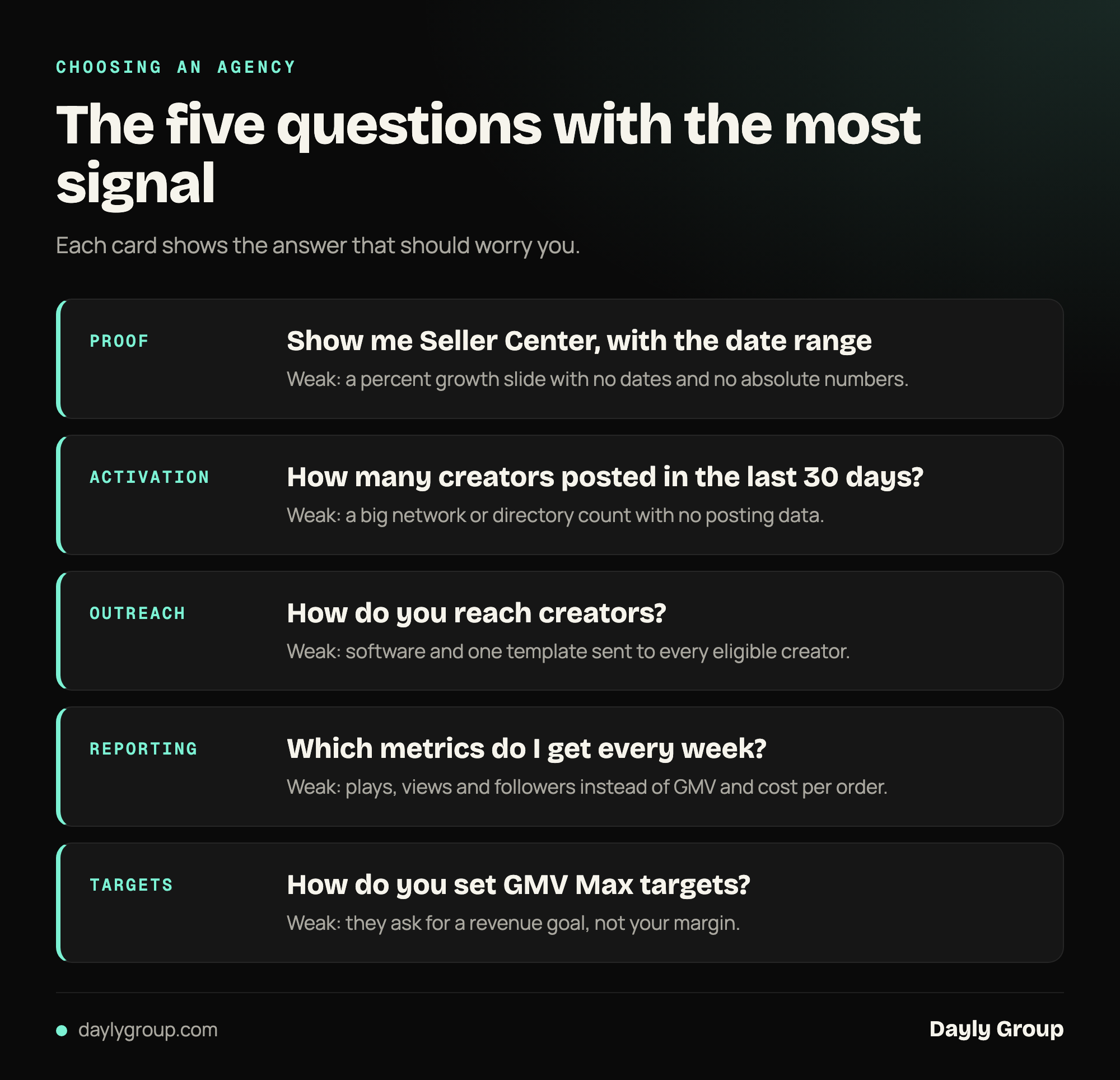
This is the highest-signal question on the list. Seller Center is TikTok's seller dashboard, and it shows GMV, orders and sources. A screenshot with a named date range and absolute numbers is evidence. A percentage growth claim is not.
- Strong: A live or dated dashboard from a comparable brand, with the account owner's permission and the date range visible. Explains what the brand's margin allowed.
- Weak: A slide that says "+400% GMV" with no baseline, no dates and no absolute figures. Or a screenshot with the range cropped out.
One note: any brand's results are one brand's results. Ask about the starting point, the category and what was spent to get there.
4. How do you decide who gets a sample?
Samples are product you ship free to creators in the hope they post. They cost real money, and a few creators usually drive most of the GMV. So who gets a sample matters more than how many samples go out.
- Strong: A selection process: fit with your product, past sales performance in your category, content quality, and a cap per round. They track GMV per sample.
- Weak: "We send to everyone who applies." Or no tracking at all.
5. How do you reach creators: targeted, or software and volume?
Most brands and agencies reach creators the same way: software finds every eligible creator in a category and sends the same invitation to all of them. Creators know it. Ask a creator who sells on TikTok Shop what their inbox looks like and expect dozens of near-identical requests a day, most of them ignored. An agency whose method is the same tool and the same template is competing in the loudest channel there is.
Software is fine. It helps find creators and track results. The problem is when the tool is the strategy, because then requests sent becomes the metric, and the number of creators who reply, post and sell goes unmeasured.
Ask how creators are chosen and contacted:
-
Who is chosen. Criteria such as fit with your product, past sales of similar products, audience and content style. Not "everyone in the category".
-
What the message looks like. Ask to see three messages sent last week. A good one refers to the creator's actual content and makes a clear offer. A template with a name merged in is the baseline everyone already ignores.
-
What is offered. Commission-only invitations tend to be the most ignored. Paid collaborations, and relationships with creators who already sell in your category, tend to get answers.
-
What is measured. Reply rate, post rate and sales by outreach method, not requests sent.
-
What happens to non-responders. A sensible follow-up, then stop. Repeated blasts teach creators to ignore your brand.
-
Strong: "We pick creators by fit and sales history. Here are three recent messages and the reply, post and sales rates by method." They talk about relationships and response, not volume sent.
-
Weak: "We use [a tool] to reach thousands of creators." Ask how many replied, posted and sold.
We hold ourselves to the same standard. Our outreach is targeted, creator relationships are managed by hand, and we start from a community of creators we already work with before approaching strangers. Ask us for the messages and the rates too.
6. What happens when a creator takes a sample and never posts?
This happens to every program. The question is whether the agency has a process. A good one has a follow-up sequence, a deadline, a record of who ignored you and a rule for not sampling them again.
- Strong: "We follow up at set intervals, flag non-posters and stop sending. Here is our sample-to-post rate by creator tier." They show you the tracking, not a promise.
- Weak: "Most of them post." That is a claim with no record behind it.
7. How many creators actually posted in the last 30 days?
Ask for activation, not directory size. A creator directory or "network" count says how many names are in a list. It does not say how many posted, sold or are active now. Ask for the number of creators who posted your product in the last 30 days for a comparable brand, and how many of them produced sales.
- Strong: A specific count of posting creators with a date range, and the share that drove GMV.
- Weak: A big number of creators "in our network." Ask how many posted last month.
8. Which metrics will you report every week?
Weekly reports should tell you whether the program makes money. The list: GMV, cost per order, GMV per sample, creator mix (the share of GMV from each creator), and contribution margin. Contribution margin is what is left of each order after product cost, platform fee, shipping and creator commission.
- Strong: Those five, plus ad spend, and a note on what changed and why. Access to live data, not only a PDF.
- Weak: Plays, views, followers, engagement. Those describe attention. They do not describe commerce.
9. How do you set GMV Max targets?
GMV Max is TikTok's automated campaign type for driving Shop sales with paid spend. Targets should come from your margin. The break-even ROI on ads is 1 divided by your contribution margin before ads. At a 40% margin that is 2.5, and a target below it loses money.
- Strong: "We start from your margin and set the target to clear break-even, then raise it as content improves." They ask for your cost data on the first call.
- Weak: "What revenue do you want to hit?" A revenue goal ignores whether the sales are worth keeping.
10. Who writes the creator briefs, and can I see one?
A brief tells a creator what to show, what to say and what to avoid. It is where compliance and conversion meet. Bad briefs produce videos that get views and no orders.
- Strong: A named role writes them. You see a recent one with the hook, the product proof, the claim limits and the call to action.
- Weak: "Creators know what works." Or a template with your logo on it.
11. How do you handle category rules and compliance?
TikTok Shop has category rules, restricted claims and listing requirements that change. If your category is health, wellness or beauty, claims need extra care. Any agency should say that claims must follow TikTok's category rules, and talk in terms of what a product supports, not what it cures.
- Strong: A compliance check in the workflow before listings and briefs go live, and a plain statement about what they will not say for you.
- Weak: "We'll figure it out." Or an eagerness to use claims you know the platform will remove.
12. Who is my day-to-day contact, and how many accounts do they carry?
The person on the sales call is often not the person who runs your account. Ask to meet the day-to-day lead before signing.
- Strong: A named contact, an account count and an escalation path. They describe the roles: a project lead, ads, creator outreach, sampling, listings and reporting.
- Weak: "Our team will handle it." No name, no count.
13. What happens to my content, creators and data if we part ways, and what will you not do this quarter?
Two questions, one theme: clarity. Content produced for your shop, your creator relationships and your ad account history should be yours. And a strong agency can tell you what it will deliberately not do this quarter, because focus is a decision.
- Strong: "The Shop and ad accounts are in your name. You keep content and creator data. Here is the notice period." And a specific "not doing" list: not chasing a new category until the hero SKU works, say.
- Weak: Silence on exit terms, or "we'll sort it out." An agency with no list of things it won't do is doing everything badly.
Does official TikTok partner status matter?
Partner status is a signal worth asking about, but it is not proof of performance. It may say something about how the agency works with the platform. It does not say whether your shop will make money. Seller Center numbers are the proof. Ask about partner status, then ask for the dashboard.
How do the strong and weak answers compare side by side?
Strong answers share three traits: they name a number, they name a date and they show a record. Weak answers share the opposite three: adjectives, round claims and a deck.
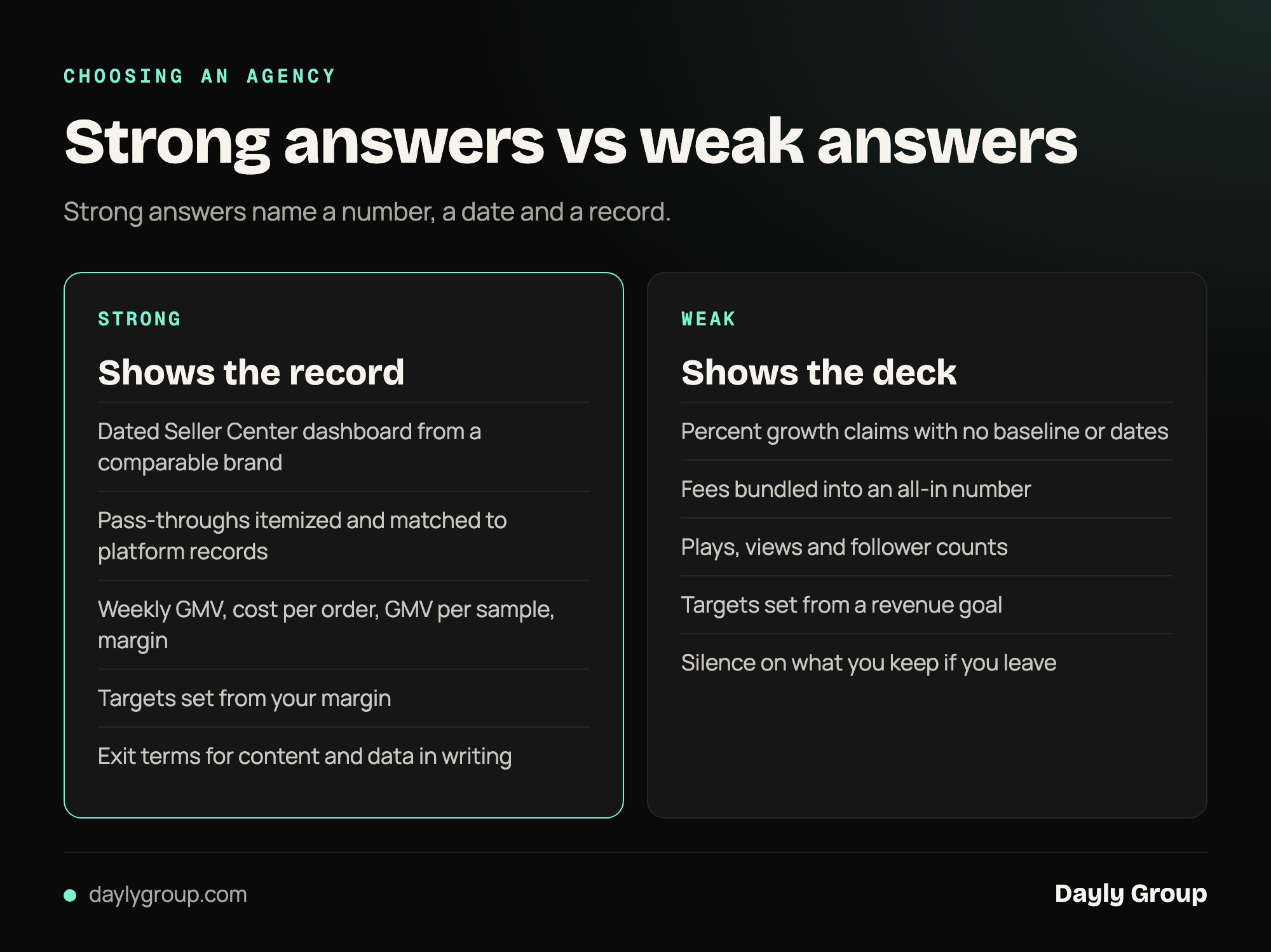
Use the list on a call. Take notes on the exact words. If you want to compare the answers against what to avoid, read the red flags post. If you are deciding whether to hire an agency at all, agency vs in-house covers the tradeoffs. And if you ran this process on an Amazon agency before, the Amazon version has overlapping questions.
For what we do and do not include, see our TikTok Shop service. We built it around setup and compliance, catalog and offers, the creator and affiliate program, content, paid media and weekly reporting.
FAQ
Q: How do I choose a TikTok Shop agency? A: Choose a TikTok Shop agency by asking for dated Seller Center proof from a comparable brand, a written scope with pass-throughs, weekly reporting on GMV and cost per order, and GMV Max targets set from your margin. Strong answers come with numbers and dates.
Q: What questions should I ask a TikTok Shop agency? A: Ask a TikTok Shop agency what the fee includes, whether it marks up creator pay or ad spend, how it chooses sample recipients, how many creators posted in the last 30 days, which metrics it reports weekly, who your day-to-day contact is and what happens to your content and data if you leave.
Q: Does a TikTok partner badge mean an agency is good? A: A TikTok partner badge is a signal worth asking about, but it is not proof that an agency performs. Ask any TikTok Shop agency for Seller Center numbers with date ranges from a comparable brand. Those are the proof.
Q: What metrics should a TikTok Shop agency report? A: A TikTok Shop agency should report GMV, cost per order, GMV per sample, creator mix and contribution margin every week. Plays and views describe attention, not commerce. Ask for live data access, not just a monthly PDF.
Q: Should I hire a TikTok Shop agency or build in-house? A: A TikTok Shop agency fits when you need creator outreach, ads, listings and reporting running at once without hiring each role. In-house fits when TikTok Shop becomes a large, permanent share of revenue. See agency vs in-house for the comparison.
If you want a baseline before you start interviewing, request the free TikTok Shop Gap Report. It shows your shop against top sellers in your category, the GMV it is missing and the ranked first moves.
Keep reading
Book a free Gap Analysis. We'll tell you what's leaking, what's scaling, and where the next 30% lives.
Book a Gap Analysis →