
Is TikTok Shop Profitable for DTC Brands? The Margin Math
TikTok Shop is profitable when your contribution margin after commission, fees, returns and discounts is high enough to fund creators and ads. It is a loss when it is not. You can calculate which before you launch.
TikTok Shop is profitable for a DTC brand when its contribution margin, after commission, platform fees, returns and discounts, is high enough to fund creators and ads. It is a loss when it is not. The answer is a number you can calculate before you launch, not a feeling about the platform, and this post shows you how.
If you are a $3M+ brand with your own product and inventory, you have done the hard part. The question is whether the unit economics survive a channel that runs on creator commission and paid amplification.
What makes TikTok Shop profitable or not?
Profit on TikTok Shop comes down to three numbers: your contribution margin per order, your break-even ROI on ads, and your cost per order. Calculate them in that order, before you spend on samples or ads.
Contribution margin is the share of each order you keep after variable costs (product, referral fee, affiliate commission, fulfillment, returns, discounts), before ad spend. We build the full stack in TikTok Shop fees and the true cost of a sale, and the worksheet there is the input to everything below.
GMV, or gross merchandise value, is the total order value in your Shop. A shop can post strong GMV and lose money on every order.
The three margin tests
Run these three tests on each SKU you would put on TikTok Shop. A SKU that fails one is a SKU to fix or hold back.
Test 1: contribution margin per order
Take your selling price after any standing discount. Subtract product cost, the referral fee for your category (read the current rate in Seller Center), the affiliate commission you plan to set, fulfillment and shipping, and expected returns. Divide what is left by the price.
Say you get 30%. That is your contribution margin before ads. At 40% you have room to fund creators and ads. At 15% you probably do not. The thresholds are yours to set, but the test is simple: is there enough left after variable costs to pay for the thing that makes the channel work, which is paid amplification of creator content.
Test 2: break-even ROI
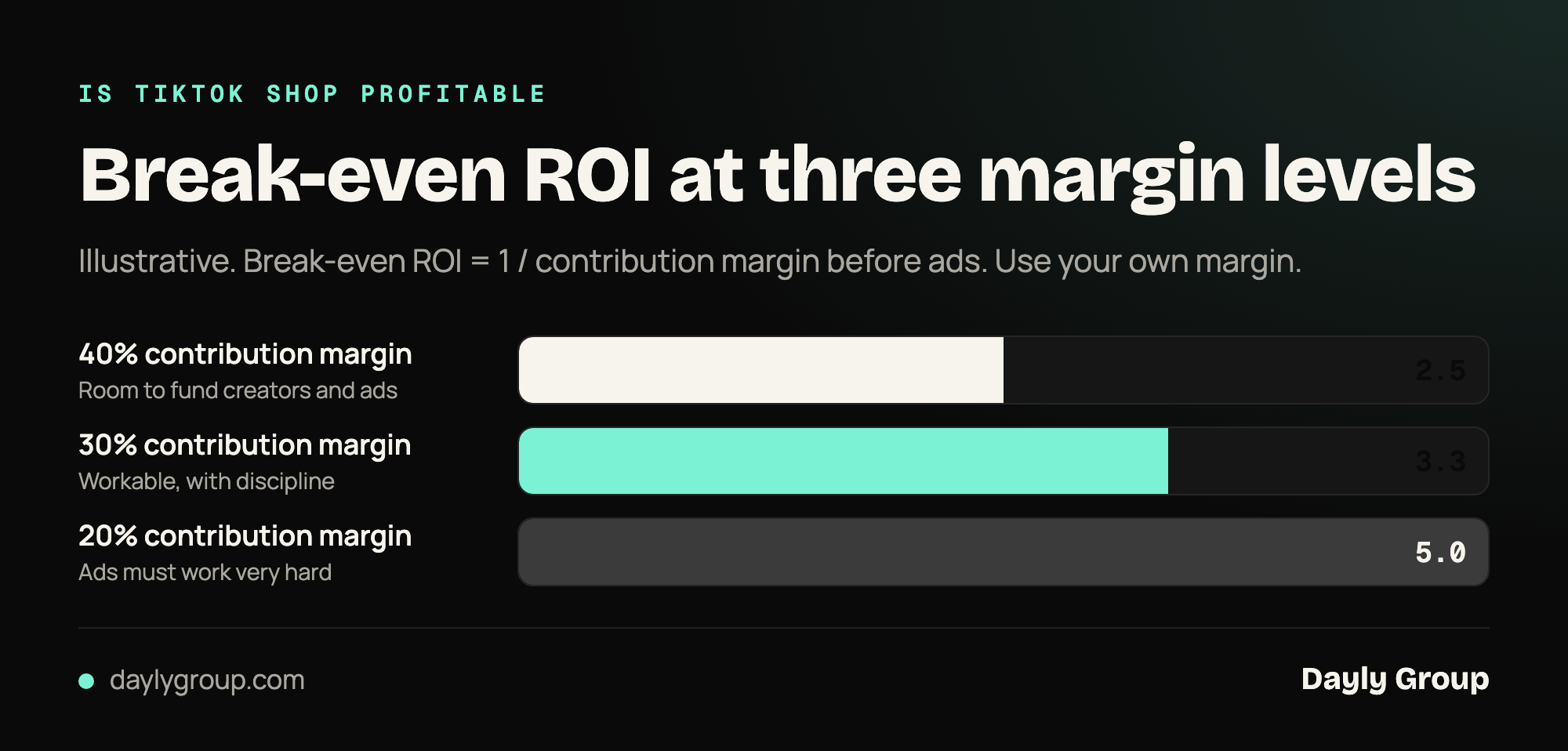
Break-even ROI equals 1 divided by your contribution margin before ads. It is the return on ad spend at which your ads pay for themselves and nothing more.
At 30%, break-even is 1 / 0.30, which is 3.33. At 40%, it is 2.5. At 20%, it is 5.0. The lower your margin, the higher the return you need from every ad dollar, and the harder it gets to find one that clears it.
This is the test most brands skip, and it is the one that decides whether GMV Max can work for you. If your platform-reported return sits below break-even, scaling spend scales a loss. We explain how to set the target in TikTok Shop GMV Max explained.
Test 3: cost per order
Cost per order is ad spend divided by orders. Compare it against your contribution per order in dollars, not percent.
If an order leaves you $30 before ads and ads cost you $5 to land that order, you keep $25. If ads cost $35 per order, you lose $5 on it. Cost per order is the easiest of the three to track weekly, and it tells you fast when something is off.
Tests 2 and 3 are the same question asked two ways, one as a ratio and one in dollars. Track both.
Which products fit TikTok Shop economics?
The products that fit are the ones people can see working in a short video, that solve a clear problem or satisfy an impulse, and that carry enough margin to pay a creator and an ad budget. We look for four things.
- Visually demonstrable. The product does something you can see in 15 seconds: a before and after, a reveal, a clear use. If a creator needs a paragraph to explain it, it will be hard to sell in a feed.
- Problem-solving or impulse-friendly. Shoppers on the platform often buy because a video showed them something they did not know they needed. Products with a clear problem or an easy yes do better than products that need research.
- Enough margin. After commission, fees and returns, there must be room left. This is test 1 again.
- A hero SKU. One product you can put creators and ads behind, with stock to back it. Spreading effort over a whole catalog dilutes it.
Price matters too. Very low-priced items struggle because fixed costs like shipping eat the order, and the right range depends on your category.
If your best candidate is in a health, wellness or beauty category, the same math applies, but the content has to follow TikTok's category rules on what you can claim. Write product benefits in supports-style language and check the rules for your category before a creator posts.
When should a brand wait?
A brand should wait when its margin is thin, its return rate is high, its inventory cannot support a spike, or its category is restricted and not yet approved. Waiting is not failure. Launching into a bad stack is.
Here are the cases we would tell a brand to pause on:
- Thin margin. If break-even ROI comes out at a figure you have never hit on any ad platform, the model does not work yet. Fix price, cost or commission first.
- High return rate. Returns eat margin twice, through the refund and the lost unit. If your product returns heavily on social-driven orders, reduce that first.
- Inventory problems. Content can pull orders in quickly and unevenly. Stockouts waste creator effort and hurt the algorithm's view of your listing. If you cannot back a spike, do not light the match.
- A restricted category without approval. Some categories require approval before you can sell or promote. Check your category in Seller Center and get approved before you spend on content.
- A permanent discount you cannot pull back. If your price on the platform is a discounted price forever, your real margin is the discounted margin. Model that.
GMV is not profit
GMV is the total value of orders placed. Profit is what stays after every cost in the stack. They move together only when your margin holds.
A shop can double its GMV and lose more money, because every extra order carries commission, fees, shipping, returns and an ad cost. Attributed revenue from ads makes this worse, because it feels like proof. It is revenue the platform credits to your campaign, which can include orders that would have happened anyway.
So judge the channel on contribution margin dollars after ads, not on GMV and not on the return ratio alone. If GMV rises and contribution dollars do not, you are buying revenue, not profit.
Launch phase versus steady state
A launch phase is an investment period where you spend ahead of revenue to build a base of creator content, and a steady state is when that content and your ads produce orders at a margin you keep. They should be judged differently.
In launch you send samples, set commissions to attract creators, and wait for content to land. Spend runs ahead of sales. Your first weeks will look worse than your model. That is expected, and you should decide in advance how much you will invest and what you will look at to decide whether to keep going.
Our approach to timing is that inputs have timelines, not outcomes. Content flows in weeks. GMV Max needs a base of content before it has much to work with, so early ad results are noisy. Judge a launch on input measures first: samples sent, videos posted, sample-to-post rate, GMV per sample. Then move to contribution margin as the content base builds.
The mistake is to judge a launch by steady-state profit, or to call a steady state a launch so you never look at the margin. Pick one, write it down, and check it on a schedule.
What does a real example look like?
One example, with honest limits. The Period Company, a feminine-care brand doing $3M+ a year elsewhere with no TikTok Shop presence, was built from a cold start on TikTok Shop. In its first 12 months it reached $622K in Shop GMV across 33.5K orders, and about $80.8K in the most recent 30 days as of October 2026.
This was paid-driven. Over those 12 months GMV Max carried about $154K in spend and about $425K in attributed revenue, a return of 2.75, or about $5.20 per order. About two thirds of the brand's GMV came through GMV Max.
Read that carefully. It is one brand, results vary, and the figures are from Seller Center. A return of 2.75 only pays if the contribution margin before ads is above about 36%, because 1 / 2.75 is roughly 0.36. That is the point of the margin math: the same ad result is a profit for one brand and a loss for another. We are not telling you to expect this. We are showing you that the first thing to know is your own break-even.
What should you track weekly?
Track a short list every week, and keep it in one sheet. The aim is to see a problem while it is small.
- Shop GMV and orders.
- Contribution margin per order on your actual numbers, not the model.
- GMV Max spend, attributed revenue, return and cost per order, next to your break-even ROI.
- Sample-to-post rate, and GMV per sample by creator.
- Return rate by SKU.
- Inventory cover for the hero SKU, in days of stock.
- Active discounts and any change to your price floor.
GMV per sample by creator shows who is worth sending more product, because a few creators typically drive most of GMV. Inventory cover is the line brands forget until a video works and the product is gone.
A simple go and no-go list
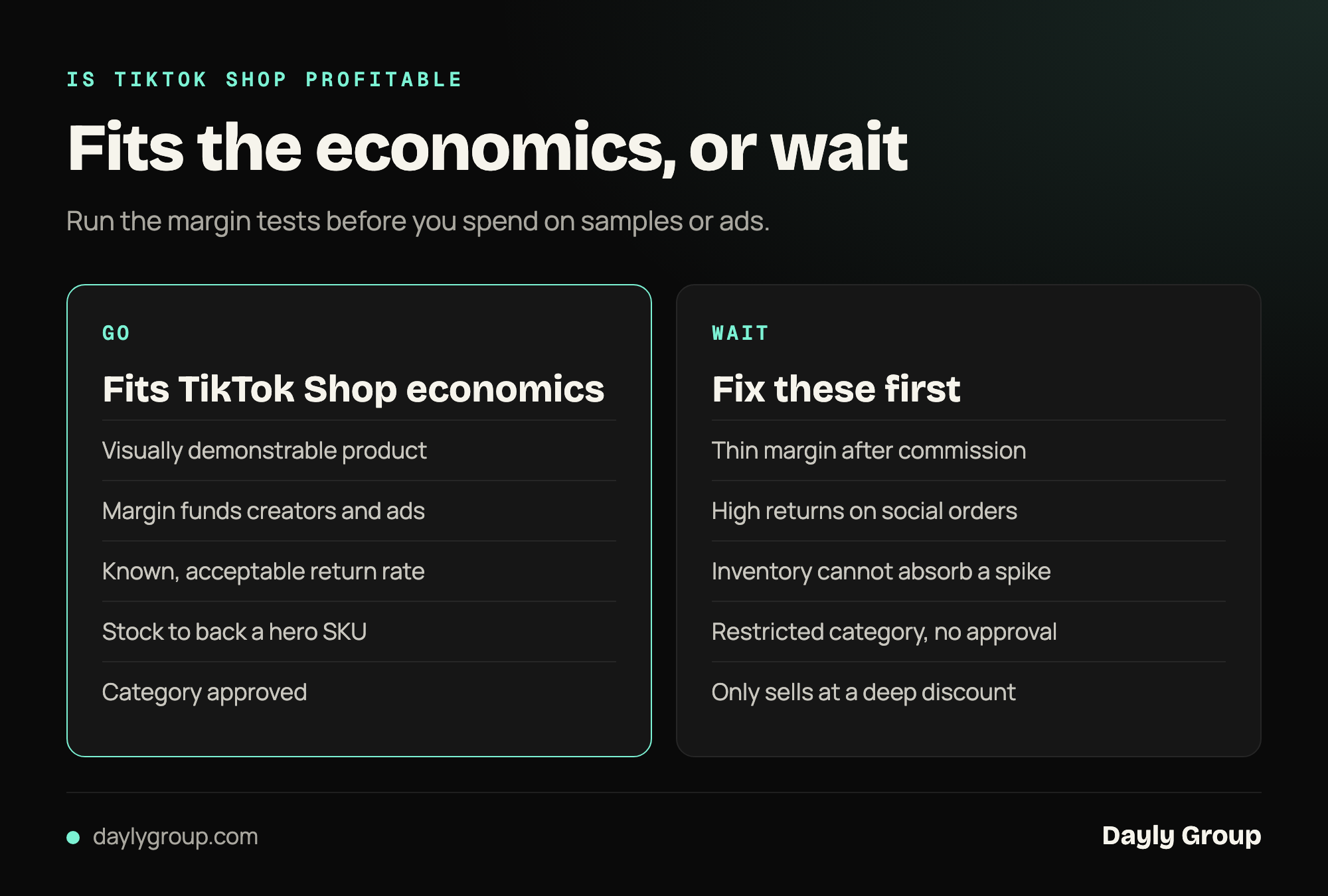
Use this before you commit budget. If you can say yes to all of the go items and no to the wait items, you have a basis to launch.
Go if:
- Contribution margin before ads clears the level that funds creators and ads, and you know your break-even ROI.
- The product is visually demonstrable and has a clear reason to buy.
- Return rate is understood and acceptable.
- Inventory can support a spike on the hero SKU.
- Your category is approved, and your claims follow the category rules.
- You have decided how much you will invest in the launch phase and what you will check at the end of it.
Wait if:
- Break-even ROI is higher than you have ever achieved on any paid channel.
- Returns on social-driven orders are high and unexplained.
- Stock is tight or lead times are long.
- Your category needs approval you do not have.
- The only price you can sell at is a deep standing discount.
Our guide to how to launch on TikTok Shop covers the next step once the math checks out. If you also sell on Amazon and want to compare channels, see TikTok Shop versus Amazon for DTC brands. Our TikTok Shop service page describes how we run it, and the case studies show how we report results on other channels.
FAQ
Q: Is TikTok Shop profitable for DTC brands? A: TikTok Shop is profitable for a DTC brand when its contribution margin after commission, fees, returns and discounts is high enough to fund creators and ads. When margin is thin, it loses money even as GMV grows. Calculate your contribution margin and break-even ROI before you launch.
Q: What margin do you need to make money on TikTok Shop? A: You need a contribution margin high enough that your break-even ROI is a return you can achieve. Break-even ROI equals 1 divided by contribution margin before ads, so a 40% margin needs 2.5, a 30% margin needs about 3.3, and a 20% margin needs 5.0. Those are illustrative, so use your own numbers.
Q: Why can a brand have high GMV on TikTok Shop and still lose money? A: A TikTok Shop brand can lose money on high GMV because GMV counts order value, not what you keep. Each order carries product cost, platform fees, creator commission, shipping, returns and ad cost. If those add up to more than the order value, more GMV means a bigger loss.
Q: Which products work best on TikTok Shop? A: The products that work best on TikTok Shop are visually demonstrable, solve a clear problem or suit an impulse purchase, and have enough margin to pay commission and ads. A hero SKU with stock behind it beats a spread-thin catalog. Test price points in your category rather than assuming.
Q: When should a DTC brand wait to launch on TikTok Shop? A: A DTC brand should wait on TikTok Shop when margin is thin, returns are high, inventory cannot support a spike, or its category needs approval it lacks. Waiting to fix those costs little. Launching into them costs creator effort and ad spend you do not get back.
If you want your own numbers checked before you decide, request the free TikTok Shop Gap Report. It compares your shop against top sellers in your category and ranks the first moves.
Keep reading
Book a free Gap Analysis. We'll tell you what's leaking, what's scaling, and where the next 30% lives.
Book a Gap Analysis →