
TikTok Shop GMV Max Explained: How It Works and When to Use It
GMV Max is TikTok's automated campaign type for promoting Shop products. You set a budget and a target return, and the system handles the rest, so what you feed it decides the result.
GMV Max is TikTok's automated campaign type for promoting Shop products to drive orders. You set a budget and a target return, and the system handles targeting and creative selection. That means the result depends on what you feed it: proven creator content, and a target set from your margin rather than a revenue goal.
GMV means gross merchandise value, the total value of orders in your Shop. Here is how GMV Max works, what you still control, and how to read its numbers without fooling yourself.
What is TikTok Shop GMV Max?
GMV Max is TikTok's automated Shop ads format. It has largely replaced older Shop ad setups for most advertisers, and it is the default way many brands now pay to amplify Shop products.
Platform options change often, so confirm what is available to your account in TikTok Ads Manager before you plan around any detail here. The principle is stable: you give an automated system a goal and inputs, and it decides where and when to show your ads.
Unlike manual campaign setups from other ad platforms, you are not picking audiences, building lookalikes or hand-tuning bids. The system does that. Your job moves to the inputs.
What does GMV Max automate?
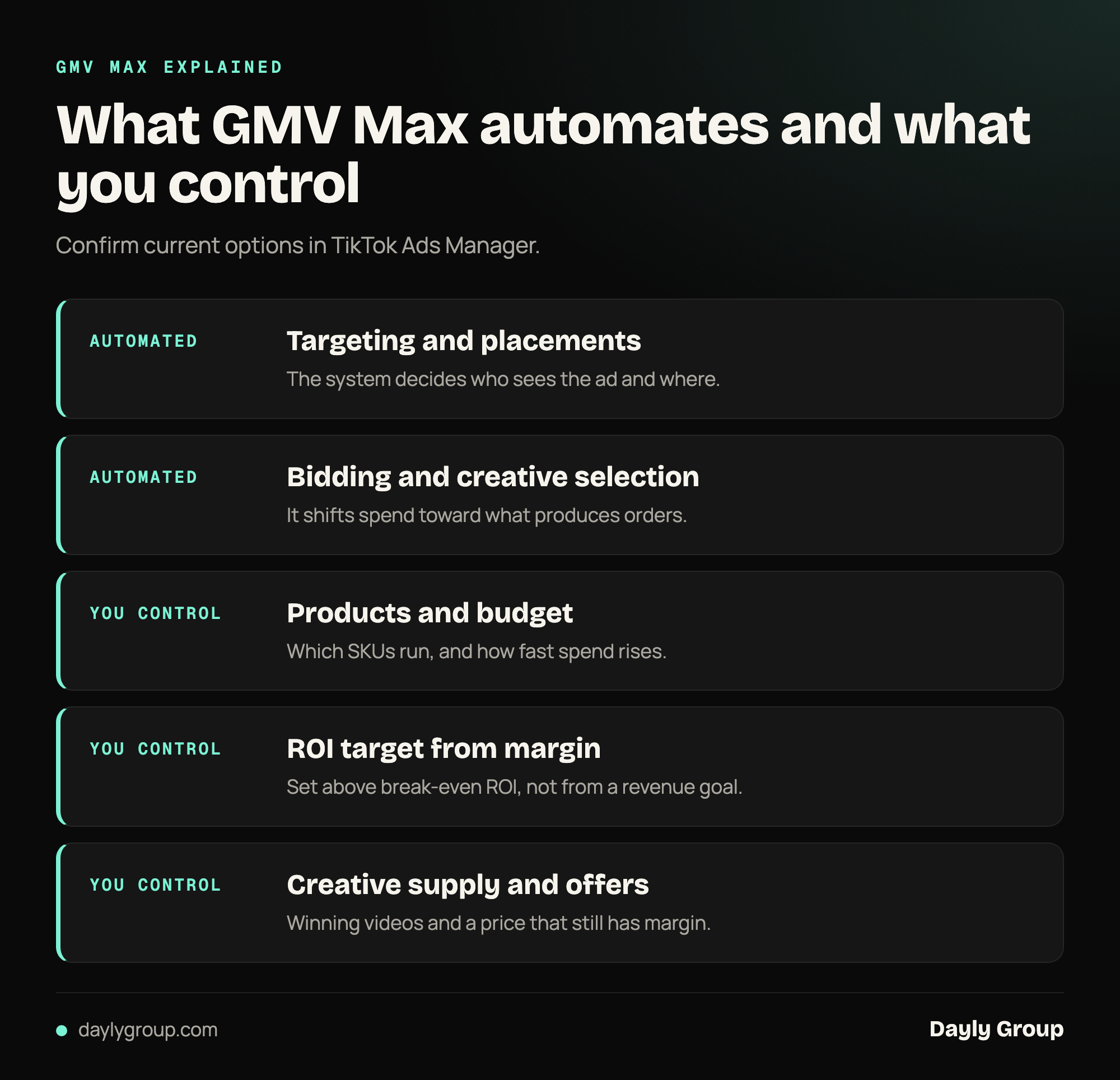
GMV Max automates targeting, placement, bidding and the choice of which creative to show to which shopper. It tests combinations and shifts spend toward what produces orders, inside your budget and target.
Automation is a real advantage. It reacts faster than a person can and does not get bored of a creative that is fatiguing. It is also the reason a lot of brands lose money in it: if you hand an automated system the wrong goal or weak inputs, it will pursue the wrong goal efficiently.
What do you still control?
You still control five things, and they matter more than the settings. In our view they are the whole job.
- Products. Which SKUs are in the campaign. Start with the hero SKU that has the best margin and the strongest content.
- Budget. How much the system can spend, and how fast you raise it.
- ROI target. The return you tell the system to aim for. This is the most important setting, and we cover how to choose it below.
- Creative supply. The videos available to run. This is the biggest lever you have, and the one agencies talk about least.
- Offers. Your price, discounts and bundles. The system will push whatever you give it, including a bad offer.
Notice what is missing from that list: clever audience settings. In an automated campaign type, the creative and the target do the work.
Why does GMV Max need creator content first?
GMV Max needs a base of proven creator content first because the system can only choose among the videos it has. If you have few videos, or none that sell, it has nothing good to scale.
Creator content is the fuel. Creator affiliates, meaning creators who promote your product and earn a commission on orders, post videos. Some sell. Most do not. The ones that sell show up in your Shop data as videos with real orders behind them. Those are your winning creative.
Our approach is to build that base first, then feed it to the campaign. Content flows in weeks, and GMV Max needs that base before it has much to work with, so the order is: get products to the right creators, find the videos that convert, then put spend behind them.
This is also why a few creators matter more than many. A few creators typically drive most of the GMV, so who gets a sample matters more than how many samples go out. Those creators supply the winners the system scales.
If you want the creator side in detail, our post on the TikTok Shop affiliate program for brands covers it.
Is there a learning period?
Yes. Automated systems need data before they perform, so the first stretch of a GMV Max campaign is a learning period when results are noisy and spend may run ahead of orders. The platform shows learning status in Ads Manager, so check there for how it works on your account.
Do not judge a campaign in days. Early results mix in the learning period, a thin content base and day-to-day variance in orders. Brands that change the target every other day reset the learning and never get a clean read. Decide on a review window before you launch, and hold to it unless something is clearly broken, such as a stockout or a pricing error.
How do you set the ROI target from margin?
Set the ROI target from your break-even ROI, which is 1 divided by your contribution margin before ads. Never set it from a revenue goal.
Contribution margin before ads is what you keep from an order after product cost, the referral fee, affiliate commission, fulfillment, returns and discounts. Our post on TikTok Shop fees and the true cost of a sale walks the stack. Here is the use of it:
- Illustrative contribution margin before ads: 30%.
- Break-even ROI: 1 / 0.30 = 3.33.
At a return of 3.33, ads exactly pay for themselves. To make money, your target must sit above break-even by whatever cushion you want for profit and for error. With a 30% margin, a target of 4 means you keep about $0.30 of every $1 of attributed revenue, so $1.20 of contribution on each $1 spent, and $0.20 of that is profit after the ad dollar. Those are illustrative numbers. Replace them with yours.
A revenue-goal target ("I want $100K this month") tells the system to find volume. It will, at any return. That is how brands post a big month and a loss.
The ROI ladder
The ROI ladder is a way to scale while protecting margin. Start conservative, hold the return, and raise spend in steps while the return holds. When the return drops below your floor, stop climbing.
- Set the target above break-even, with a clear cushion.
- Run at modest budget through the learning period. Judge on a pre-agreed window.
- If the return holds above your floor and contribution dollars are positive, raise the budget in measured steps.
- If the return slips toward break-even, hold the budget, add content, and wait for a clean read.
- If you want more volume, lower the target a little, deliberately, knowing the cost in margin.
The point of the ladder is that scale is a decision, not a drift. Every step up has a number behind it.
How do you read GMV Max results honestly?
Read GMV Max against total Shop GMV and contribution margin, not against its own report alone. The campaign reports attributed revenue and a return, but attribution is generous.
Attributed revenue is the revenue the platform credits to your campaign. It can include sales that might have happened anyway: from organic traffic, from a creator video that was already selling, or from shoppers who were going to buy. Ads get credit for some of those. So:
- Compare total Shop GMV before and after you scale spend. Did total GMV rise, or did attribution just shift?
- Check contribution margin dollars after ads, not just the return ratio.
- Watch cost per order next to your contribution per order.
- Check what share of GMV runs through GMV Max. A high share means the shop leans on paid.
This is the same discipline we describe in is TikTok Shop profitable for DTC brands: the platform reports revenue, and you decide whether it was profit.
What does one real example show?
One brand, offered with honest limits. The Period Company, a feminine-care brand doing $3M+ a year elsewhere with no TikTok Shop presence, was built from a cold start on TikTok Shop. Over its first 12 months, GMV Max carried about $154K in spend and about $425K in attributed revenue, a return of 2.75, or about $5.20 per order. About two thirds of that brand's GMV came through GMV Max.
That is a paid-driven story, not organic luck, and it is one brand. Results vary, and the figures come from Seller Center. A return of 2.75 earns money only if contribution margin before ads is above about 36%, since 1 / 2.75 is roughly 0.36. Your break-even may be higher or lower. That is why you start from the margin.
What are the common mistakes?
Four mistakes cause most of the damage, and every one comes from feeding the system the wrong thing.
- A revenue-goal target. The system chases volume at any return. Set the target from break-even instead.
- Scaling spend before content volume. Money without winning videos goes to weak creative. Build the base first.
- Too few winning videos. One or two winners fatigue quickly. Keep creators posting so the system has fresh material.
- Judging in days. The learning period and normal variance make short windows misleading. Set a review window in advance.
A fifth is worth naming: running a standing deep discount through the campaign. The system will happily scale a price that has no margin. Fix the offer before the spend.
How do content and GMV Max fit together?
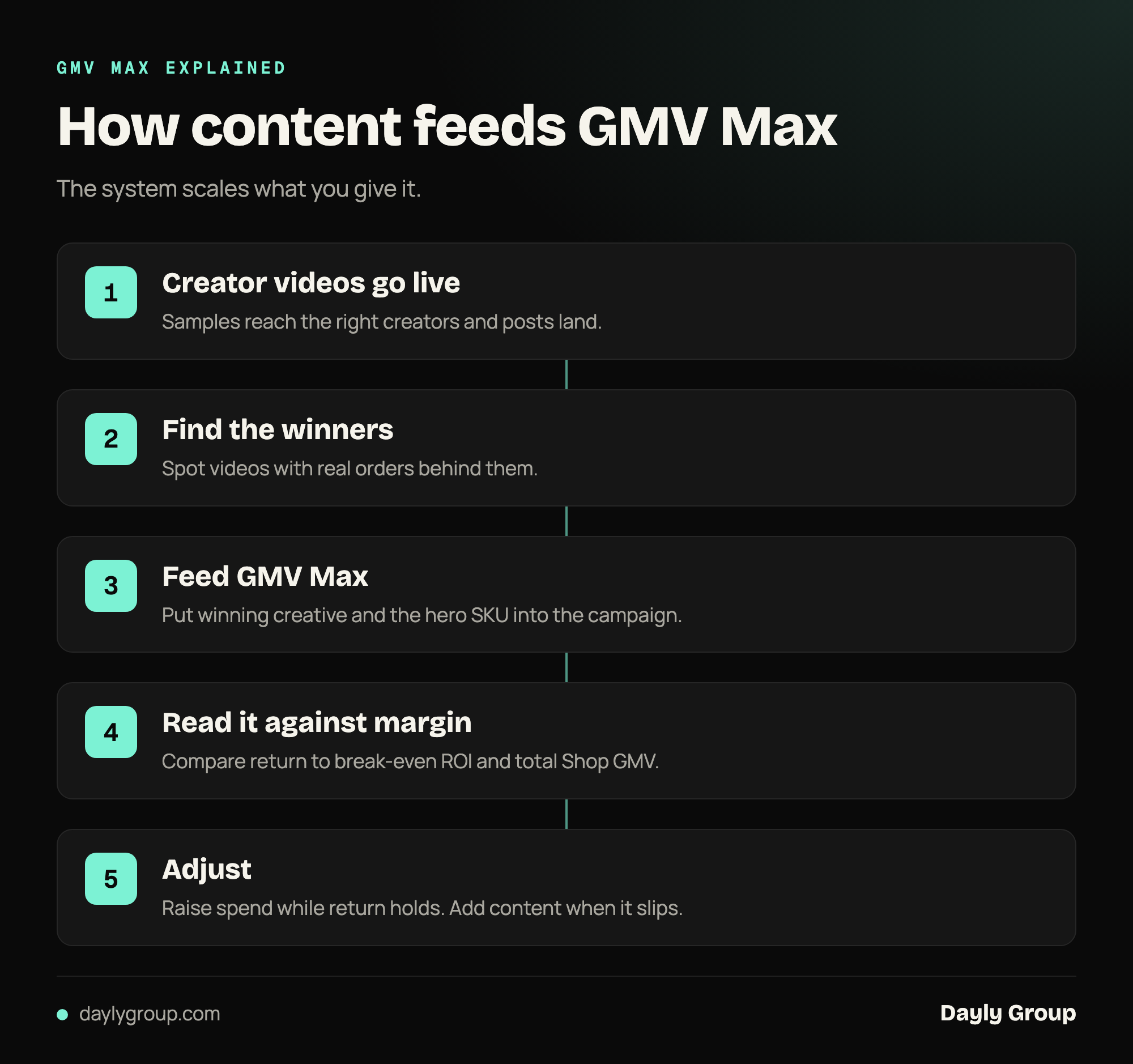
They run in a loop. Creators post, you find the videos that sell, you feed those to GMV Max, you read the results against margin, and you adjust. Then you send product to more of the creators who sold.
Brands that treat GMV Max as a separate "ads" job, run by someone who never sees the creator program, lose that loop. The ads person needs to know which videos work, and the creator team needs to know which videos the ads liked. If you also sell on Amazon, TikTok Shop versus Amazon for DTC brands explains how the two channels differ in how they use ad spend. For how the whole program is put together, read what a TikTok Shop agency does, or see our TikTok Shop service page.
FAQ
Q: What is GMV Max on TikTok Shop? A: GMV Max is TikTok's automated campaign type for promoting Shop products to drive orders. You set a budget and a target return, and the system handles targeting, placements, bidding and creative selection. Confirm current options in TikTok Ads Manager, since platform features change.
Q: What ROI target should I set in GMV Max? A: Set your GMV Max ROI target above your break-even ROI, which equals 1 divided by your contribution margin before ads. With a 30% margin, break-even is 3.33, so a target should sit above that. Do not set a target from a revenue goal, because the system will chase volume at any return.
Q: How long does GMV Max take to work? A: GMV Max needs a learning period and a base of proven creator content before it performs, so judge it over an agreed window rather than days. Content flows in weeks, and early results are noisy. Check the learning status in Ads Manager and avoid changing the target repeatedly.
Q: Is GMV Max attributed revenue the same as profit? A: No. GMV Max attributed revenue is revenue the platform credits to the campaign, before product cost, commission, fees, returns and discounts, and it can include sales that might have happened anyway. Judge the campaign against total Shop GMV and contribution margin dollars after ads.
Q: What are the most common GMV Max mistakes? A: The most common GMV Max mistakes are setting a revenue-goal target, scaling spend before there is enough winning creator content, working with too few winning videos, and judging results in days. Each one feeds the automated system a weak input. Set the target from margin and build content first.
If you want your margin and break-even worked out before you put money behind GMV Max, request the free TikTok Shop Gap Report.
Keep reading
Book a free Gap Analysis. We'll tell you what's leaking, what's scaling, and where the next 30% lives.
Book a Gap Analysis →