
TikTok Shop Fees: The True Cost of a Sale for DTC Brands
The referral fee is the small line. The true cost of a TikTok Shop sale is that fee plus affiliate commission, fulfillment, returns, discounts, ad spend and samples. Here is the stack, in order, with the math.
The TikTok Shop referral fee is the smallest line in your cost stack. The true cost of a sale is the referral fee plus affiliate commission, fulfillment, returns, discounts, ad spend and samples. Add those up and a $100 order often leaves a fraction of what the dashboard suggests. This guide walks the stack in order, so you can see your real contribution margin before you scale.
Every rate below is illustrative. Fee schedules change and public sources disagree on the current referral rate, so read your category's rate in Seller Center and replace my round numbers with yours.
What does a TikTok Shop sale actually cost?
A TikTok Shop sale costs seven things: product cost, the referral fee, affiliate commission, fulfillment and shipping, returns, discounts and ad spend, plus the samples you sent to get content in the first place. Most brands only model the first two or three.
Here is the order we walk it in: product cost, referral fee, affiliate commission, fulfillment, returns, discounts, ad spend, samples. Each line sits on top of the one before it.
GMV means gross merchandise value, the total value of orders placed in your Shop. It is a revenue figure, not a profit figure.
The worked example: a $100 order
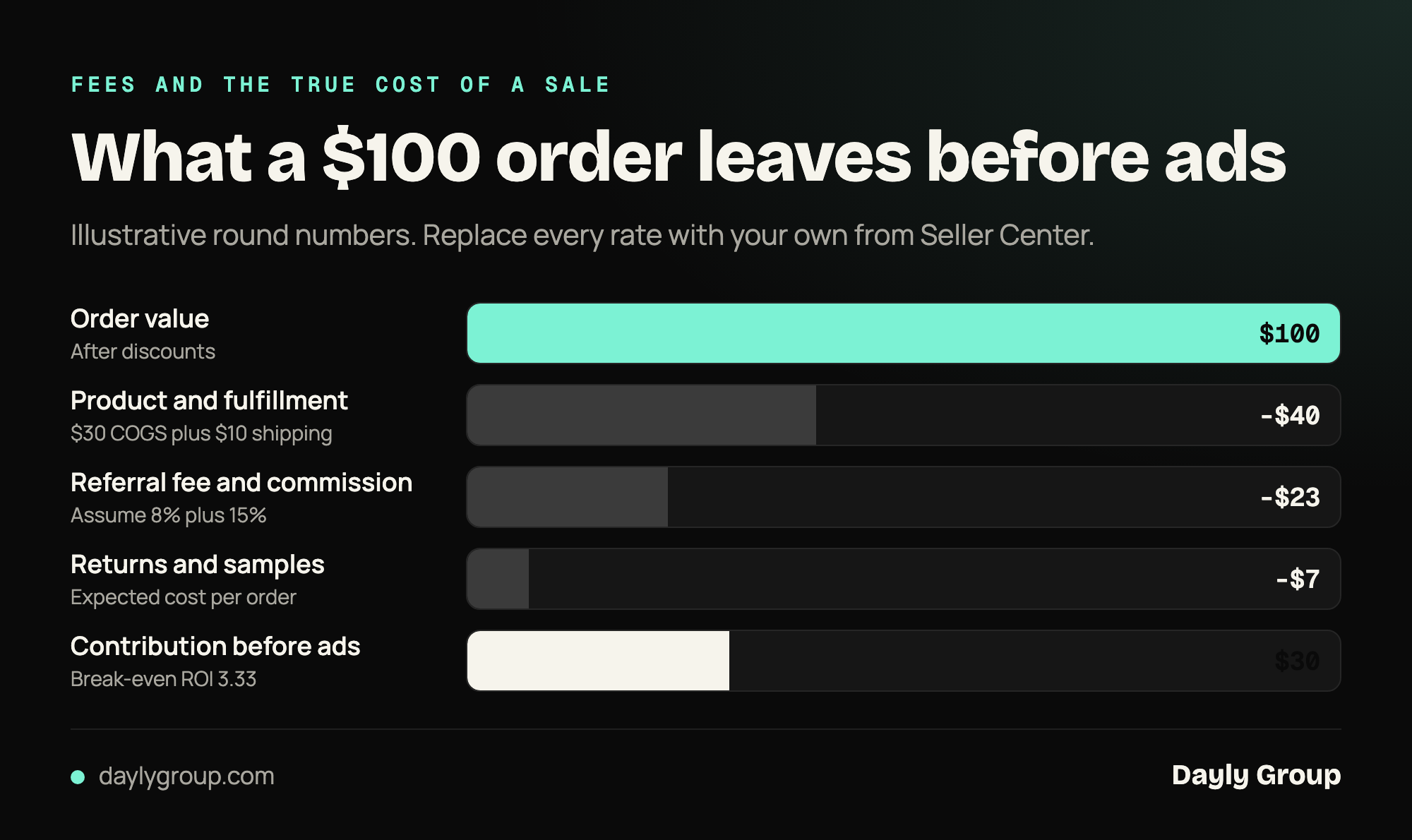
Here is a $100 order, with every number illustrative and round. Replace each with your own.
- Order value after discounts: $100.
- Product cost: $30.
- Fulfillment and shipping: $10.
- Referral fee, assuming 8% for the math: $8. Use your rate.
- Affiliate commission, assuming 15%: $15. This is a number you set.
- Expected cost of returns and refunds: $4.
- Samples, spread across the orders they produce: $3.
Total cost before ads: $70. What is left is $30. That is a 30% contribution margin before ads, and it is the number every other decision hangs on.
The referral fee, the line most brands ask about first, is $8 of a $70 stack. The affiliate commission is almost twice that, and you chose it.
How does the referral fee work?
The referral fee is a percentage of the order value that the platform takes on each sale, and the percentage depends on the product category. It is the one line you cannot negotiate or set.
Public sources disagree on the current rate, and rates and seller promotions change. Do not trust a blog post for this number, including this one. Open Seller Center, find your category, and write the current rate into your model.
Check what the fee applies to (product price only, or other order components) in the documentation for your category, and note the answer in your spreadsheet.
How much should you pay in affiliate commission?
Affiliate commission is the percentage you pay a creator when a shopper buys through their video or showcase, and it is the cost line you control most directly. You set it per product, and it is usually the biggest line after product cost.
An affiliate is a creator who promotes your product and earns a commission on the orders they drive. Your rate decides who is willing to promote you.
The tradeoff is simple and uncomfortable:
- A low commission keeps your margin intact and attracts few creators, or creators who do not sell.
- A high commission attracts more creators, including the ones with real audiences, and shrinks your margin on every order.
Our view is that the right commission is the lowest rate that still gets strong creators to pick up the product. You find it by testing, not by copying a competitor's number. A higher rate on a hero SKU you want creators to prioritize can pay for itself if it buys the content that powers everything else. A high rate on a low-margin SKU is a loss you chose.
Model the commission on the price the shopper actually paid, and read your account terms on what happens to it when an order is refunded.
What do fulfillment and shipping add?
Fulfillment and shipping is the cost of getting the product to the shopper, and it comes in two parts: what you pay to pick, pack and ship, and any platform fee tied to the way the order is fulfilled. It does not scale with price, so it hurts low-ticket products most.
Fulfillment fees and shipping programs vary by method and account, and they change. Pull your actual cost per shipped order from your warehouse or 3PL, add any platform fulfillment fee shown in Seller Center, and put the total in your model.
A $10 cost is a rounding error on a $150 order and a margin killer on a $25 one, so product price matters as much as product fit.
How do returns and refunds change the math?
Returns take back revenue you already counted, and often the shipping and the product too. A returned order can be a lost sale plus outbound shipping, return shipping and a unit you cannot resell.
Model returns as an expected cost per order, not a rare event. Take your return rate for the product, multiply by what each return costs you, and spread that across all orders. That is the $4 in our example.
Check your return rate by SKU (social-driven impulse buying often returns differently from your website or Amazon), what a return really costs you, and how refunds interact with commission and fees under your account terms. Those rules change, so read them.
Why do discounts matter so much?
Discounts reduce the order value your whole stack runs on, and a permanent discount puts every sale at the floor price. The costs underneath (product, fulfillment) do not shrink when the price does.
Platform-funded discounts are promotions TikTok pays for. Seller-funded discounts are the ones you fund: vouchers, price cuts, bundles. Read what each program asks you to fund before you opt in.
Here is why a standing discount is dangerous. Take our $100 example and run it at 20% off. The shopper pays $80, but your product cost ($30) and fulfillment ($10) stay put. The commission and fee shrink with the price, so say they drop to about $18 from $23, and returns and samples to $6. Now your stack is $64 and your contribution is $16, which is 20% of the new order value. You gave away 20% of the price and about 47% of the profit.
That is the arithmetic that sinks brands who launch with a deep discount to get traction and never pull it back. Your real price is the price shoppers see.
The rule we use: decide your floor price and your contribution margin at that floor before you accept any promotion.
How should you think about GMV Max ad spend?
GMV Max is TikTok's automated ad campaign type for promoting Shop products, and its spend is the line that makes attributed revenue look better than profit. We cover the mechanics in TikTok Shop GMV Max explained.
You pay for ad spend on top of everything above. The platform reports attributed revenue against that spend, usually as a return ratio. Treating that ratio as profit is the trap, for two reasons:
- Attributed revenue is revenue, so product cost, commission, fees, returns and discounts still come out of it.
- It can include orders that might have happened anyway, from organic traffic or creator videos.
So a return of 3.0 does not mean you made money. It means $3 of attributed revenue per $1 of spend. Whether that is profitable depends on your contribution margin, which brings us to the two terms you need to define.
What are contribution margin and break-even ROI?
Contribution margin is the share of each order you keep after all variable costs, before ad spend and fixed overhead. Break-even ROI is the return on ad spend at which your ads exactly pay for themselves, and it equals 1 divided by your contribution margin before ads.
Using our example:
- Contribution margin before ads: 30%, or 0.30.
- Break-even ROI: 1 / 0.30 = 3.33.
At a return of 3.33, each $1 of ad spend brings in $3.33 of revenue, of which you keep 30%, which is $1.00. You are even on the ad dollar. Above 3.33, you make money on the margin. Below it, you lose money on every attributed order.
Change one input and it moves: a 40% margin gives a break-even of 2.5, and a 20% margin gives 5.0. We go through that range in is TikTok Shop profitable for DTC brands. You can calculate this before you run a single ad.
What do samples really cost?
Samples are free units you send to creators so they will make videos, and the true cost is the product cost, the shipping, and the fact that many samples never become a posted video. Measure it per posted video, not per sample sent.
If a unit costs you $30 landed and only some creators post, a posted video costs more than a sample. The honest metrics are cost per posted video and GMV per sample. A few creators typically drive most of the GMV, so who gets a sample matters more than how many go out.
Early in a launch, samples run ahead of sales, so plan for those first weeks as a launch phase cost.
Which costs do you control, and which do you not?
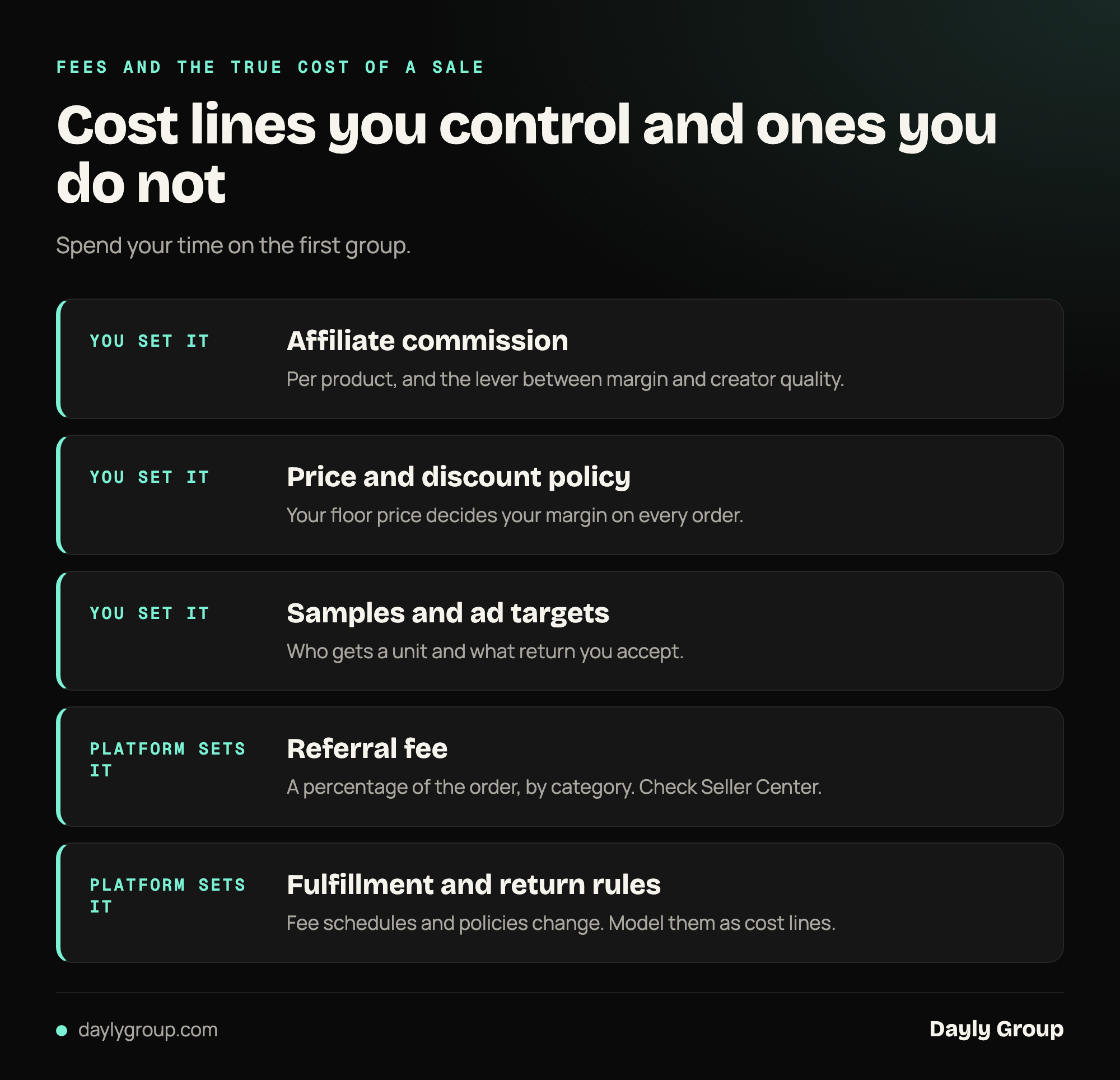
You control the affiliate commission, your discount policy, your price, your sample list and your ad targets. You do not control the referral fee, the platform's fulfillment rules or the platform's return policies.
The levers are on your side of the page.
How do you model a TikTok Shop sale in a spreadsheet?
Build one row per SKU and one column per cost line, then calculate contribution margin and break-even ROI. Do it before launch, and update it when rates change. Use this checklist:
- Price: your real selling price after any standing discount.
- Product cost: landed COGS per unit.
- Referral fee: the current rate for your category from Seller Center.
- Affiliate commission: the rate you will set, applied to the paid price.
- Fulfillment and shipping: your actual cost per order plus any platform fulfillment fee.
- Returns: return rate times cost per return, per order.
- Discount effect: re-run the sheet at your promotional price, not just list price.
- Samples: expected sample cost per order, with a launch-phase version and a steady-state version.
- Contribution margin before ads: price minus lines 2 to 8, divided by price.
- Break-even ROI: 1 divided by line 9.
Then add a cell for your GMV Max target ROI, set above break-even with the cushion you want. Mark any guessed line as a guess and replace guesses with real figures one at a time. If the bottom number comes out thin, read how to launch on TikTok Shop and TikTok Shop versus Amazon for DTC brands before you commit.
If you want help building the model for your catalog, our TikTok Shop service starts from exactly this math. We scope it from the Gap Report, so we don't publish a rate card.
FAQ
Q: What are the fees on TikTok Shop? A: TikTok Shop fees include a referral fee, which is a percentage of the order value that varies by category, plus any fulfillment-related fees that depend on how the order ships. Rates and schedules change and public sources disagree, so read the current numbers for your category in Seller Center. The referral fee is only part of your cost, because affiliate commission, returns, discounts, ads and samples sit on top of it.
Q: Is the TikTok Shop referral fee the main cost of selling? A: No. The TikTok Shop referral fee is usually one of the smaller lines in the stack. Product cost and the affiliate commission you set typically take a larger share of each order, and discounts and returns can take more. Model the whole stack before judging the platform.
Q: How much affiliate commission should a brand pay on TikTok Shop? A: A brand should pay the lowest TikTok Shop affiliate commission that still gets strong creators to promote the product. Too low and few good creators pick it up. Too high and it eats the margin that funds ads. Test rates on your hero SKU and compare the result against your contribution margin, not against a competitor's rate.
Q: What is break-even ROI on TikTok Shop? A: Break-even ROI on TikTok Shop is the ad return at which your ad spend exactly pays for itself, and it equals 1 divided by your contribution margin before ads. With a 30% margin, break-even is 3.33. Any attributed return above that number earns money on the margin, and any return below it loses money.
Q: Why is attributed revenue not the same as profit on TikTok Shop? A: Attributed revenue on TikTok Shop is revenue the platform credits to your ads, and it is before product cost, commission, fees, returns and discounts. It can also include orders that would have happened without the ad. Profit is what remains after those costs, which is why you judge ads against contribution margin.
Want your own numbers worked through? Request the free TikTok Shop Gap Report and we will show where your shop stands against top sellers in your category.
Keep reading
Book a free Gap Analysis. We'll tell you what's leaking, what's scaling, and where the next 30% lives.
Book a Gap Analysis →