
ACoS vs TACoS: The Amazon Advertising Metrics That Actually Matter
Most Amazon sellers obsess over ACoS. The best ones watch TACoS. Here's the difference and how to use both to scale profitably.
Most Amazon sellers treat ACoS like a report card. Get it low, and you're winning. But if you've ever cut ad spend to hit a "good" ACoS number and watched your organic rank crater two weeks later, you already know the problem: ACoS alone doesn't tell you what's actually happening to your business.
TACoS does.
Understanding both metrics — and how they interact — is the difference between managing campaigns and managing growth.
What Is ACoS and How Do You Calculate It?
ACoS stands for Advertising Cost of Sale. It measures how much you're spending on ads relative to the revenue those ads directly generated.
ACoS = Ad Spend ÷ Ad Revenue × 100
So if you spent $500 on PPC and those campaigns drove $2,500 in sales, your ACoS is 20%.
ACoS is useful for evaluating campaign efficiency at the keyword and ad group level. It tells you whether a specific campaign is generating revenue at a cost you can sustain given your margins. If your product has a 35% gross margin and your ACoS is 40%, you're losing money on every ad-driven sale — full stop.
The benchmark most sellers hear is "keep ACoS under 30%," but that's a meaningless target without knowing your margin structure. A supplement brand with 70% margins can run ACoS at 50% profitably. A low-margin consumable at 20% margins needs ACoS under 15% to break even. The number that matters is your breakeven ACoS, which equals your gross margin percentage.
Where ACoS falls short: it only looks at sales attributed to ads. It ignores everything happening in your organic channel — which is often where the real leverage lives.
What Is TACoS and Why It's a Better Health Metric
TACoS stands for Total Advertising Cost of Sale. It measures ad spend against your total revenue — organic plus paid.
TACoS = Ad Spend ÷ Total Revenue × 100
Using the same example: you spent $500 on ads, drove $2,500 in ad-attributed sales, but your product also generated $5,000 in organic sales that week. Total revenue is $7,500.
TACoS = $500 ÷ $7,500 = 6.7%
Your ACoS was 20%. Your TACoS was 6.7%. Very different pictures of the same business.
TACoS reveals what ACoS cannot: how dependent your overall business is on paid traffic. A low TACoS means organic is doing heavy lifting. A high TACoS means you're renting nearly all of your visibility. That's not automatically bad — but it's something you need to know.
The most important thing TACoS can tell you is whether your advertising investment is building compounding equity in the form of organic rank, or just buying sales that disappear the moment you pause spend.
The Relationship Between TACoS and Organic Rank
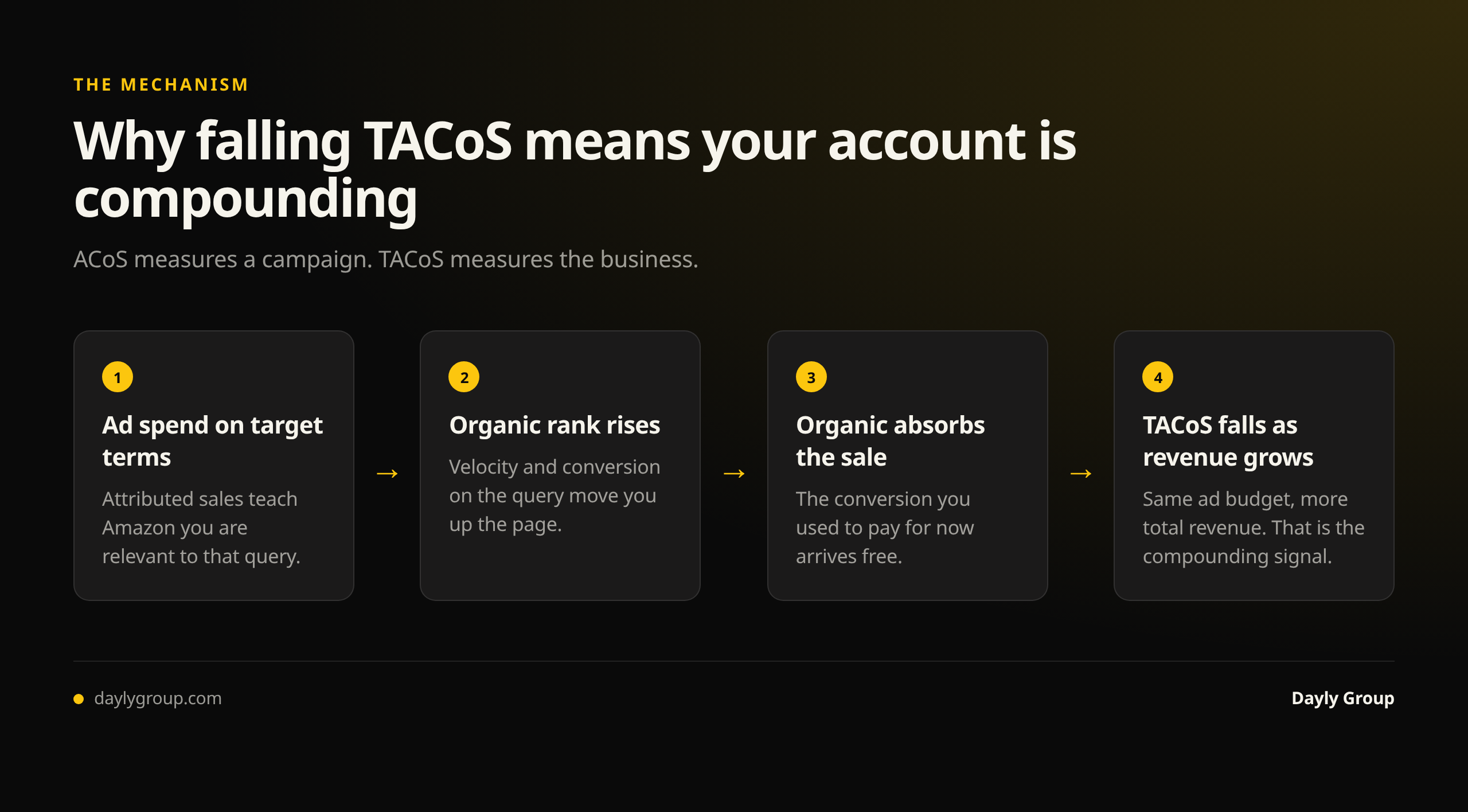
Here's the dynamic that most sellers miss. When you invest in Amazon advertising, you generate sales velocity. Amazon's algorithm treats sales velocity as a signal of relevance — and relevance drives organic rank. Higher organic rank means more impressions, more clicks, more organic sales.
As organic rank improves, you'll see your TACoS decline even if your ad spend stays flat — because the denominator (total revenue) is growing as organic sales increase. A falling TACoS while maintaining or growing total revenue is the clearest signal that your advertising is working as intended: it's purchasing organic position, not just buying short-term sales.
The reverse is also true and worth watching. If TACoS is rising while total revenue is flat or declining, it means you're spending more to hold the same ground. Organic rank is likely slipping, and ads are filling the gap. That's a warning sign — not a time to cut spend, but a time to audit why organic is weakening (pricing, reviews, listing quality, competitor movement).
Track TACoS weekly. A consistent downward trend over 60–90 days is one of the best leading indicators of a healthy, scaling listing.
What "Good" Looks Like by Category and Margin
There's no universal "good" TACoS. Here's a realistic framework by product type:
- High-margin consumables / supplements (50–70% margin): ACoS up to 40–45% is sustainable. TACoS of 8–12% is healthy at scale.
- Mid-margin hard goods / home & kitchen (30–45% margin): Target ACoS below 25%. TACoS of 10–15% is reasonable; below 10% signals strong organic.
- Low-margin commodities / electronics accessories (15–25% margin): ACoS needs to stay under 15%. TACoS above 10% at scale is a margin problem.
- New launches (any category): TACoS of 20–30%+ is expected and acceptable. You're buying rank. Judge it by trajectory, not absolute number.
For ACoS benchmarks by category, the gap between breakeven and target ACoS should account for fixed overhead, referral fees, FBA fees, and your desired profit margin — not just COGS.
How to Use TACoS to Decide When to Scale or Cut Ad Spend
TACoS gives you a cleaner decision framework than ACoS alone. Here's how to read the signals:
TACoS is falling + total revenue is growing: Organic is compounding. This is the moment to increase ad spend aggressively — you're in a flywheel. Pulling back here is one of the most common and costly mistakes in Amazon PPC management.
TACoS is flat + total revenue is flat: You've hit an equilibrium. Ads are sustaining position but not building it. Time to test new keywords, refine targeting, or invest in listing improvements to break the plateau.
TACoS is rising + total revenue is flat: Organic is eroding. Ads are compensating. Diagnose before spending more — check BSR trends, review velocity, competitor activity, and listing conversion rate.
TACoS is rising + total revenue is growing: Scaling mode, typically during a launch or category push. Acceptable in the short term if trajectory is intentional and cash flow supports it.
A Practical Framework: TACoS Targets by Growth Stage
Different stages of a product's lifecycle demand different TACoS thresholds. Applying one number across a full catalog is a mistake.
Launch Phase (Days 1–60) Goal: velocity and rank acquisition. TACoS target: 20–35%. You're spending aggressively on broad and phrase match, running coupons, building initial review count. Don't optimize for profitability yet — optimize for rank position. Judge success by BSR movement and keyword rank, not ACoS.
Scale Phase (Months 2–6) Goal: convert ad-driven rank into organic rank. TACoS target: 12–20%. Tighten match types, harvest converting search terms, pause waste. TACoS should be declining month-over-month. If it isn't, something in the flywheel is broken.
Profit Phase (Month 6+) Goal: maximize profitable volume. TACoS target: 6–12% depending on margin structure. At this stage, well-ranked products should be generating significant organic sales. Ads shift from rank-building to defending position and capturing incremental demand. Focus on exact match, branded terms, and high-intent keywords.
The Bottom Line
ACoS tells you if a campaign is efficient. TACoS tells you if your business is healthy. You need both.
If you're managing your Amazon catalog by ACoS alone, you're flying with one instrument. TACoS adds the altitude reading — it shows whether you're building something that compounds or just paying to tread water.
The best-performing Amazon brands we work with across 300+ accounts audited share a common trait: they know their TACoS targets by product stage, they watch the trend weekly, and they use it to make deliberate, data-backed decisions about when to push and when to pull back. That discipline is what separates sustainable growth from a profitable quarter that falls apart the moment ad spend gets cut.
To find where your spend is actually leaking, run the 12-point PPC audit.
FAQ
Q: What is the difference between ACoS and TACoS? A: ACoS is ad spend divided by ad-attributed sales — it measures a campaign. TACoS is ad spend divided by total sales including organic — it measures the business. ACoS can improve while the account shrinks, and worsen while the account gets healthier, which is why TACoS is the better health metric.
Q: What is a good TACoS on Amazon? A: It depends on margin and stage rather than a universal number. Launch phases often run deliberately high TACoS to buy rank; established products with healthy organic typically settle much lower. The direction matters more than the level: falling TACoS with rising revenue means organic is compounding.
Q: Why is my ACoS rising while my account is doing well? A: Because as organic rank improves, organic absorbs the easy conversions and your ads pick up colder, more expensive traffic. ACoS rises while the business improves. Check TACoS — if it's falling as revenue grows, this is exactly what success looks like. Why your ACoS is climbing covers the diagnosis.
Q: How does TACoS relate to organic rank? A: Ad spend on a target term produces attributed sales that teach Amazon you're relevant to that query, which lifts organic rank, which means organic starts absorbing conversions you previously paid for. Total revenue grows on the same ad budget, so TACoS falls. Falling TACoS is the measurable fingerprint of compounding organic strength.
Q: Should I use ACoS or TACoS to decide on ad spend? A: Use TACoS to decide strategy and ACoS to manage individual campaigns. TACoS tells you whether advertising is building the business; ACoS tells you which campaign or keyword is inefficient inside that strategy. Judging the whole account on ACoS is how brands cut the discovery spend that was funding their organic rank.
Keep reading
Book a free Gap Analysis. We'll tell you what's leaking, what's scaling, and where the next 30% lives.
Book a Gap Analysis →