
Amazon External Traffic Strategy: The Complete Playbook for DTC Brands
Meta ads, email, affiliates and the Brand Referral Bonus — how to send outside traffic to Amazon without burning money, and how to make the algorithm reward you for it.
Most brands treat Amazon as a channel that either works or doesn't. It sits there, it converts, and the only lever anyone touches is PPC. Meanwhile the same brand is spending real money on Meta, sending every click to its own site, and wondering why its Amazon organic rank is stuck.
External traffic is the lever almost nobody pulls properly. Done right, it does three things at once: it sells units, it improves organic rank, and it earns you back a percentage of the sale. Done wrong, it's the fastest way to torch a $10,000 ad budget and conclude that "Amazon doesn't work for us."
This is the playbook we use with brands doing $1M to $50M+ on Amazon.
Why External Traffic Moves Organic Rank
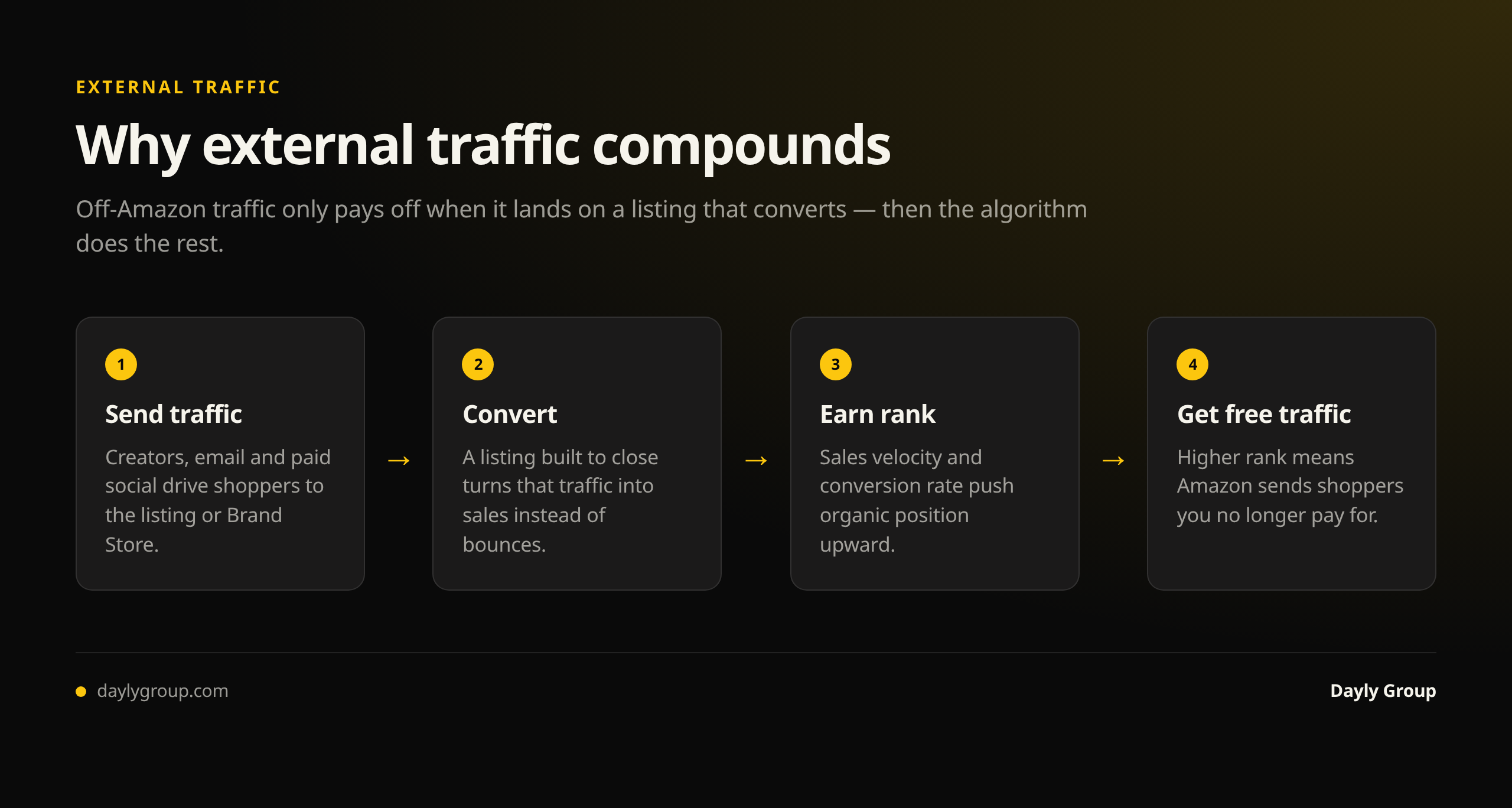
Amazon's algorithm rewards sales velocity and conversion rate. It doesn't especially care where the buyer came from.
That's the whole opportunity. A sale driven by a Meta ad counts toward the same velocity signal as a sale driven by a Sponsored Products click — but it doesn't cost you a competitive CPC in an auction against ten other sellers bidding on your main keyword. And because external traffic is usually warmer (they've seen your creative, they know the brand), it can convert at a rate that pulls your listing's overall conversion rate up.
Higher conversion rate plus higher velocity is exactly what the algorithm uses to decide who ranks on page one. This is why external traffic is best understood as an organic rank strategy that happens to also drive revenue, not as a separate acquisition channel.
The catch: the reverse is also true. Cold, badly targeted external traffic that lands on your listing and bounces will lower your conversion rate and can actively hurt rank. Sending traffic is not the strategy. Sending traffic that buys is the strategy.
Meta Ads to Amazon: How to Do It Without Burning Budget
Meta is the highest-volume external source for most consumer brands, and the one most often run badly.
Send traffic to a single product, not your storefront. Storefront traffic scatters. If someone clicks an ad for a specific product, they should land on that product's detail page — or better, an Amazon Attribution link for that ASIN so you can actually measure what happened.
Use Amazon Attribution from day one. Without it you're flying blind: you'll see Meta spend and total Amazon sales and have no defensible way to connect them. Attribution gives you clicks, detail page views, add-to-carts and purchases per ad. It's free, it's in Seller Central, and skipping it is the single most common mistake we see.
Target warm audiences first. Retargeting site visitors, engaged video viewers and your email list to Amazon almost always beats cold prospecting to Amazon. Cold audiences need education your listing can't provide — Amazon's detail page is a closing environment, not a discovery one.
Match creative to the listing. If the ad shows a lifestyle shot and a "50% off" flash, and the listing shows a white-background hero at full price, you've broken the promise between click and page. Conversion collapses. Your main image and A+ content need to look like the continuation of the ad, not a different brand.
Judge it on blended economics. A Meta-to-Amazon campaign at a 2.0 ROAS looks mediocre next to a 4.0 on your own site — until you add the Brand Referral Bonus, the organic rank lift, and the subscribe-and-save tail. Look at total Amazon contribution, not the campaign row.
The Brand Referral Bonus: Getting Paid to Send Traffic
If you're brand-registered and driving external traffic to Amazon, the Brand Referral Bonus pays you back an average of about 10% of qualifying sales as a credit against your referral fees.
It applies to sales that come from your tracked external links, which means enrolling and using Amazon Attribution tags is the mechanical requirement. It is not automatic.
Think about what that does to your unit economics. On a product where Amazon's referral fee is 15%, a bonus of roughly 10% of the sale price effectively cuts that fee to around 5% for externally-driven orders. That's often the difference between a Meta-to-Amazon campaign being break-even and being profitable — and most brands running external traffic have simply never enrolled.
Email: The Cheapest External Traffic You Have
You already own the list. The reason most brands don't send it to Amazon is a fear of cannibalizing their own DTC margin. Reasonable — but incomplete.
Two situations where sending email traffic to Amazon is straightforwardly correct:
- Launches and rank pushes. A concentrated burst of velocity on a new ASIN, from an audience that already trusts you, is the single most efficient way to get a product indexed and ranking. A week of list-driven sales can accomplish what months of PPC would.
- Prime-loyal and repeat-purchase segments. A meaningful chunk of your list will buy on Amazon regardless, because of Prime shipping and stored payment. You're not converting a DTC customer into an Amazon customer; you're capturing a sale you were going to lose to a competitor's listing.
Segment for it. Don't blast the whole list. And use tracked links so the Brand Referral Bonus and Attribution data both flow.
Affiliates, Creators and Influencers
Affiliate and creator traffic is external traffic that someone else pays to produce. Two models worth running:
Creator content with Attribution links. Give creators a tracked link to a specific ASIN. You get the velocity, the Brand Referral Bonus applies, and the content itself keeps working long after the post. TikTok and YouTube product reviews are especially effective because the buying intent is already formed by the time someone clicks.
Affiliate and deal networks. Lower quality and lower margin, but useful for a defined rank push. Time-box these. They're a tool for a launch window, not a permanent channel.
What to avoid: anything that promises "traffic" as a volume metric. Bot traffic, incentivized clicks and low-intent placements will damage your conversion rate, which is the exact metric you're trying to protect.
Prepare the Listing Before You Send a Single Click
This is where most external traffic programs quietly fail. The traffic is fine. The destination isn't.
Before you spend on external:
- Conversion rate above category benchmark. If your listing converts at 8% and category norm is 15%, external traffic will magnify the leak, not fix it. Fix the listing first.
- Inventory depth for the spike. Going out of stock mid-push doesn't just stop sales — it resets the rank you just bought.
- A+ content and brand story live. Warm traffic from a Meta ad expects brand continuity.
- Reviews above the credibility threshold. Under roughly 20 reviews, external traffic converts poorly no matter how good the creative is.
- Attribution links built and tested. Every link, every channel, before launch.
How to Measure It Honestly
Three numbers, in this order:
- Attribution-level performance. Clicks → detail page views → purchases per campaign. If detail page views are high and purchases are low, the problem is the listing. If clicks are high and detail page views are low, your link or tracking is broken.
- Total Amazon contribution margin. External spend, PPC spend, referral fees minus the Brand Referral Bonus, FBA fees, COGS. Judge the channel here, not in the Meta dashboard.
- Organic rank movement on target keywords. This is the delayed payoff, and the reason a campaign that looks break-even in month one can be your best-performing spend in month three. Track rank weekly on your ten priority keywords and read it against your external push calendar.
Where Brands Get This Wrong
- Running external traffic to a listing that isn't ready to convert
- Never enrolling in the Brand Referral Bonus, and leaving ~10% of qualifying sales on the table
- No Amazon Attribution, so no way to prove or improve anything
- Sending cold prospecting traffic and expecting Amazon's page to do the education
- Judging the channel on last-click ROAS while ignoring rank lift and referral bonus
- Pushing traffic without inventory to absorb the spike
Frequently Asked Questions
Q: Does external traffic really improve Amazon organic rank? A: Yes — indirectly but reliably. Amazon's algorithm rewards sales velocity and conversion rate, and it doesn't discount sales because the buyer came from off-platform. Well-targeted external traffic raises both signals. Badly targeted traffic lowers conversion rate and can hurt rank, so the quality of the traffic matters more than the volume.
Q: How much of my Meta budget should go to Amazon instead of my own site? A: Start at 10–20% against warm audiences and measure blended contribution margin on both channels. Brands with strong Prime-loyal customer bases or a rank goal on a specific ASIN often go much higher during a push window.
Q: What is the Brand Referral Bonus and do I qualify? A: It's an Amazon program that credits brand-registered sellers roughly 10% of qualifying sales driven through tracked external links, applied against referral fees. You must be enrolled in Brand Registry and use Amazon Attribution links for sales to qualify.
Q: Can I send email traffic to Amazon without hurting my DTC revenue? A: Yes, by segmenting. Send launch pushes and Prime-loyal or repeat-purchase segments to Amazon, and keep first-purchase and high-LTV nurture flows on your own site. The customers most likely to buy on Amazon anyway are the ones to send.
Q: How long before external traffic shows up in organic rank? A: Typically two to four weeks of consistent velocity before rank movement is clear, and that movement holds only if your listing's conversion rate holds. This is why we treat external traffic as a sustained program rather than a one-week experiment.
External traffic is the highest-leverage underused channel on Amazon, and it's also the easiest to do badly. If you want to know whether your listings are ready to absorb it — and what your realistic rank upside is — book a 45-minute gap analysis. We'll pull your account, look at conversion rate against category benchmarks, and tell you plainly whether external traffic is your next lever or a distraction.
Keep reading
Book a free Gap Analysis. We'll tell you what's leaking, what's scaling, and where the next 30% lives.
Book a Gap Analysis →