
Amazon Consulting Services: What They Actually Include (and What They Cost)
A straight breakdown of what Amazon consulting services really cover, the four engagement models and what each one costs, plus how to tell whether you need a consultant, an agency or neither.
"Amazon consulting services" is one of the vaguest phrases in e-commerce. It's used by solo freelancers charging $150 an hour, by full-service agencies running eight-figure accounts, and by everyone in between — and the deliverables behind it range from a shared Google Doc to a team of nine people operating your channel daily.
So here's the honest version, from an agency that has run both consulting engagements and full-service retainers for DTC brands doing $1M to $100M+ on Amazon. What's actually included, what the four engagement models cost, and how to tell which one you need.
What's actually inside "Amazon consulting services"
Strip away the packaging and almost every legitimate Amazon engagement is built from six workstreams. Any provider worth paying should be able to tell you which of these they own and which they don't.
1. Account and catalogue health. Suppressed listings, variation issues, buy box loss, brand registry problems, restricted-category approvals, stranded inventory, IP and hijacker enforcement. Unglamorous, and it is where the fastest money usually is — you cannot rank or convert a listing Amazon has suppressed.
2. Organic search (Amazon SEO). Keyword research, indexation, title and bullet structure, backend terms, A+ content, and rank tracking. This is the compounding workstream: rank earned through sales velocity keeps producing traffic you don't pay for. See our organic rank guide for the mechanics.
3. Conversion rate. Main image, image sequence, pricing and coupon strategy, reviews, A+ modules, video. Most brands treat this as design work. It's the highest-leverage number in the account — a jump from 8% to 12% conversion changes the economics of every campaign at once.
4. Advertising. Sponsored Products, Brands, Display, and DSP where the budget justifies it. Campaign architecture, bid and placement management, search-term harvesting and negation, and the actual goal — managing TACoS rather than chasing ACoS on individual campaigns.
5. Profitability. FBA fee and dimension audits, storage and long-term fees, refund and reimbursement recovery, COGS-level margin analysis by ASIN. Almost nobody selling you "consulting" does this properly, and it routinely finds money that no amount of ad optimization would have produced.
6. Strategy and forecasting. Range and variation architecture, pricing, new-product sequencing, inventory planning against seasonality, Prime Day and Q4 planning, marketplace expansion.
If a proposal doesn't map cleanly onto those six, ask which ones are missing. The gaps are usually 1 and 5 — the two that need actual account access and unglamorous work, and the two where we most often find the problem.
The four engagement models, and what they cost
The ranges below are what we see across the market in 2026, not our own rate card. They're wide because scope is wide.
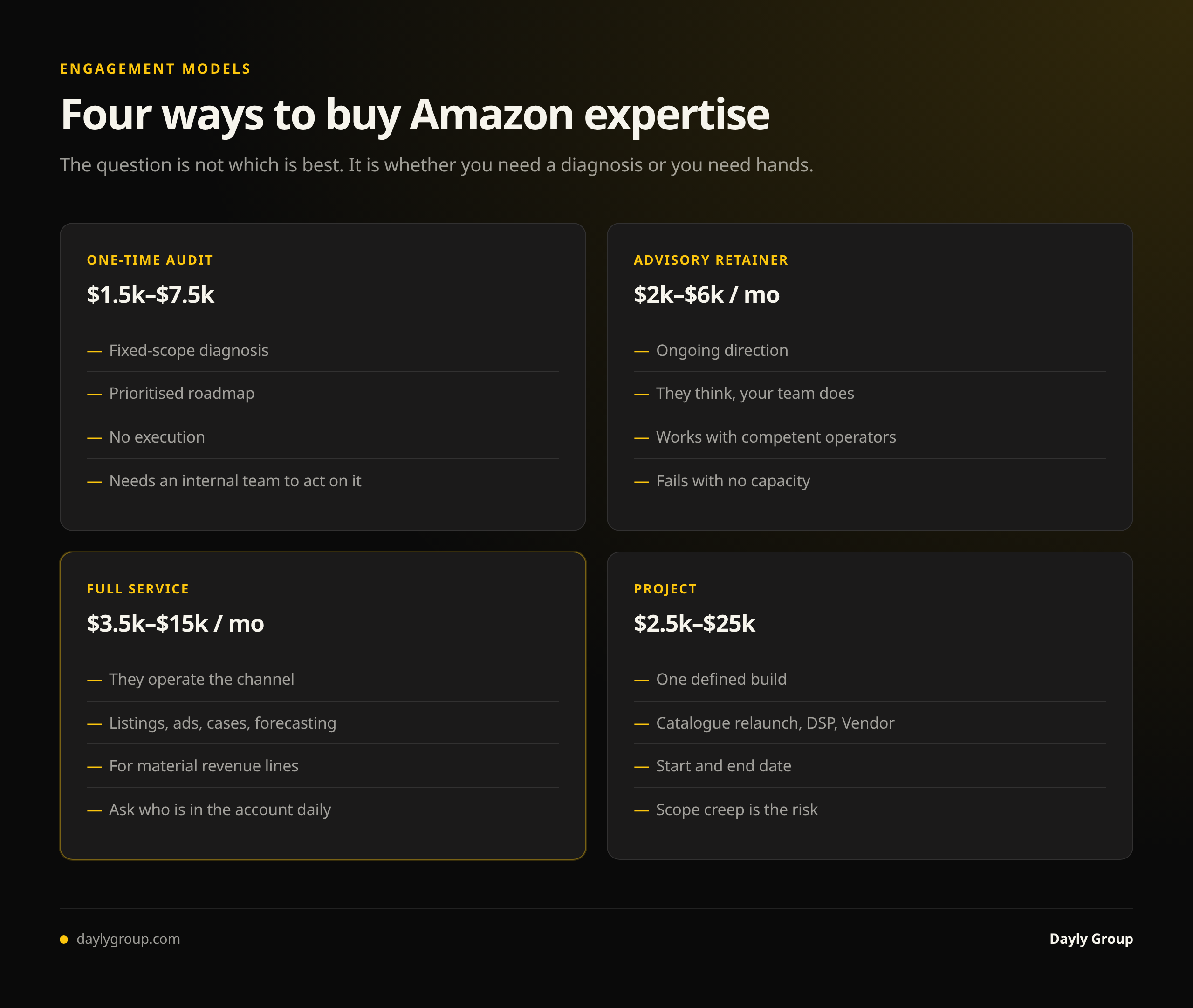
Audit or one-time consult — roughly $1,500–$7,500. A fixed-scope diagnostic. Someone with access to your account tells you what's wrong, quantifies it, and hands you a prioritized roadmap. No execution. Best value in the category if you have a team able to execute the findings.
Advisory retainer — roughly $2,000–$6,000/month. Ongoing strategic guidance, usually a recurring call plus async access. They think, your team does. Works when you have competent operators who need direction, not hands.
Full-service management — roughly $3,500–$15,000/month, sometimes plus a revenue share. They operate the channel: listings, ads, cases, reporting, forecasting. Appropriate once Amazon is a material revenue line and the work exceeds what one internal person can carry.
Project work — roughly $2,500–$25,000 per project. A defined build: full catalogue relaunch, marketplace expansion, DSP standup, Vendor Central transition. Start and end date, specific deliverable.
Two pricing patterns deserve suspicion. Percentage-of-revenue-only deals reward a provider for revenue you would have earned anyway — fine as a bonus layered on a base fee, poor as the whole arrangement. And any fee tied to ad spend creates an incentive to spend more of your money, which is the opposite of what you want.
When a one-time consultant genuinely beats an agency
Retainers get sold by default. Often they shouldn't be. Choose the one-time consult when:
- You have a specific, bounded problem. Rankings dropped after a listing change. ACoS climbed 8 points in a quarter. One ASIN won't index. These are diagnosable in days, not managed for months.
- You have execution capacity but no Amazon expertise. A marketing team that can implement well but has never operated Amazon gets more from a roadmap than from an agency that slowly replaces them.
- You're deciding whether to invest in the channel at all. Before committing to a year of retainer fees, pay for an honest assessment of the ceiling. Sometimes the answer is that your product economics don't work on Amazon — worth knowing for $3,000 rather than $60,000.
- You're evaluating your current provider. An independent audit of an account someone else manages is the cheapest accountability you can buy.
Conversely, don't buy a consult when the real problem is that nobody has time to do the work. A roadmap handed to a team with no capacity becomes an expensive PDF. That's the most common way this money gets wasted, and it's worth being blunt with yourself about which situation you're in.
What a good engagement looks like in the first 30 days
Whatever the model, the early shape should be roughly the same. If it isn't, you're being onboarded into a template rather than into your business.
Week 1 — access and diagnosis, no changes. Seller Central and Ads access, Brand Analytics, and a full read of the account. Anyone making changes in week one is guessing.
Week 2 — quantified findings. Not "your listings need optimization." Something closer to: this ASIN isn't indexed for its head term, these four are losing the buy box on price, refund reimbursements haven't been filed in eleven months, and here is the revenue attached to each.
Weeks 3–4 — highest-leverage fixes first, sequenced. Health and profitability issues before ad restructures, because they're faster and they change the baseline you'd measure the ad work against.
Ongoing — one scoreboard. Sessions, conversion rate, organic rank on target terms, TACoS, and contribution margin. Reporting that shows ad metrics only is reporting designed to look good.
What no consultant can fix
Worth saying plainly, because it saves people money. Amazon consulting does not fix a product with a 2.9-star average and a real quality problem. It does not fix unit economics that can't absorb referral fees, FBA fees and a realistic ad cost. It does not fix chronic stockouts caused by cash constraints upstream.
Good consultants will tell you this in the first two weeks. The ones who take the retainer anyway and optimize campaigns around a broken foundation are why the category has a reputation problem.
How to choose between providers
Three questions separate operators from vendors.
"Who will actually be in my account, and what else do they run?" Ask for the named person and their account load. Impressive strategy calls followed by a junior executing across fifteen accounts is the standard failure mode.
"Show me an account you improved where the numbers went down first." Real operators have these stories — a fee restructure, a deliberate ad pullback, a price correction. A provider with only monotonic success stories is showing you a highlight reel.
"What would make you tell me not to hire you?" Anyone who can't answer this has never turned down revenue, which tells you how the advice will be shaped.
More detail on evaluation in how to choose an Amazon agency, and on the internal-versus-external trade-off in in-house vs. Amazon agency.
The honest summary
Most brands doing under about $50k/month on Amazon are better served by a one-time audit plus internal execution than by a retainer. Most brands above that, with Amazon as a genuine growth priority, need hands rather than advice. And nearly everyone benefits from an independent audit before signing anything — including an audit of the provider they already have.
If you want that assessment on your account, see what we've done for other brands and book a Gap Analysis call. If the answer is that you don't need us, we'll say so.
FAQ
Q: What do Amazon consulting services include? A: Six workstreams: account and catalogue health, organic search, conversion rate optimization, advertising, profitability (fees, reimbursements, ASIN-level margin), and strategy or forecasting. Providers vary in which they actually own — the most commonly missing are account health and profitability, because both require deep account access and unglamorous work.
Q: How much do Amazon consulting services cost? A: Market ranges in 2026: a one-time audit runs roughly $1,500–$7,500; an advisory retainer $2,000–$6,000 per month; full-service management $3,500–$15,000 per month, sometimes with a revenue share; defined projects $2,500–$25,000. Be wary of fees tied to ad spend, which reward a provider for spending more of your budget.
Q: Is an Amazon consultant worth it? A: Worth it when you have a specific bounded problem, when you have execution capacity but no Amazon expertise, or when you need an independent read on whether the channel deserves more investment. Not worth it when the real constraint is that nobody has time to do the work — then you need hands, not a roadmap.
Q: What's the difference between an Amazon consultant and an Amazon agency? A: A consultant diagnoses and directs; an agency operates. Consultants suit brands with internal execution capacity or a single defined problem. Agencies suit brands where Amazon is a material revenue line and the daily workload exceeds one internal person.
Q: When should I hire an Amazon consultant instead of a full-service agency? A: Hire the consultant when the question is "what's wrong and what should we do?" and hire the agency when the question is "who's going to do it?" If you can't confidently name the person who will implement the roadmap next month, you need the agency.
Keep reading
Book a free Gap Analysis. We'll tell you what's leaking, what's scaling, and where the next 30% lives.
Book a Gap Analysis →