
In-House vs Amazon Agency: The Real Cost of Managing Amazon Yourself
A clear-eyed cost comparison of in-house, freelance and agency Amazon management — what each actually costs, what breaks at scale, and how to tell which one your brand needs.
Every brand doing meaningful volume on Amazon eventually asks the same question: do we hire for this, or do we bring in a partner?
Most answer it by comparing an agency retainer to a salary, deciding the salary is cheaper, and hiring. Two years later they're on their third Amazon manager, PPC is running on autopilot, and Amazon is a channel nobody in the building fully understands.
The comparison is wrong because the salary isn't the cost. Here's the honest version.
What In-House Amazon Management Actually Costs
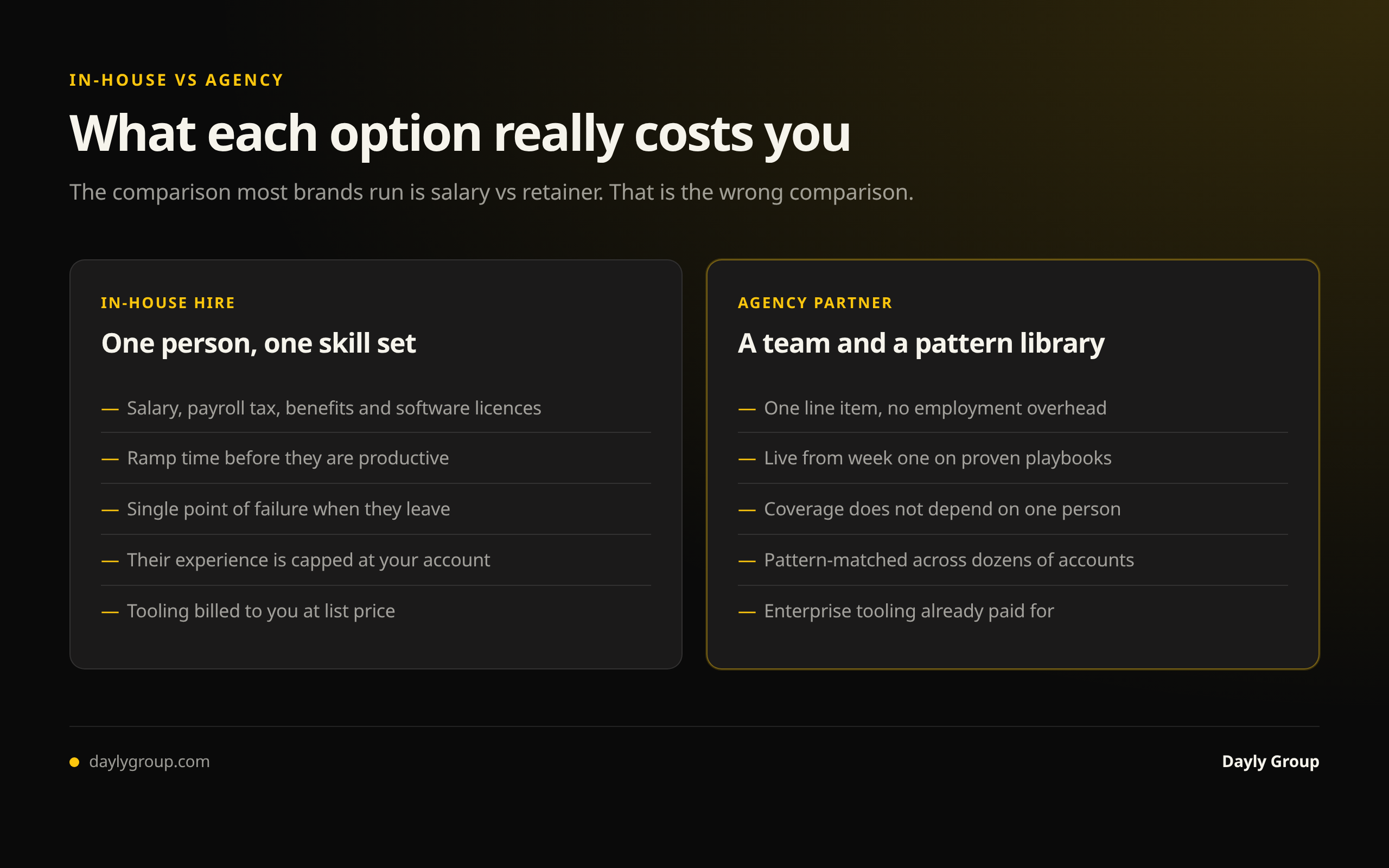
An Amazon channel needs five distinct skill sets: advertising, listing and creative optimization, inventory and supply planning, catalog and case management, and strategy. In-house, you either hire several people or hire one person and accept they'll be strong at one or two of those and mediocre at the rest.
Real cost of the one-person version:
- Salary. A competent Amazon manager who has genuinely scaled an account runs $70,000–$110,000. Below that band you're hiring someone learning on your P&L.
- Loaded cost. Payroll tax, benefits, equipment, software seats. Add 25–30%.
- Tooling. Keyword and rank tracking, listing tools, analytics, repricing. $200–$1,000+/month.
- Management overhead. Someone senior spends real hours reviewing work in a domain they don't know well enough to audit.
- Ramp time. Three to six months before that hire is making decisions that improve the account.
- Single-point-of-failure risk. They leave, and the institutional knowledge leaves with them. Amazon knowledge is rarely documented well.
All in, a single mid-level in-house hire is typically $110,000–$150,000 a year — for one person's judgment, one person's pattern library, and coverage of maybe two of the five skill sets.
What Freelancers Cost, and Where They Break
Freelancers run $1,000–$4,000/month and are genuinely the right answer in two situations: you're under roughly $50,000/month on Amazon, or you need one narrow capability (PPC only, listing copy only).
Where they break:
- Scope is capped by hours. A freelancer at 10 hours a month can maintain an account. They cannot run a rank campaign, rebuild a catalog and manage a launch simultaneously.
- No redundancy. Vacation, illness or a lost client means your channel stops.
- Limited pattern library. Most manage a handful of accounts, often in unrelated categories.
- Rarely strategic. You get execution against instructions. If you don't know what to instruct, that's the gap.
Freelancers are a good answer to "who does this work." They're a poor answer to "what should we be doing."
What an Agency Costs and What You're Actually Buying
Agency retainers for serious Amazon management run $3,000–$10,000+/month, sometimes with a revenue-share component. On paper that's comparable to a salary. What differs is what's inside it.
Pattern recognition across accounts. The single most valuable thing an agency has is scar tissue. Having managed dozens of accounts across categories, an experienced team has seen your specific problem before — usually many times — and knows which fix works and how long it takes. An in-house hire is running an experiment on your account. That difference compounds.
A full team instead of a generalist. Advertising, creative, catalog, and strategy handled by people who each do only that. No single point of failure.
No ramp. A good agency is making changes in week one, not month four.
Category and competitive intelligence. What CPCs actually look like in your category right now. Which competitors are buying aggressively. What conversion rate is normal, so you know whether 11% is a problem or fine.
Accountability structure. Reporting, benchmarks, and a relationship you can end. Ending an underperforming agency relationship is a 30-day notice. Ending an underperforming hire is a months-long process.
What you're giving up is real too: some control, some brand intimacy, and the fact that an agency's knowledge of your product will never match your own team's.
The Honest Decision Framework
Stay in-house if: Amazon is your dominant channel and core competency, you're at a scale that justifies three-plus specialists, and you already have senior leadership who can audit Amazon work. At $50M+ on Amazon with a real internal team, in-house is usually correct.
Use a freelancer if: you're under ~$50,000/month on Amazon, or you need one specific skill filled and you know what to direct.
Use an agency if: Amazon is important but not your entire business, you're between roughly $50,000 and $2M a month, you don't have anyone internally who can audit Amazon decisions, or you've already cycled through a hire or two without the channel improving.
The hybrid that works best: keep an internal owner who holds brand, product and inventory knowledge and owns the relationship — pair them with an agency for advertising, optimization and strategy. You get institutional memory and specialist depth. This is how most of our best client relationships are structured.
The Cost Nobody Puts in the Spreadsheet
The comparison people run is salary versus retainer. The comparison that matters is what the channel earns under each option.
A brand doing $200,000/month on Amazon at a 30% contribution margin makes $60,000 a month. If management improves that by 25% — through better campaign structure, fixed indexing, a main image that actually converts — that's $15,000 a month, or $180,000 a year, from the same traffic.
Against that number, the difference between a $9,000 retainer and a $10,000 loaded monthly salary is noise. The question was never which is cheaper. It's which one produces the better account.
And the inverse is the cost people never book: a year of an under-supported hire learning on your account is a year of organic rank you didn't build, competitors you let take page one, and PPC waste you can't get back. That's the expensive option, and it never shows up as a line item.
Questions to Ask Before You Sign Either Way
If you're hiring in-house: What's the largest account you've personally managed, and what did revenue do under you? Walk me through how you'd structure PPC for one of our ASINs. How do you decide when to cut a keyword? What's your read on our current listings?
If you're hiring an agency: Who specifically will touch my account day to day? Show me a brand in my category and what changed. What will you do in the first 30 days? What are you not good at? What's the notice period? Do you own the account or do I?
The last one matters more than people realize. You should always own your Seller Central account, your Brand Registry and your creative assets. Any partner who resists that is telling you something.
Frequently Asked Questions
Q: Is an Amazon agency cheaper than hiring in-house? A: Usually comparable on cash cost and materially better on capability per dollar. A $110,000–$150,000 fully-loaded in-house hire buys one generalist's judgment; a $3,000–$10,000/month retainer buys a specialist team with no ramp time and cross-account pattern recognition. The real comparison is what the channel earns under each, not which line item is smaller.
Q: At what revenue does an Amazon agency make sense? A: Roughly $50,000/month in Amazon revenue is where specialist management reliably pays for itself. Below that, a freelancer or part-time internal owner is usually the better economics. Above about $2M/month, a hybrid internal team plus specialist support tends to win.
Q: What's the risk of outsourcing Amazon management? A: The real risks are losing internal channel knowledge, an agency that assigns junior staff to your account, and misaligned incentives — a partner optimizing for a metric that isn't your profit. Mitigate all three: keep an internal owner, ask who specifically works on your account, and agree on the reporting metrics before you sign.
Q: How long before an agency shows results? A: Expect wasted-spend reductions within 30 days, listing and conversion improvements at 30–60 days, and organic rank movement at 60–90 days. Anyone promising transformation in two weeks is describing an ad placement, not channel growth.
Q: Can I do both — in-house and an agency? A: Yes, and it's often the best structure. The internal person owns brand, product, inventory and the relationship; the agency owns advertising, optimization and strategy. You keep institutional knowledge and get specialist depth without hiring four people.
If you're weighing this decision, the useful next step isn't a pitch — it's data. Book a 45-minute gap analysis and we'll pull your account, benchmark it against your category, and tell you plainly what the upside is and whether you need us to get it. Some brands leave that call and hire internally. That's a fine outcome. See also how to choose an Amazon agency and what full account management covers.
Keep reading
Book a free Gap Analysis. We'll tell you what's leaking, what's scaling, and where the next 30% lives.
Book a Gap Analysis →