
Seller Central vs. Vendor Central: Which Is Right for a DTC Brand?
The real trade-offs between selling to Amazon and selling on Amazon — margin, control, chargebacks, and why most DTC brands we work with stay on Seller Central.
Vendor Central used to be a status symbol. An invitation from Amazon's retail team felt like arriving.
For most DTC brands in 2026, it's the wrong choice — and the brands that discover this discover it eighteen months in, after margin has quietly eroded through chargebacks and price control they no longer have. That's not a universal rule, and there are brands for which Vendor Central is clearly right. But the default should be Seller Central, and the burden of proof belongs to the alternative.
Here's the actual comparison.
The fundamental difference
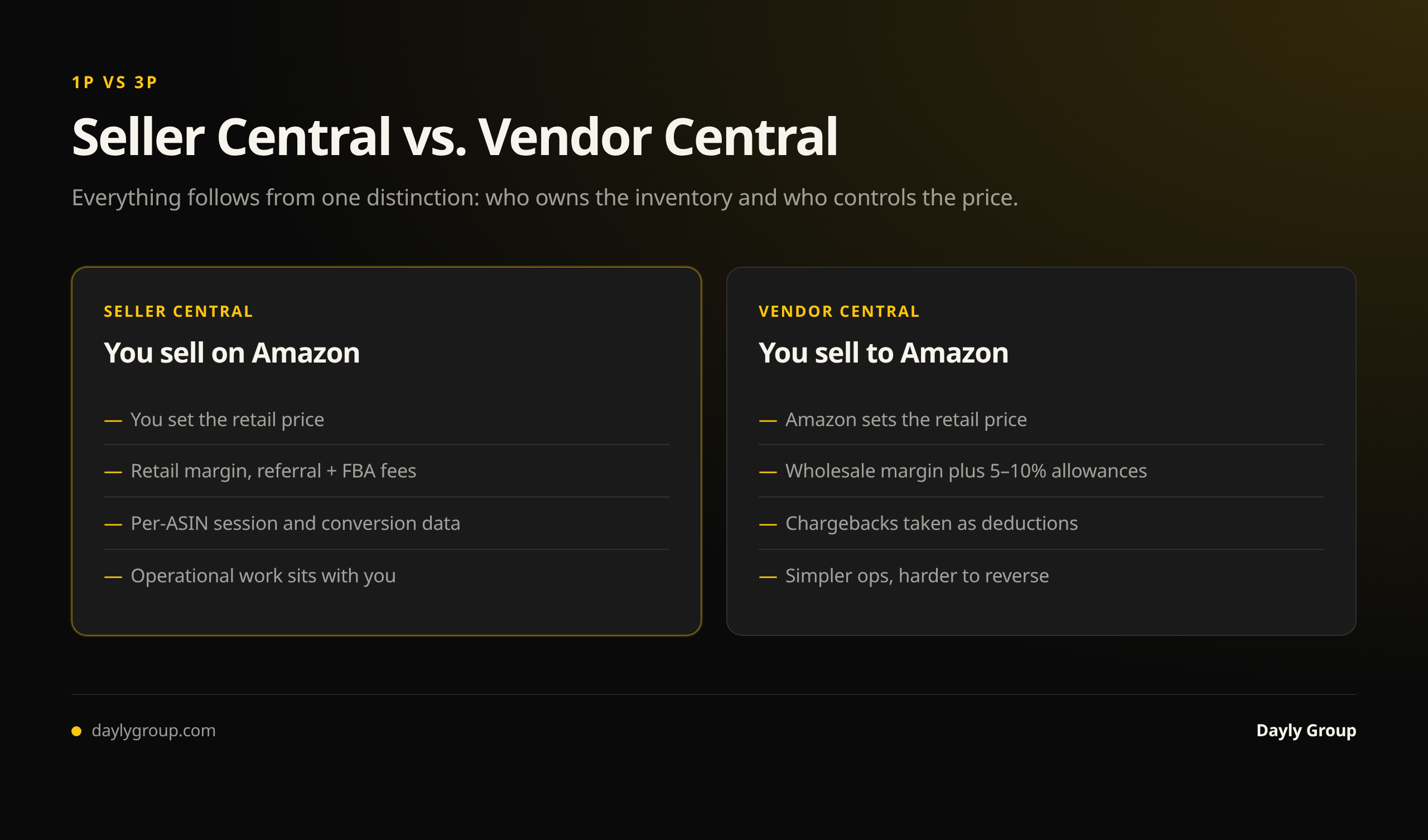
Seller Central (3P): you sell on Amazon. You own the inventory until a customer buys it, you set retail price, you keep the customer-facing relationship, and Amazon takes a referral fee plus fulfillment fees.
Vendor Central (1P): you sell to Amazon. They issue purchase orders at wholesale, own the inventory, and set the retail price — whatever you'd prefer it to be. You're a supplier.
Everything downstream follows from that one distinction: who owns the inventory and who controls the price.
Where Vendor Central genuinely wins
Operational simplicity. Purchase orders in, pallets out. No FBA shipment planning, no per-unit fulfillment management, no customer service. For a brand without e-commerce operations capacity, that's real value.
Cash flow predictability. Large POs with defined payment terms, rather than daily sales settling into a rolling balance.
A+ Premium and retail programs. Historically easier access to premium content, Subscribe & Save mechanics and certain merchandising placements — though Amazon has narrowed much of this gap for brand-registered sellers.
The "Ships from and sold by Amazon" badge. A genuine conversion advantage in some categories, particularly higher-consideration purchases where the shopper is nervous about the seller.
Volume. Amazon's retail team forecasting and ordering at scale can move more units than you'd sell yourself, at lower per-unit effort.
Where Vendor Central costs you
You lose price control, completely. Amazon can discount your product to whatever it likes. That resets your price on other channels, breaks MAP agreements with retail partners, and trains customers to a lower price you can't undo. For a brand with wholesale relationships, this is the single biggest risk and it's frequently underestimated.
Chargebacks and deductions. ASN errors, carton labeling, routing violations, late deliveries, missing PO acknowledgment — each carries a fee. In poorly managed vendor accounts these can consume several percent of revenue, and they arrive as deductions rather than invoices, so they're easy not to notice.
Co-op and marketing allowances. Negotiated percentages off invoice for damage allowances, marketing development funds and accruals. These are normal in retail and shocking to brands used to DTC margins.
Wholesale margin. You're selling at wholesale, not retail. The margin difference has to be paid for by volume, and often isn't.
Less data. Seller Central gives you granular session and conversion data per ASIN. Vendor analytics are improving but remain thinner, and you lose the direct customer relationship entirely.
Forecasting risk in both directions. Under-forecast and you get chargebacks for shorting POs. Over-forecast and Amazon stops ordering while you hold inventory built for POs that never come.
Hard to reverse. Moving back to Seller Central means rebuilding listings, reviews history considerations, and re-establishing price — while Amazon may keep selling through remaining inventory at prices you don't control.
The honest recommendation for most DTC brands
Stay on Seller Central if:
- You sell through other channels where price consistency matters
- Margin is tight enough that wholesale pricing plus allowances doesn't clear
- You want per-ASIN conversion data and control of the listing
- You have, or can build, basic e-commerce operations capacity
- You're under roughly $10M in Amazon revenue
Consider Vendor Central if:
- Amazon is your dominant channel and price consistency elsewhere isn't a constraint
- Your margins genuinely absorb wholesale pricing plus 5–10% in allowances
- You lack operational capacity and value simplicity over control
- Your category benefits materially from the Amazon-sold badge
- You have someone who understands EDI, routing compliance and chargeback disputes
Consider hybrid (both): Some brands run Vendor Central for core high-volume SKUs and Seller Central for new launches, variants and testing. It's operationally heavier and requires care to avoid competing with yourself on the same ASIN, but it preserves launch control while capturing 1P volume where it makes sense.
What changes about managing the account
The strategic work is similar — listings, keywords, conversion, advertising — but the operational reality differs sharply.
On Seller Central, the levers are yours: pricing, inventory placement, promotions, listing edits, FBA fee optimization, reimbursement claims. Most improvements are things you can simply execute.
On Vendor Central, a meaningful share of the work is managing Amazon itself: negotiating annual vendor terms, disputing chargebacks, escalating unfilled POs, correcting cost files, and fighting for the retail price you want. That work is unglamorous and it's where vendor accounts leak the most money — chargeback recovery and terms negotiation routinely outweigh advertising optimization in value.
Anyone managing a vendor account for you should be able to tell you your chargeback rate, your dispute recovery rate, and what your co-op terms are. If they can only talk about ACoS, they're managing half the account. How to know if your agency is doing a good job covers what the reporting should include.
The question to ask before switching
Not "is Vendor Central better?" but: what specifically can't we do on Seller Central that Vendor Central would let us do — and is it worth losing price control?
If there's a clear answer, switch. If the answer is prestige, volume promises from a retail rep, or a vague sense that 1P is more legitimate, stay where you are.
If you want a read on which model your economics support, see what we've done for other brands and book a Gap Analysis call.
FAQ
Q: What's the difference between Amazon Seller Central and Vendor Central? A: On Seller Central you sell on Amazon — you own the inventory until it sells, you set retail price, and you keep the customer relationship, paying a referral fee plus fulfillment fees. On Vendor Central you sell to Amazon at wholesale via purchase orders; Amazon owns the inventory and sets the retail price. Everything else follows from who controls inventory and price.
Q: Is Vendor Central better than Seller Central for a DTC brand? A: Usually not. Most DTC brands do better on Seller Central because they keep price control, margin and per-ASIN data. Vendor Central makes sense when Amazon is your dominant channel, your margins absorb wholesale pricing plus 5–10% in allowances, you lack operational capacity, and you have someone who can handle EDI, routing compliance and chargeback disputes.
Q: What are Vendor Central chargebacks? A: Fees Amazon deducts for compliance failures — ASN errors, incorrect carton labeling, routing violations, late or short deliveries, unacknowledged POs. They're taken as deductions rather than billed as invoices, so they're easy to miss, and in poorly managed vendor accounts they can consume several percent of revenue. Disputing them is a core part of managing a 1P account well.
Q: Can I switch from Vendor Central back to Seller Central? A: Yes, but it's harder than the move in. You rebuild listings and re-establish your retail price, and Amazon may continue selling remaining inventory at prices you don't control during the transition. Plan the wind-down of purchase orders deliberately rather than stopping abruptly.
Q: Can you use Seller Central and Vendor Central at the same time? A: Yes — some brands run core high-volume SKUs through Vendor Central and use Seller Central for launches, variants and testing. It preserves launch control while capturing 1P volume, but it's operationally heavier and needs care to avoid competing against yourself on the same ASIN.
Keep reading
Book a free Gap Analysis. We'll tell you what's leaking, what's scaling, and where the next 30% lives.
Book a Gap Analysis →