
How Much Does an Amazon Agency Cost? Freelancer vs. Agency vs. In-House (2026)
Real 2026 cost ranges for managing your Amazon channel three ways — plus the total cost of ownership math most brands get wrong when they compare a $6,000 retainer to an $85,000 hire.
Most brands compare these three options wrong. They put a $6,000/month agency retainer next to an $85,000 salary, decide the hire is cheaper, and discover fourteen months later that it wasn't — because the retainer was a fully loaded number and the salary was about 60% of one.
Here are the actual 2026 ranges for all three, the total cost of ownership math that makes them comparable, and the revenue thresholds where each one stops making sense. These are market ranges we see across the category, not our rate card.
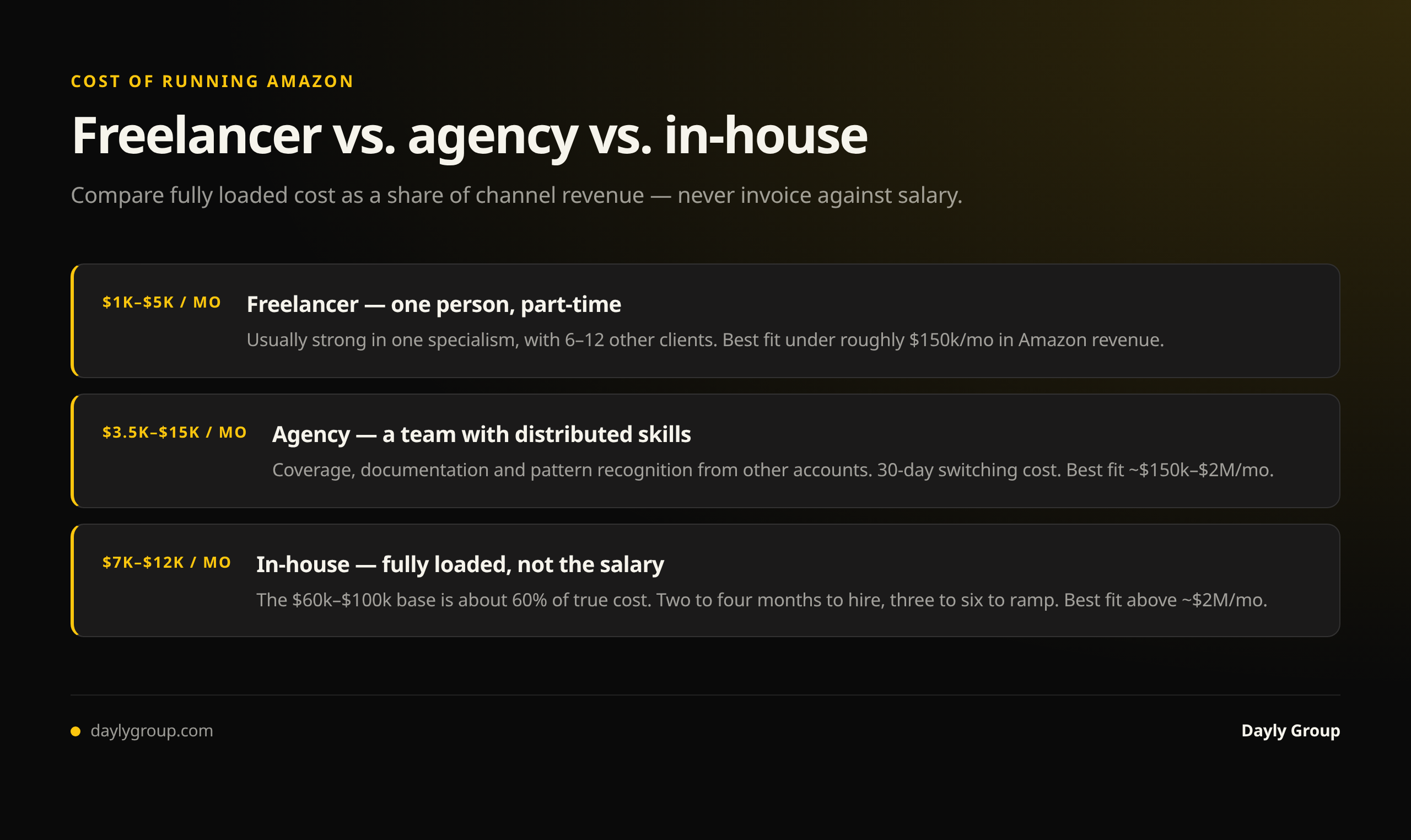
Option 1: Freelancer — $1,000–$5,000/month
Typical rates: $30–$100/hour, or $1,000–$5,000/month for a part-time retainer.
Freelancers are the right answer more often than agencies admit. A capable freelancer running a straightforward catalogue for $2,500/month is excellent value, and plenty of $1–3M brands run this way successfully for years.
What you're actually buying: one person's part-time attention, usually in one specialism. Most Amazon freelancers are strong in either advertising or listings — rarely both, and almost never in account health, fee auditing or forecasting.
The real risks, in order of how often they bite:
- Specialism gaps. An ads-focused freelancer will optimize campaigns while a suppressed listing or a fee misclassification quietly costs more than their fee.
- Concurrency. They have six to twelve other clients. When two accounts have a crisis in the same week, you may not be the priority.
- Single point of failure. No coverage for illness, holidays or departure, and typically no documentation. When a freelancer leaves, the institutional knowledge leaves with them.
- No escalation path. No Amazon partner-manager relationships, no leverage on stuck cases.
Best fit: under roughly $150k/month on Amazon, a catalogue under about 30 SKUs, and someone internal who can notice if things go wrong.
Option 2: Agency — $3,500–$15,000/month
Typical structures: flat retainer $3,500–$15,000/month; retainer plus 2–8% revenue share; occasionally performance-weighted with a lower base.
What you're actually buying: a team with distributed specialisms — advertising, listings, creative, account health, and someone senior on strategy — plus process, coverage and pattern recognition from other accounts in your category. That last one is genuinely undervalued: an agency that has already solved your exact problem on another brand saves you the tuition.
The real risks:
- Seniority bait-and-switch. You're sold by a strategist and served by a junior carrying twelve accounts. Ask who is in the account daily and how many others they run.
- Template treatment. Process becomes a script applied to your account regardless of fit.
- Misaligned pricing. Percentage-of-ad-spend models reward spending more of your money. Revenue-share-only models pay for growth you'd have had anyway. A base fee with a performance component on incremental growth is the cleanest structure.
- Attention decay. Month one is exceptional; month nine is a report. Contract a quarterly business review with named participants.
Best fit: roughly $150k–$2M/month on Amazon, or below that if Amazon is your primary growth priority and you need execution capacity now rather than a hire in five months.
Option 3: In-house hire — $85,000–$140,000 fully loaded
This is where the comparison usually breaks. The salary is not the cost.
Base salary: $60,000–$100,000 for a competent Amazon manager in 2026 (US), higher in major metros and for genuinely senior operators.
Then add the parts people leave out:
- Base salary — $60,000–$100,000
- Payroll taxes and benefits (~25–30%) — $15,000–$30,000
- Recruiting (agency fee, or your own time) — $8,000–$20,000
- Software — keyword, analytics and repricing tools — $3,000–$9,000
- Creative and content support — $5,000–$15,000
Fully loaded: roughly $85,000–$140,000/year, or $7,000–$12,000/month.
Then the two costs that never appear on a spreadsheet:
Ramp time. Two to four months of hiring, then three to six months to genuine productivity. That's up to nine months of full cost at partial output, and it's the single most underweighted number in this decision.
Single-person risk. One person cannot be expert in advertising, SEO, creative, catalogue health, fee auditing and forecasting. And Amazon managers are among the most poached roles in e-commerce — if they leave at month fourteen, you restart the clock and pay the recruiting cost again.
Best fit: above roughly $2M/month on Amazon, where the workload genuinely justifies a full-time person and the fully loaded cost is a small fraction of channel revenue. Below that, you're usually paying agency money for one person's skill set.
The comparison that actually matters
Stop comparing monthly fees. Compare cost as a percentage of Amazon revenue against capability coverage.
A $6,000/month agency on $400,000/month of Amazon revenue is 1.5% of revenue for full coverage. An $85,000 fully loaded hire on the same revenue is 1.8% for one person's skill set, plus nine months of ramp. At $2M/month, the same hire is 0.35% and looks entirely different.
Run the arithmetic on your own numbers:
- Total annual cost — fully loaded, including software, creative and ramp.
- Divide by annual Amazon revenue — that's your management cost as a percentage.
- List the six workstreams — account health, SEO, conversion, advertising, profitability, strategy — and mark honestly which the option covers.
- Add the switching cost — a bad hire costs you 9–14 months. A bad agency costs you a 30-day notice period. That asymmetry is worth real money and is almost never priced in.
Most brands land at 1–3% of Amazon revenue for management. Consistently above 5% means you're overpaying or too early for the option you've chosen; well under 1% usually means the channel is under-resourced, not efficient.
The hybrid most $1–5M brands should consider
The best structure is often neither/both: one internal owner plus specialist external execution.
An internal coordinator — often an existing e-commerce or marketing person, not a new hire — owns inventory, pricing decisions, and internal alignment. An external team handles advertising, listings and account health. You get accountability inside the business and specialist depth outside it, usually for less than a senior hire.
It also de-risks the sequence: you build internal knowledge while external capability carries the channel, so if you do hire later, you hire someone into a working system rather than asking them to build one. We covered the trade-offs in more depth in in-house vs. Amazon agency.
What to ask before you sign anything
Of a freelancer: how many clients do you have, what's your specialism, what happens when you're on holiday, and what documentation do I keep if we part ways?
Of an agency: who is in my account daily and how many accounts do they carry, what's the notice period, what's included versus billed extra (creative? DSP? case management?), and what does your reporting show beyond ad metrics?
Of a candidate: walk me through diagnosing a 30% organic rank drop on one ASIN. Anyone who goes straight to advertising doesn't understand the channel.
And of all three: what would you tell me not to spend money on? The answer tells you whether you're getting advice or a sales pitch.
The short version
Under $150k/month: freelancer or a one-time audit plus internal execution. $150k–$2M/month: agency, or the hybrid. Above $2M/month: in-house team with external specialists on the hardest pieces. And whichever you choose, measure it as a percentage of channel revenue against coverage of all six workstreams — not as a monthly invoice.
If you want an independent read on what your channel actually needs, see what we've done for other brands and book a Gap Analysis call.
FAQ
Q: How much does an Amazon agency cost per month? A: Market rates in 2026 run roughly $3,500–$15,000 per month for full-service management, sometimes with a 2–8% revenue share on top. Most brands should expect total management cost to land between 1% and 3% of their Amazon revenue. Be cautious of fees calculated as a percentage of ad spend, since that structure rewards spending more of your budget.
Q: What is the average salary for an in-house Amazon account manager? A: Base salary is typically $60,000–$100,000 in the US for 2026. Fully loaded — payroll taxes, benefits, recruiting, software and creative support — the real cost is roughly $85,000–$140,000 per year, or $7,000–$12,000 per month. Add two to four months to hire and three to six months to full productivity.
Q: Is a freelancer cheaper than an Amazon agency? A: On invoice, yes — $1,000–$5,000 per month versus $3,500–$15,000. Whether it's cheaper in outcome depends on coverage. Freelancers are usually strong in one specialism, so the risk is an unmonitored area (account health, FBA fees, reimbursements) costing more than the fee difference.
Q: At what revenue should I hire an in-house Amazon manager? A: Generally above about $2M per month in Amazon revenue, where a fully loaded hire is a small fraction of channel revenue and the workload justifies a full-time person. Below that, you're often paying agency-level money for one person's skill set, without the coverage.
Q: How do I compare an agency retainer to an in-house salary fairly? A: Convert both to fully loaded annual cost, express each as a percentage of annual Amazon revenue, then mark which of the six workstreams each actually covers. Include ramp time for the hire and the switching cost of each — a bad hire costs you 9–14 months, a bad agency costs you a 30-day notice period.
Keep reading
Book a free Gap Analysis. We'll tell you what's leaking, what's scaling, and where the next 30% lives.
Book a Gap Analysis →