
How to Choose an Amazon Agency: 8 Questions to Ask Before You Sign
Most Amazon agencies overpromise and underdeliver. Here's exactly how to vet one — from the right questions to the red flags that cost brands thousands.
Most Amazon agencies will tell you exactly what you want to hear on a sales call. Impressive pitch decks. Vague promises about "scaling your brand." A few logos dropped as social proof. Then you sign, pay a retainer, and spend the next six months chasing someone junior for updates while your ad spend bleeds out.
We started Dayly because we lived that experience as sellers first. We got burned. We built internally, figured it out, and eventually realized the only way to fix a broken agency model was to build a different one. That background means we know exactly where agencies cut corners — and what questions actually separate the good ones from the ones you'll regret.
Here are the eight questions to ask before you sign anything.
One more piece of homework before any sales call: cross-check the agency on an independent directory. Platforms like designrush rank PPC agencies with verified client reviews, which makes the claims in this post's eight questions checkable before you ever get pitched.
1. Do you have experience in my category?
Amazon is not one marketplace. Supplement brands operate in a completely different compliance and competitive environment than kitchen brands, apparel, or beauty. An agency that excels at commodity products may have no idea how to navigate FDA claim restrictions, high-ACOS seasonal categories, or gated brand registries.
Ask for specific category experience and push past the generic answer. "We've worked with consumer goods brands" is not an answer. "We've managed five supplement brands with hero SKUs above $40 and competitors spending seven figures on ads" is.
Red flag: they pivot to showing you results in a completely unrelated vertical and call it transferable.
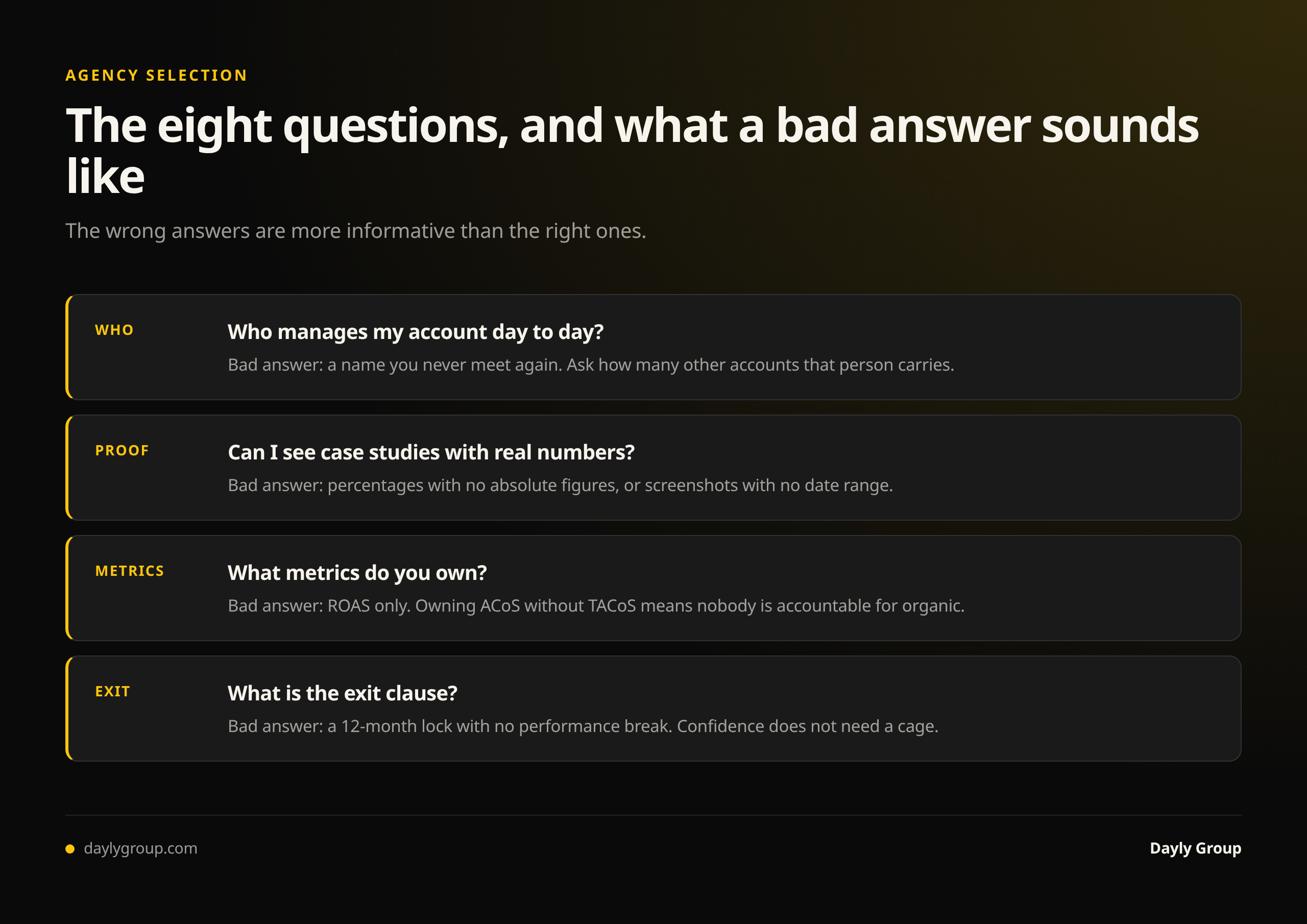
2. Who actually manages my account day-to-day?
The person on the sales call is almost never the person who runs your account. In most agencies, the talent on the pitch is senior, the talent on the account is a coordinator who joined three months ago.
Ask directly: "Who will be my day-to-day contact, and can I speak with them before I sign?" Ask what their experience level is, how many accounts they manage simultaneously, and what escalation looks like when something goes wrong.
If they can't introduce you to your actual account manager before contract signing, you don't know who you're hiring.
3. How do you report results — and what metrics do you own?
This question exposes more than anything else. A lot of agencies report on metrics that look good but don't connect to business outcomes. Impressions, clicks, and "revenue attributed" are easy to inflate. What actually matters: TACOS trend over time, organic rank movement on priority keywords, new-to-brand customer percentage, and net margin after ad spend.
Ask them: "What metrics do you own vs. what do you report on?" The distinction matters. Owning a metric means they'll take accountability if it moves the wrong direction. Reporting on it means they'll show it to you and shrug.
Also ask what their reporting cadence is and whether they use live dashboards or static decks. Static decks sent monthly are almost always designed to look good, not be useful.
4. What's your approach to PPC vs. organic growth?
Amazon PPC and organic ranking are not separate strategies — they're two levers on the same machine. Paid traffic to a listing that converts well signals relevance to the algorithm. Organic rank improvements reduce your dependence on paid ads over time. A competent agency treats them as interconnected.
Be skeptical of agencies that are purely PPC shops with no organic ranking capability, or purely SEO-focused with no paid media depth. Also be skeptical of anyone who talks about PPC without tying it to TACOS targets and a roadmap to reduce paid dependency over a defined timeframe.
The real question is: what does the 12-month roadmap look like for reducing ad costs while growing revenue? If they can't answer that, they're not thinking strategically.
5. Can I see case studies with real numbers?
Case studies are where the honesty test gets real. Any agency can say they "scaled a brand by 200%." The question is: from what baseline, over what time period, in what category, and what happened to margins?
Push for specifics. Ask to see a brand that started below your current revenue and grew past where you want to be. Ask what the TACOS looked like at the start vs. at peak growth vs. today. Ask what obstacles they hit and how they handled them.
If every case study is a clean upward chart with no context, it was curated to look that way. Real growth stories have messy periods. Agencies that have actually done the work aren't afraid to show the rough patches alongside the wins.
6. What's your minimum contract length and exit clause?
This one tells you how confident they are in what they're delivering. Agencies that require six- or twelve-month locked contracts with no performance-based exit clause are hedging against the possibility that results won't come fast enough to retain you voluntarily.
A confident agency should be willing to include performance benchmarks in the contract with a defined exit path if those benchmarks aren't hit. At minimum, ask for a 30-day written notice clause after an initial period, and get clear on what fees apply if you exit.
Read the contract with as much scrutiny as you'd apply to any vendor relationship. Vague language around "reasonable notice" or undefined deliverables is there to protect them, not you.
7. How do you handle underperformance?
This is the question most brands never ask — and the one that matters most when things inevitably hit a rough patch.
Ask: "If we're three months in and TACOS is trending the wrong direction, what's the process?" A good agency will walk you through an escalation framework — analysis of root cause, a specific remediation plan, defined timeline to correction, and a clear owner. A bad agency will get defensive or give you something vague about "optimizing the account."
The way an agency talks about failure before it happens tells you everything about how they'll behave when it does. Accountability is cultural. You can usually tell in the first conversation whether it's built into how they operate.
8. Do you run their own Amazon brand?
This is the sleeper question. Most agencies don't. And it shows — because managing someone else's brand with someone else's money is a fundamentally different experience than having real money on the line.
Agencies that have operated their own brands understand stockout risk, margin pressure, ranking volatility after a pricing change, the anxiety of a product going out of stock during peak season. They've made mistakes at their own expense and learned from it. That operational depth changes how they think about your account.
It doesn't disqualify an agency if they haven't run their own brand — but it should factor into how much you trust their instincts when things get complicated.
The right agency doesn't just manage your Amazon account management — they think like operators, not vendors. They're accountable to outcomes, not activity. They tell you what's not working before you have to ask.
Those agencies exist. But they're not going to find you. You have to ask the right questions to find them.
We've audited over 300 Amazon accounts. The pattern of what separates growing brands from stalled ones is consistent. If you want a second set of eyes on where your account stands, we're happy to take a look.
FAQ
Q: How do I choose an Amazon agency? A: Judge on four things: who actually manages your account day to day and how many other accounts they carry, whether they can show case studies with absolute numbers and date ranges rather than percentages alone, which metrics they contractually own (TACoS and contribution profit, not just ACoS and ROAS), and whether the exit clause has a performance break. Category experience matters less than most brands assume; operating discipline matters more.
Q: What questions should I ask an Amazon agency before signing? A: Ask who manages the account daily and their account load, what they'd do in the first 30 days, which metrics they report monthly, what they'd deliberately not do this quarter, what they got wrong on a recent account, what the exit clause is, and whether they run their own Amazon brand. The weak answers are more informative than the strong ones.
Q: How much should an Amazon agency cost? A: Market rates typically run as a monthly retainer, a percentage of revenue, a hybrid, or project fees for audits. What matters is whether the fee is small relative to the contribution profit it generates. See what Amazon agency management costs for how the models compare.
Q: What are red flags when hiring an Amazon agency? A: Guaranteed rank or revenue results, long lock-ins with no performance break, reporting that only contains good news, case studies with percentages but no absolute numbers, an unnamed day-to-day manager, and owning ACoS without owning TACoS. Any agency that has never described a failed test isn't testing.
Q: Should I hire an Amazon agency or build in-house? A: In-house makes sense when Amazon is a large, permanent share of revenue and you can hire genuine expertise plus tooling. An agency makes sense when you need multiple specialisms at once without four salaries. In-house vs. agency covers the fully-loaded cost comparison.
Keep reading
Book a free Gap Analysis. We'll tell you what's leaking, what's scaling, and where the next 30% lives.
Book a Gap Analysis →