
How Do I Know If My Amazon Agency Is Doing a Good Job?
Twelve questions that separate an agency creating value from one managing your account competently but not growing it — plus the reporting red flags worth acting on.
This is an awkward question to ask us, since we are an Amazon agency. So let's be direct about the bias and then be genuinely useful: some of what follows would fail a few of our own accounts in a given quarter, and the brands who ask these questions are better clients than the ones who don't.
The hard part is that Amazon accounts drift slowly. A bad agency relationship rarely announces itself — it looks like fine reports, responsive emails, and revenue that's flat for reasons that always sound plausible.
Start with the only test that matters
Is your Amazon contribution profit growing?
Not revenue. Not ROAS. Not ACoS. Contribution profit — revenue minus COGS, Amazon fees, ad spend and the agency fee.
Revenue growth funded entirely by ad spend isn't growth, it's purchased volume. An improving ACoS achieved by cutting the campaigns that were driving discovery isn't efficiency, it's contraction. Contribution profit is the number that can't be gamed by optimizing one metric at the expense of another, and it's the one many agency reports never show.
If your agency can't produce that number, that itself is the answer to your question — not because they're dishonest, but because you cannot manage what you don't measure.
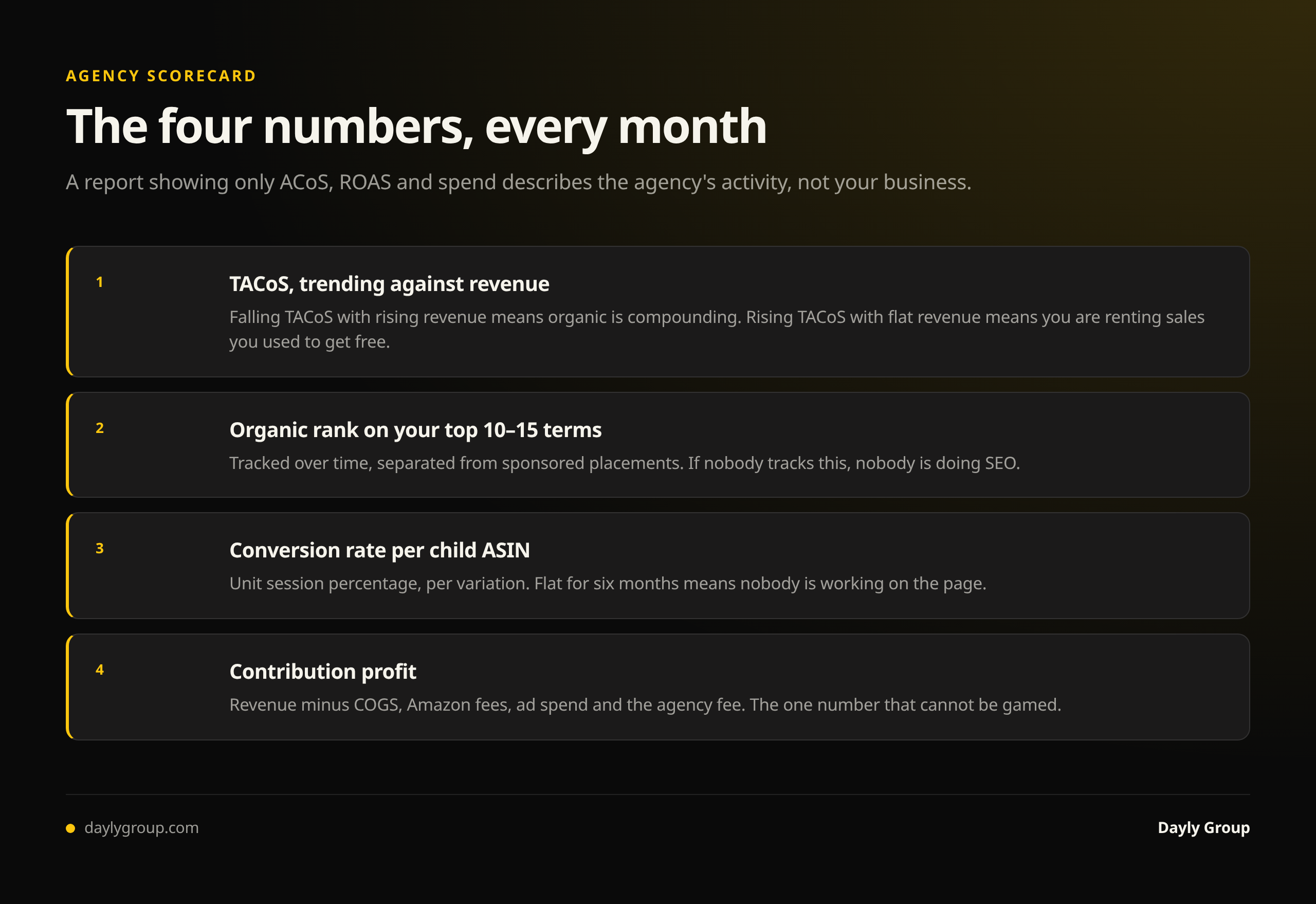
The four numbers you should see every month
1. TACoS, trending. Ad spend as a share of total revenue. Falling TACoS with rising revenue means organic rank is compounding and advertising is doing its job. Rising TACoS with flat revenue means you're renting sales you used to get free. ACoS alone hides both. Our ACoS vs TACoS explainer covers why.
2. Organic rank on your top 10–15 terms. Positions, tracked over time, separated from sponsored placements. If nobody is tracking this, nobody is doing SEO — and organic is the only traffic that gets cheaper over time.
3. Conversion rate per child ASIN. Unit session percentage, per variation. Improving conversion makes every other lever work better; flat conversion for six months means nobody is working on the page.
4. Contribution profit. As above.
The twelve questions
On strategy
- What are we deliberately not doing this quarter, and why? A real strategy has exclusions. An agency doing "everything" is prioritizing nothing.
- What's our biggest constraint right now? They should name one thing — reviews, price competitiveness, catalogue gaps, inventory — and it shouldn't always be "budget".
- What did you get wrong last quarter? Everyone is wrong about something. An agency that never reports a failed test isn't testing.
On execution
- Who is in my account daily, and how many other accounts do they carry? The single most predictive question. Sold by a strategist, served by a junior on fifteen accounts is the standard failure mode.
- What changed in the account in the last 30 days? They should answer specifically and quickly. Vagueness here means little happened.
- When did we last audit FBA fees and file reimbursements? Unglamorous, frequently ignored, and routinely worth more than a month of ad optimization.
- Are all our ASINs indexed for their target terms? If they don't know, some aren't. It takes minutes to check.
On accountability
- Show me a test that failed and what you learned. Real operators have these. A pure highlight reel is a sales deck, not a report.
- What would you do differently if this were your brand and your money? The gap between their answer and what they're actually doing is the interesting part.
- What should we stop paying you for? Almost nobody volunteers this. The ones who do are keepers.
On the relationship
- What do you need from us that you're not getting? Often the real blocker is on your side — creative approvals, inventory decisions, pricing authority — and a good agency will have been waiting to say so.
- If we parted ways tomorrow, what would I keep? Documentation, keyword research, creative assets, campaign structure. If the answer is "nothing", you've been renting rather than building.
Red flags in the reporting itself
Ad metrics only. A report that shows ACoS, ROAS and spend but not organic rank, conversion rate or contribution profit is a report about the agency's activity, not your business.
Revenue growth with no efficiency context. "Up 40%" means little without knowing what it cost.
Screenshots instead of trends. A single month's numbers with no time series prevents you from seeing direction, which is the only thing that matters.
No mention of anything going wrong. Every account has problems every month. A report with no problems in it is curated.
Metric switching. ACoS featured when it's improving, revenue when ACoS isn't, ROAS when neither is. Pick the scoreboard at the start and keep it.
Vanity keyword counts. "Now ranking for 4,000 keywords" is meaningless. Fifteen terms that convert matter; 4,000 long-tail impressions don't.
What is not evidence of a bad agency
Fairness matters here, because brands sometimes fire the wrong people:
- A bad month. Amazon is volatile. Judge on a rolling quarter.
- Rising ACoS while organic improves. Often a sign of health. Check TACoS.
- Being told no. An agency that pushes back on a bad idea is doing its job.
- Deliberate short-term declines. A price correction, fee restructure or ad pullback can cost revenue this month to fix economics permanently. It should be flagged in advance, though.
- Problems that are actually yours. Chronic stockouts, a 3.6-star product, or unit economics that can't absorb a realistic CPC are not agency failures. No agency fixes those, and the good ones say so early.
The 90-day test
If you're unsure and don't want to churn on a hunch, do this instead:
Month 1: Ask for the four numbers, with 12 months of history. Note how hard it is to get them. Month 2: Ask questions 1, 4 and 8. Judge the specificity, not the polish. Month 3: Commission an independent audit of the account from someone who isn't managing it and isn't pitching to. A few thousand dollars for an outside read on an account costing you six figures a year is cheap accountability.
That last one is the highest-value money in this whole category, and it's the reason we do standalone audits on accounts we don't manage.
If you want that independent read, see what we've done for other brands and book a Gap Analysis call. If you're weighing the alternative structures, in-house vs. agency and what agency management actually costs cover the trade-offs.
FAQ
Q: How do I know if my Amazon agency is doing a good job? A: The single test is whether Amazon contribution profit is growing — revenue minus COGS, Amazon fees, ad spend and the agency fee. Revenue growth funded by ad spend isn't growth, and an improving ACoS achieved by cutting discovery campaigns isn't efficiency. Ask for TACoS trending, organic rank on your top terms, conversion rate per child ASIN, and contribution profit. If they can't produce those, nobody is managing them.
Q: What should an Amazon agency report on every month? A: TACoS as a trend against revenue, organic rank for your top 10–15 keywords separated from sponsored placements, conversion rate per child ASIN, and contribution profit after all fees. Plus what specifically changed in the account that month and what didn't work. Reports that show only ACoS, ROAS and spend describe the agency's activity rather than your business.
Q: When should I fire my Amazon agency? A: When contribution profit has been flat or declining for two or more quarters with no strategy change, when they can't tell you what changed in your account in the last 30 days, when reporting only ever contains good news, or when you'd keep nothing if you left tomorrow. Don't fire over a single bad month or over a rising ACoS while organic rank is improving — both can be normal.
Q: Is rising ACoS a sign my Amazon agency is failing? A: Not necessarily, and often the opposite. As organic rank improves, organic absorbs the easier conversions and ads pick up colder traffic, so ACoS rises while the account gets healthier. Check TACoS instead — if it's falling as revenue grows, advertising is building compounding organic strength.
Q: Should I get an independent audit of my Amazon account? A: Yes, and it's the cheapest accountability available. An audit from someone who neither manages the account nor is pitching to replace the incumbent costs a few thousand dollars against an account you're likely spending six figures a year on. It either confirms your agency is doing well or tells you precisely where it isn't.
Keep reading
Book a free Gap Analysis. We'll tell you what's leaking, what's scaling, and where the next 30% lives.
Book a Gap Analysis →