
Why Did My Amazon Organic Ranking Drop? A Diagnostic Checklist
Nine causes of a sudden Amazon rank drop, in the order you should check them — starting with the two that take sixty seconds and account for most cases.
A rank drop feels like an algorithm problem. It almost never is.
In the accounts we've audited, sudden organic rank loss traces back to something specific and findable — usually a listing change nobody logged, a stock event, or a competitor doing something temporary. The instinct is to start rewriting the listing. That's the wrong first move, because if you change things before you diagnose, you lose the ability to tell what actually happened.
Work through these in order. The first two take a minute and catch a surprising share of cases.
1. Are you still indexed for the term? (60 seconds)
Search the exact keyword plus your ASIN in the Amazon search bar. If your product doesn't appear, you haven't dropped in rank — you've fallen out of the index entirely, which is a different and more urgent problem.
De-indexation usually follows a listing edit. Backend search terms overflowing the 250-byte limit, a prohibited character, a flat-file upload that silently blanked a field, or a variation change that reset attributes. Check your listing's edit history before anything else.
2. Did the listing change? (2 minutes)
Someone changed something. Very often that someone is Amazon.
Check for: a title Amazon rewrote or truncated, a suppressed image, bullets replaced by a contributed-content update, a category or browse-node change, or a variation family that got split or merged. Amazon also periodically overwrites seller-supplied copy with data from other sources, and it doesn't announce it.
If you have a listing backup or a screenshot from before the drop, compare them directly. If you don't, start keeping one — a monthly export of your active listings is the cheapest insurance in Amazon operations.
3. Did you go out of stock — even briefly?
Stockouts are the most commonly underestimated cause. A few hours at zero inventory can cost rank, and recovery lags the restock by days or weeks because rank rebuilds on accumulated sales velocity, not on availability.
Low inventory alone can suppress rank too — Amazon factors in whether you can fulfill the demand a top position would generate. Check your inventory history against the date of the drop before you look at anything else on-page.
4. Did your conversion rate fall?
Rank on Amazon is largely a function of sales velocity and conversion. If your conversion rate dropped, rank follows, and the cause is usually one of:
- Price — yours went up, or a competitor's came down
- Buy Box loss — check whether you actually hold it; you can rank and still not be the default seller
- Reviews — a cluster of negatives, or a rating that crossed below 4.0
- A badge you lost — Best Seller, Amazon's Choice, Prime eligibility
- Images — a suppressed or replaced main image kills click-through before conversion even starts
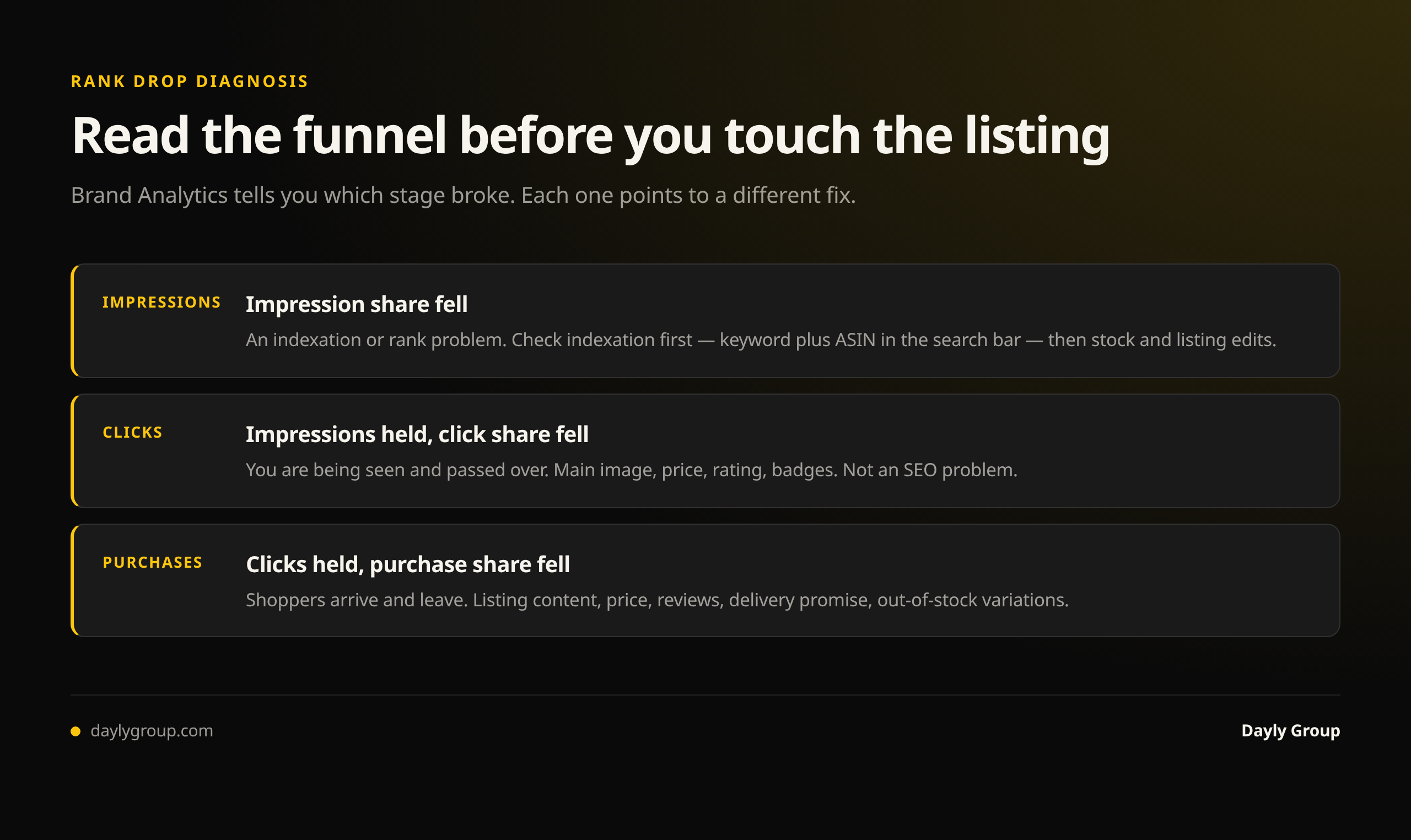
Brand Analytics Search Query Performance tells you which stage broke: impression share, click share, or purchase share. That distinction determines whether this is an SEO problem at all.
5. What did your competitors do?
Pull the ASINs now ranking above you and check their price, Buy Box and sales-rank history in Keepa. You're looking for a discount, a coupon, a lightning deal, or a review surge.
This step matters because it separates a durable competitive shift from a two-week promotion. Rebuilding your listing to counter a temporary price cut is one of the most common wasted efforts in Amazon SEO — the competitor reverts, and you've changed a page that was working.
6. Did your ad spend change?
Ads don't directly buy organic rank, but they buy sales velocity, and velocity feeds rank. If you cut a campaign that was driving conversions on your head term, organic rank often follows it down a few weeks later.
This lag is why the cause gets missed: the budget change and the rank drop don't look connected because they're a month apart. Check what changed in advertising four to six weeks before the drop, not the week of it.
7. Is it seasonality or a demand shift?
Before assuming you lost rank, check whether the whole category moved. If total search volume for the term fell, your impressions drop while your position holds — which looks identical to a rank problem in most dashboards.
Brand Analytics shows category-level query volume, and Google Trends is a decent proxy for direction. Some drops are simply the season ending.
8. Did you get hit by a policy or compliance issue?
Check Account Health. A policy warning, a restricted-claim flag, an IP complaint, or a pending compliance document can suppress a listing's visibility without removing it. These often produce a sharp drop with no on-page explanation, and they don't resolve until you address the underlying case.
9. Only now: consider that Amazon changed something
Amazon does adjust ranking behavior, and Rufus and AI-assisted search have shifted how some queries resolve — see our Rufus optimization guide. But this should be your last hypothesis, not your first, because it's the only one you can't act on directly.
If a genuine algorithm shift occurred, it hit your competitors too. Check whether the whole top-10 reshuffled or just you. If it's just you, it's not Amazon.
The one rule that makes diagnosis possible
Change one thing at a time, and log it. Most brands can't diagnose a rank drop because they made six changes in the same fortnight and have no record of when. A dated change log — listing edits, price changes, campaign changes, stock events — turns an unanswerable question into a five-minute lookup.
If you're rebuilding rank from here, the organic rank guide covers the mechanics, and the listing optimization guide covers execution order. If you'd rather have someone diagnose it with you, see what we've done for other brands and book a Gap Analysis call.
FAQ
Q: Why did my Amazon organic ranking suddenly drop? A: In order of likelihood: you fell out of the index after a listing edit, someone (often Amazon) changed the listing, you went out of stock or low on inventory, your conversion rate fell because of price, Buy Box loss or reviews, or a competitor ran a promotion. Check indexation first — search your exact keyword plus your ASIN — because it takes a minute and it's a different problem from a rank drop.
Q: How long does it take to recover Amazon rank after a stockout? A: Typically two to six weeks after restocking, because rank rebuilds on accumulated sales velocity rather than on availability. Longer stockouts and more competitive terms take longer. Restocking and then waiting a week before concluding it hasn't worked is the common mistake.
Q: Can changing my Amazon listing hurt my ranking? A: Yes, in two ways. A change can drop you out of the index if it removes or breaks a keyword, overflows the 250-byte backend limit, or introduces a prohibited character. And a change that lowers conversion rate will lower rank downstream even if indexation is intact. Change one element at a time and log the date so you can attribute the effect.
Q: Does pausing Amazon ads hurt organic ranking? A: Indirectly, yes. Ads don't buy rank, but they buy sales velocity, and velocity is a ranking input. Cutting a campaign that was converting on your head term often shows up as an organic rank decline four to six weeks later — which is why the two rarely get connected.
Q: How do I tell whether a rank drop is my fault or an Amazon algorithm change? A: Look at whether the whole top ten reshuffled or only your position moved. A genuine algorithm shift affects your competitors too. If everyone else held their position and you didn't, the cause is on your side — check indexation, listing edits, stock and conversion before blaming the algorithm.
Keep reading
Book a free Gap Analysis. We'll tell you what's leaking, what's scaling, and where the next 30% lives.
Book a Gap Analysis →