
Amazon Rufus and AI Search: How to Optimize Listings for Answer Engines
Rufus answers shoppers in sentences, not search results. Here's how Amazon's AI assistant picks what to recommend, and what to change in your listings so it recommends you.
For twenty years, winning on Amazon meant winning a list. A shopper typed a keyword, Amazon returned ranked results, and your job was to be near the top of that list with a listing good enough to click.
Rufus changes the shape of that job. Amazon's AI shopping assistant doesn't hand back a list — it answers a question. "Which running shoe is best for flat feet?" doesn't return forty results. It returns a recommendation, with reasoning, and maybe two or three products. Being ranked eleventh in a list nobody sees anymore is not a position.
This is the same shift happening in Google with AI Overviews and in ChatGPT-based shopping. The mechanics differ, the strategic consequence is identical: the unit of competition moves from keyword rank to being the answer.
Here's what that actually means for a brand selling on Amazon, and what to change.
What Rufus is actually doing
Rufus is a large language model with access to Amazon's catalogue, listing content, customer reviews, Q&A, and community data. When a shopper asks a question, it interprets intent, then assembles an answer from what it can read about the products it considers relevant.
Two consequences follow directly from that, and they're the whole strategy:
1. It reads your listing as language, not as a keyword field. Keyword stuffing was always ugly; now it's actively counterproductive. A model trying to determine whether your product suits a specific use case cannot extract that from a comma-separated pile of search terms. It can extract it from a clear sentence that says who the product is for and what problem it solves.
2. It reads your reviews and Q&A as evidence. This is the part most brands underweight. Rufus can synthesize what actual customers said. If forty reviews mention that your shoe runs narrow, that fact is now available to an AI answering a question about width — whether you put it in your bullets or not.
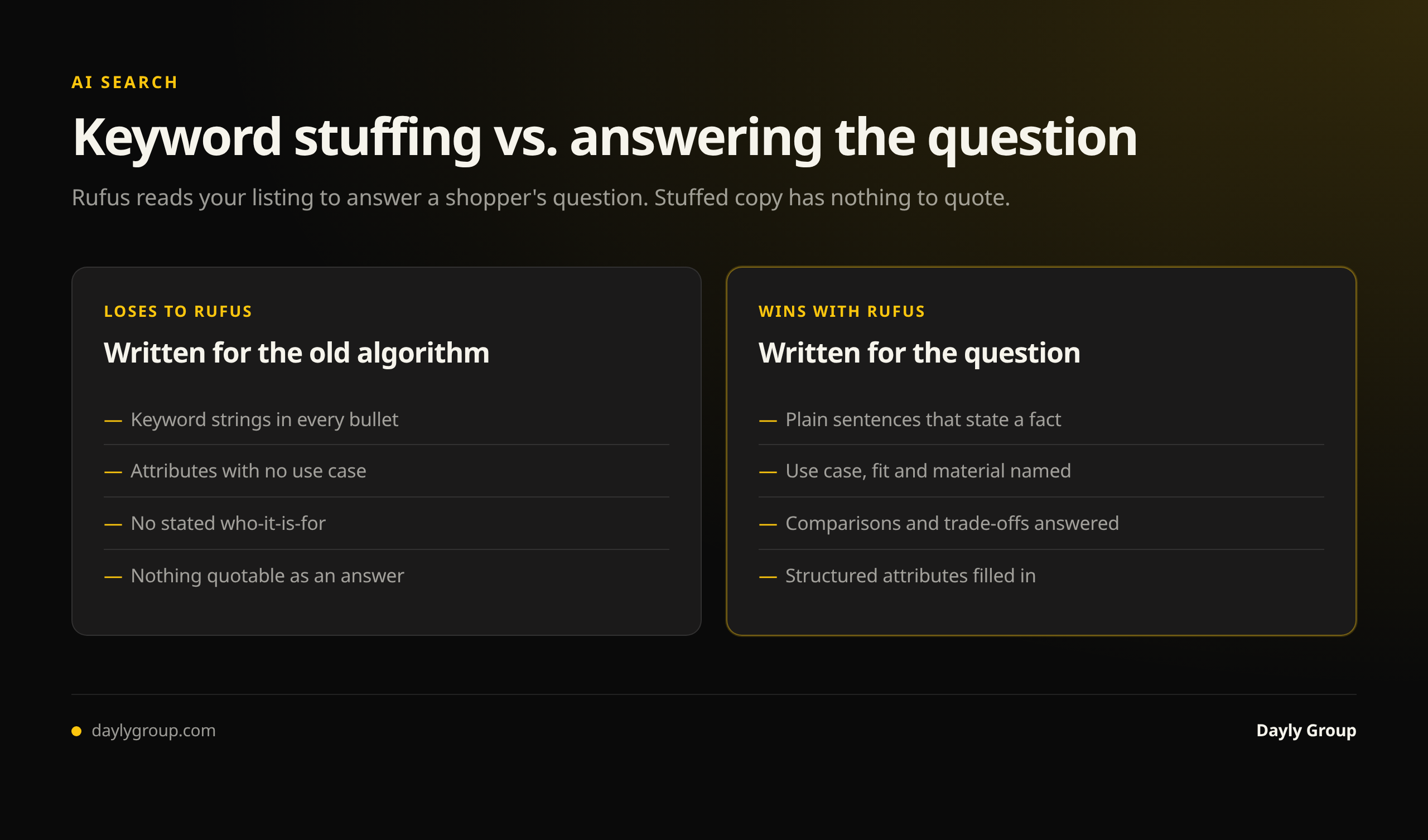
Why keyword-stuffed listings lose here
A traditional Amazon listing is optimized for a matching algorithm: get the term in the title, repeat it in the bullets, bury the rest in backend search terms. It reads badly to humans and it worked anyway, because relevance was substantially a matching problem.
An answer engine is doing something different. It's trying to determine fit — does this product solve the specific problem in the question? Fit is expressed in attributes, use cases, constraints and comparisons. A listing that says "premium quality durable running shoes for men women unisex athletic sneakers" contains keywords and almost no information. A listing that says "built for high-arch runners logging 20+ miles a week; the wider toe box suits runners who size up in most brands" contains information a model can reason with.
The uncomfortable implication: the listings that read best to humans now also perform best with AI. The tension between "written for the algorithm" and "written for the shopper" is closing.
The six changes that matter
1. Answer real questions in your listing copy
Go into your reviews, your Q&A section, and your customer service inbox, and collect the questions people actually ask before buying. Fit. Compatibility. Durability. What's included. Whether it works for a specific use case.
Then answer them explicitly in the bullets and A+ content. Not as marketing claims — as answers. "Fits standard 2-inch trailer hitches; does not fit 1.25-inch receivers" is worth more than a paragraph about premium engineering, both to a shopper and to a model deciding whether to recommend you for a specific query.
2. Write in complete, factual sentences
Bullets that read as sentences give a model something to work with. Include the qualifiers a human would want: sizes, materials, dimensions, compatibility, what it isn't for. Specificity is the currency. "Machine washable at 30°C" beats "easy care".
3. Cover use cases, not just features
A feature is "500ml insulated stainless steel". A use case is "keeps coffee hot through a 6-hour shift". Shoppers ask Rufus in use-case language, because that's how people talk. If your listing only lists features, the model has to infer the use case; if you state it, you've done that work for it.
4. Treat your reviews as part of your listing
Reviews are now indexed content that an AI will summarize on your behalf. Two practical moves: use Brand Tailored Promotions and post-purchase follow-up to build genuine review volume, and read your negative reviews as a content brief. If a recurring complaint is a misunderstanding about what the product does, that's a listing failure — fix the listing and the objection disappears from both the reviews and the AI's summary.
5. Answer your own Q&A section
An unanswered Q&A section is a gap where a competitor's clarity becomes your ambiguity. Answer every question in your Q&A directly and factually. This is one of the cheapest high-leverage tasks available on Amazon right now, and almost nobody does it.
6. Build the brand signals that break ties
When a model is choosing between two products that both fit, it falls back on the same signals a human would: review volume and rating, brand consistency, the completeness of the Brand Store, whether the content coheres. A brand that looks like a brand wins ties.
What doesn't change
None of this replaces the fundamentals. Rufus still surfaces products Amazon believes will convert, and conversion rate, review volume, price competitiveness and in-stock reliability still govern that. A beautifully written listing on a product with 12 reviews and a 3.4 rating won't be recommended over an established competitor because the copy is elegant.
Think of AI optimization as a multiplier on a healthy account, not a substitute for one. Get the listing fundamentals and organic rank right first — then make the content legible to a model.
How to tell if it's working
This is genuinely hard right now, and any agency claiming precise Rufus attribution is overselling. There's no Rufus impression report. What you can watch:
- Conversion rate on listings you rewrite. Clearer, more specific copy raises human conversion too. If CVR moves, the rewrite was worth it regardless of AI.
- Organic sessions versus ad-driven sessions in Brand Analytics over the following quarters — a shift toward organic discovery is the signal to watch.
- Query volume in Search Query Performance for longer, more natural-language terms. Conversational search is growing; your report will show it before anyone publishes a study about it.
Directionally, the bet is low-risk: every change above independently improves conversion for human shoppers. That's why we recommend making them now rather than waiting for reliable AI attribution.
FAQ
Q: Does Rufus replace Amazon SEO? A: No. Rufus sits on top of the same catalogue and the same signals. Keyword relevance, conversion rate and sales velocity still determine which products are eligible to be considered. Rufus changes how a shopper arrives at a decision, not what makes a product worth recommending.
Q: Should I stop using backend search terms? A: No, keep them accurate and complete — traditional keyword matching still drives a large share of traffic. Just stop treating the visible listing as a place to warehouse keywords. Backend fields are for matching; the visible copy is now for reasoning.
Q: Can I optimize for ChatGPT and Google AI Overviews the same way? A: The principles transfer — clear factual language, explicit use cases, structured answers to real questions. The difference is that off-Amazon answer engines read your website and third-party content, not your Amazon listing. That's where a properly built brand site and genuine review coverage matter.
Q: How much of this can I do myself? A: The Q&A answering and the review-mining are pure effort, no expertise required, and they're the highest-return items on the list. Rewriting listing copy to be simultaneously conversion-optimized and keyword-complete is where most brands need help, because it's easy to gain readability and lose indexation at the same time.
If you want a specific read on how your listings would perform against conversational search, our Amazon SEO service covers exactly this, or book a Gap Analysis and we'll walk your catalogue.
Keep reading
Book a free Gap Analysis. We'll tell you what's leaking, what's scaling, and where the next 30% lives.
Book a Gap Analysis →