How Long Does Amazon SEO Take to Work? A Realistic Timeline
What actually happens in weeks 1, 4, 12 and 24 of Amazon SEO work — which changes show up in days, which take a quarter, and what makes the difference.
The honest answer is that "Amazon SEO" bundles together changes that pay off in 48 hours and changes that pay off in six months, which is why the question gets such unsatisfying answers.
So here's the breakdown by mechanism, because the timeline depends entirely on which lever you pull.
The two clocks
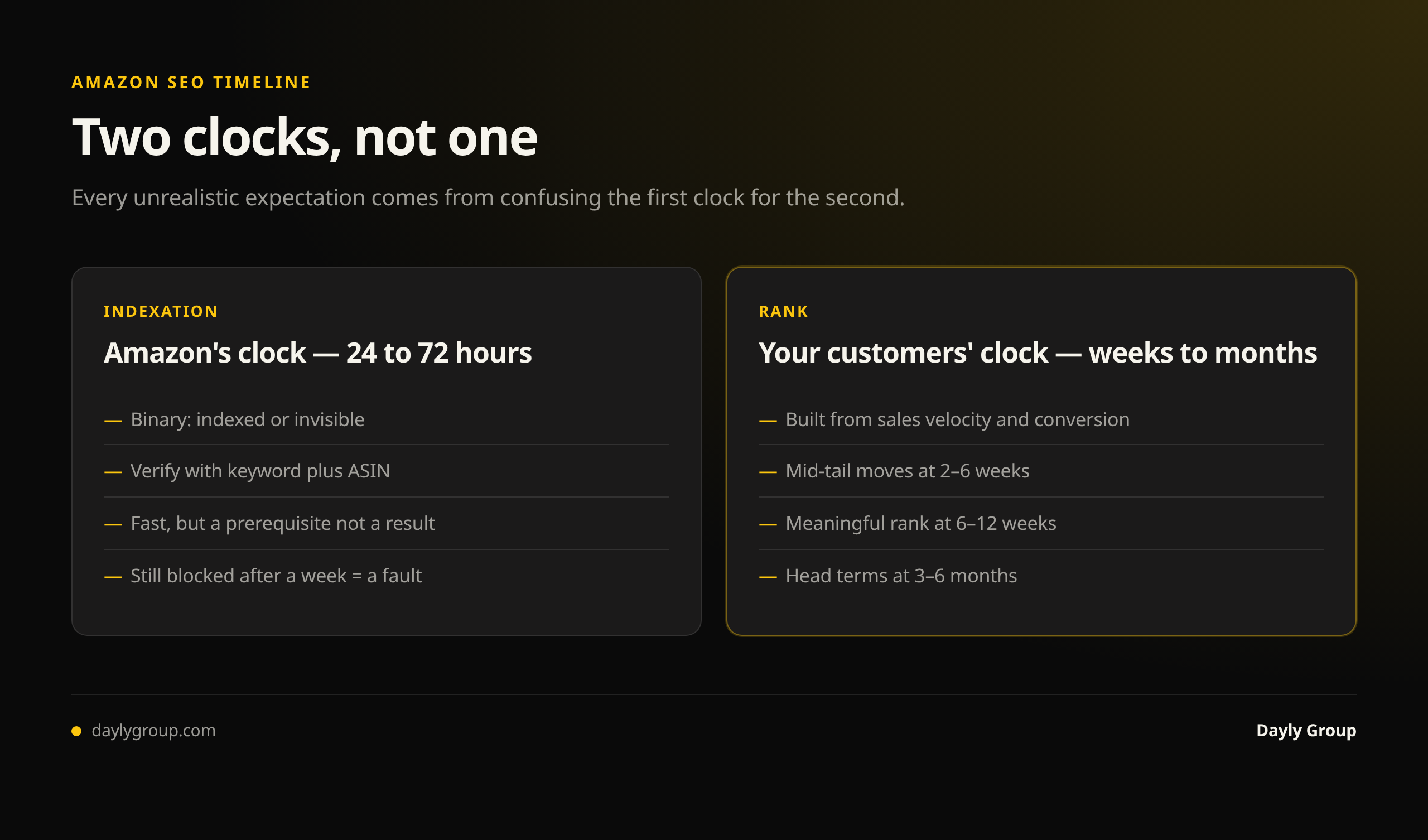
Indexation runs on Amazon's clock: 24–72 hours. Adding a keyword to a title or backend field either gets indexed within a few days or is blocked by something. Fast, binary, verifiable.
Rank runs on your customers' clock: weeks to months. Rank is built from accumulated sales velocity, click-through and conversion on a query. Amazon needs data before it will move you, and that data arrives at the speed of your actual sales.
Every unrealistic Amazon SEO expectation comes from confusing the first clock for the second.
The realistic timeline
Days 1–3: indexation
New keywords in the title, bullets or backend get indexed. Verify with the keyword-plus-ASIN search. This is the only part that's genuinely fast, and it's a prerequisite rather than a result — see how to get indexed for a keyword.
Week 1–2: conversion effects
Changes to the main image, price, bullets or A+ content affect buyer behavior immediately, so conversion rate moves within days. This is the fastest real win available, and it's why we do conversion work before chasing rank: it improves the input that rank depends on.
If you changed the main image and conversion hasn't moved in two weeks, the change didn't work. Revert and test something else.
Week 2–6: first rank movement
Amazon starts re-ranking on the new signals. Expect movement on mid- and long-tail terms first — they need less velocity to shift. Head terms barely budge yet.
Volatility here is normal and misleading. Daily rank data is sampled and noisy; judge on a 7–14 day trend, not on spikes.
Week 6–12: meaningful rank on realistic terms
This is where properly executed work shows up. Long-tail and mid-tail terms consolidate into stable positions, organic sessions grow, and TACoS starts to fall because organic is absorbing conversions ads were previously buying.
If nothing at all has moved by week 12, something is wrong — not slow. Usually indexation was never confirmed, conversion is too weak to build velocity, or the target terms were never realistic for the product.
Month 3–6: head terms and compounding
Competitive head terms move here, if they move at all. The mechanism is circular in your favor: better rank brings more sales, more sales reinforce rank. That's the compounding phase, and it's the entire reason organic is worth the wait — organic traffic gets cheaper over time while ads get more expensive.
Month 6+: durability
Rank built on genuine conversion and velocity is hard for competitors to displace, because they have to out-sell you on that query, not out-optimize you. Rank bought with unsustainable ad spend or promotions decays as soon as you stop.
What makes it faster
- Existing sales velocity. A product already selling 30 units a day builds rank far faster than one selling 3. Rank is downstream of sales, so momentum is the biggest single accelerant.
- Conversion rate. A listing at 15% builds rank on the same traffic that a 6% listing wastes. Fix conversion first — always.
- Exact-match advertising on target terms. The most reliable way to accelerate. Ad sales attributed to a specific query teach Amazon you're relevant to it. Not a shortcut around the work, but a way to compress the timeline.
- Realistic term selection. Ten achievable mid-tail terms beat one head term you'll lose for a year.
- Reviews and rating. Above 4 stars, most of the conversion battle is already won.
- In-stock consistency. Every stockout resets progress.
What makes it slower
- Low review counts on a new product against entrenched competitors.
- Head-term-only ambitions. Chasing the single biggest keyword and nothing else.
- Price uncompetitiveness. Rank follows conversion, and conversion follows price relative to the row.
- Stockouts. The most common cause of a timeline resetting.
- Changing everything at once. You lose attribution, so you can't tell what worked and end up repeating the failures.
- Category volatility. Seasonal or promotion-heavy categories move rank around for reasons unrelated to your work.
What to expect from an agency, and when
Because "it takes time" is also what an agency says when nothing is happening, here's what should be visible at each checkpoint:
- Week 2: indexation confirmed on target terms, baseline rank and conversion recorded, and a specific list of what was changed.
- Week 6: movement on mid-tail terms, conversion rate change on any listing whose page was rebuilt.
- Week 12: organic session growth, TACoS trending down, stable positions on several target terms.
- Month 6: head-term progress, and organic revenue growing as a share of total.
If week 2 can't be produced, the work didn't start. If week 12 shows nothing, the strategy is wrong rather than slow — and that's a conversation to have at week 12, not month 9.
The organic rank guide covers the mechanics behind these stages, and how to know if your agency is doing a good job covers what should be on the report.
The comparison worth making
Amazon SEO is slower than turning on ads and faster than Google SEO. Ads produce traffic today and stop the day you stop paying. Google SEO on a competitive commercial term can take a year. Amazon sits in between — roughly a quarter to see real progress, with results that persist because they're built on sales history rather than backlinks.
That's the trade: pay now for traffic, or invest a quarter for traffic that gets cheaper.
If you want an assessment of what's realistic on your specific catalogue, see what we've done for other brands and book a Gap Analysis call.
FAQ
Q: How long does Amazon SEO take to work? A: Indexation happens in 24–72 hours. Conversion-rate changes show within one to two weeks. First rank movement on mid- and long-tail terms comes at two to six weeks, meaningful rank at six to twelve weeks, and competitive head terms at three to six months. If nothing has moved by week 12, the problem is the strategy rather than the timeline.
Q: Why is my Amazon SEO not working after a month? A: A month is early for rank but late for the checks. Confirm you're actually indexed for the target terms, that conversion rate has moved on any listing you rebuilt, and that you haven't been out of stock. If all three are fine, one month is simply too soon for rank on anything competitive. If indexation was never confirmed, no amount of waiting will help.
Q: Can I speed up Amazon SEO? A: Yes, legitimately, in three ways: fix conversion rate first so the same traffic builds more velocity, run exact-match ads on target keywords so attributed sales teach Amazon you're relevant to those queries, and choose achievable mid-tail terms instead of only head terms. Existing sales momentum is the single biggest accelerant, which is why established products rank faster than launches.
Q: Is Amazon SEO faster than Google SEO? A: Generally yes. Amazon rank is driven by sales velocity and conversion on specific queries, which accumulate faster than the authority signals Google relies on. A competitive Google commercial term can take a year; a comparable Amazon term typically takes three to six months.
Q: How long does it take to recover Amazon rank after a stockout? A: Usually two to six weeks after restocking, because rank rebuilds on accumulated sales velocity rather than on availability. More competitive terms and longer stockouts extend it. This is why in-stock consistency matters more to Amazon SEO than most brands expect.
Keep reading
Book a free Gap Analysis. We'll tell you what's leaking, what's scaling, and where the next 30% lives.
Book a Gap Analysis →