
Amazon Ranking Services: What They Cost and What You Actually Get
Three very different things get sold as an 'Amazon ranking service' — software, managed programs, and schemes that get accounts suspended. What each costs, what actually moves rank, and the questions that expose a bad vendor in five minutes.
Search for an "Amazon ranking service" and you'll get three completely different products wearing the same name: software that tracks your rank, agencies that manage the work that moves it, and vendors selling manipulation that will eventually cost you the account.
They range from $30 a month to five figures, and the price tells you almost nothing about which one you're looking at. So before comparing costs, it's worth being precise about what rank actually responds to — because every legitimate service on the market is just working some subset of the same levers.
What actually moves Amazon organic rank
Amazon's ranking algorithm is mercenary in a way Google's isn't: it ranks whatever it expects to sell. That expectation is built from a short chain of signals, and everything a real ranking program does maps onto one of them.
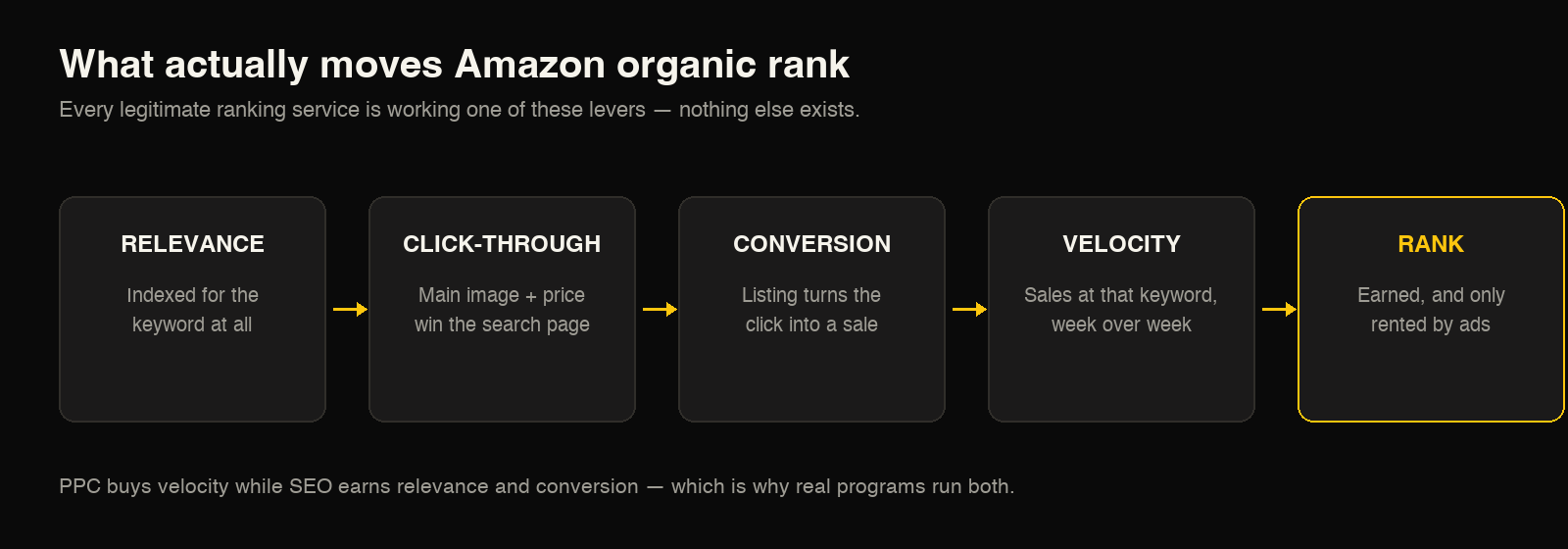
Relevance comes first because it's binary: if your listing isn't indexed for a keyword, no amount of anything else ranks you for it. Indexation problems are more common than most sellers think, and they're diagnosable — our guide to getting indexed for a keyword on Amazon walks through the checks.
Click-through is decided in the search results, before anyone sees your listing. Main image and price do almost all of the work. A ranking service that never mentions your main image is managing half the problem.
Conversion is the multiplier. Amazon watches what happens after the click; a listing that converts at 25% will out-rank a listing converting at 8% on materially less traffic. This is why listing work and ranking work are the same discipline wearing different names.
Velocity — sales attributed to the keyword, sustained week over week — is the signal the other three exist to produce. It's also the one PPC can buy directly, which is why serious ranking programs run advertising and SEO as one system: ads buy velocity at the target keyword while the organic work makes each sale count for more.
If a vendor's pitch doesn't reduce to one or more of these levers, what they're selling isn't ranking. It's either reporting, or risk.
The three things sold as "ranking services"
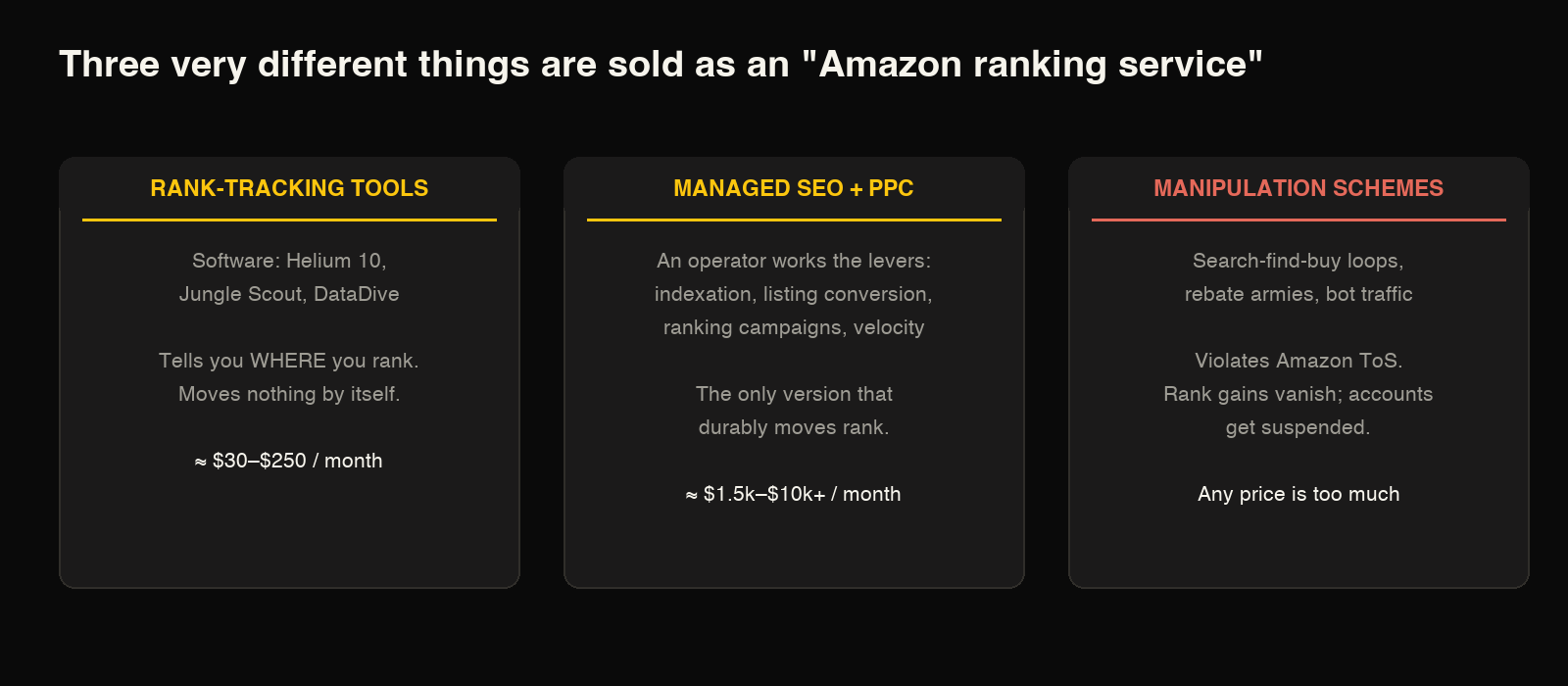
1. Rank-tracking software — roughly $30–$250/month
Helium 10, Jungle Scout, DataDive and their peers will tell you where you rank for any keyword, daily. That's genuinely useful — you can't manage what you don't measure — but tracking is not moving. A tool subscription is a thermometer, not a treatment. We've reviewed the category in our breakdown of Amazon keyword research tools; the short version is that the tools are worth having and are the beginning of the work, not the work.
2. Managed SEO + PPC programs — roughly $1,500–$10,000+/month
This is the category the search term usually intends: an operator or agency that audits indexation, rebuilds listing content for conversion, runs ranking campaigns against target keywords, and defends the position once it's won. Pricing across the industry varies with catalog size, competitiveness, and whether advertising management is bundled — single-product engagements sit at the low end, full-catalog programs with meaningful ad budgets at the high end.
What you're actually paying for is sequencing. Rank is earned with velocity over weeks, which means the conversion work has to precede the traffic push or the traffic converts poorly and teaches the algorithm the wrong lesson. Amateurs run these steps in parallel or in reverse; that difference doesn't show up on a proposal, but it's most of what separates programs that work from programs that report.
3. Manipulation schemes — any price is too much
Search-find-buy loops, rebate armies, coordinated wishlist adds, bot traffic. These do move rank, briefly — which is why they keep getting sold. They also violate Amazon's terms of service in ways Amazon has become very good at detecting. The pattern is consistent: rank gains that evaporate the moment the scheme stops paying for fake velocity, followed, for an unlucky and growing percentage of buyers, by listing suppression or outright account suspension — a risk no legitimate operator will take with someone else's business. If a vendor guarantees a specific position or asks you to fund shopper rebates, that's not a ranking service. That's a liability with an invoice.
What a legitimate engagement should include
Whatever the price point, a real ranking program has a recognizable shape. Expect, at minimum:
- An indexation and keyword audit before any promises — which terms you're indexed for, which you're not, and which are worth ranking for based on demand and difficulty, not vanity
- Listing conversion work scheduled first — main image, price positioning, A+ content, reviews strategy — because traffic pushed at an unconverting listing is wasted twice
- Ranking campaigns with named target keywords — PPC structured to buy velocity at the terms you're trying to win, not a generic "we'll manage your ads"
- Position tracking against a fixed keyword set — the same terms, every week, so progress is falsifiable
- A defense plan — what happens after you reach page one, because the velocity requirement doesn't end there
We run this sequence inside our own accounts before we ever ran it for clients — the results in our case studies are screenshots of it working, including organic units tripling in four months for a journal brand while ad efficiency improved.
When rank drops instead of climbs
Worth saying: if you're researching ranking services because your existing rank fell off a cliff, diagnose before you buy. Sudden drops usually trace to indexation loss, a suppressed listing, a stockout that broke velocity, or a competitor change — none of which a new vendor fixes faster than you can. Our diagnostic checklist for organic ranking drops covers the sequence.
Questions that expose a bad vendor in five minutes
Q: Can you guarantee a #1 ranking? A: The only honest answer is no. Rank is an auction judged continuously by an algorithm neither of you controls. A guarantee means the vendor is either lying about the outcome or planning to manipulate it — and manipulation is the version that ends in suspension.
Q: Which of my keywords will you target, and why those? A: A real operator answers with data — search volume, current position, conversion likelihood, and what the terms are worth to your P&L. A bad one answers with your brand name and your two biggest head terms, which is the keyword strategy equivalent of small talk.
Q: What happens to my rank if we stop? A: The honest answer is nuanced: positions earned through genuine velocity and conversion decay slowly and defensibly; positions rented through ad spend alone decay fast. If the vendor claims nothing changes when you stop, they're not describing rank, because velocity is a moving requirement.
Q: Do you touch my listing content, or only run traffic? A: Traffic-only "ranking" is half a program. Conversion rate is a ranking input; a service with no opinion on your main image is optimizing with one hand.
Q: How will I see progress? A: Weekly positions on a fixed keyword set, organic-attributed sales, and TACoS trending the right direction — spend against total revenue, not just ad revenue. If reporting is screenshots of ACoS, read our ACoS vs TACoS explainer before signing anything.
The bottom line
An "Amazon ranking service" costs anywhere from $30 a month for a tool that tells you where you stand, to several thousand a month for a program that changes where you stand, to your entire account for a scheme that fakes it. The levers underneath are the same in every case — relevance, click-through, conversion, velocity — and the only real differences between vendors are which levers they actually work and in what order.
If you want a second opinion on where your rank problem actually lives before you commit to anyone — including us — a free Gap Analysis looks at the account the way this post does: levers first, promises after.
Keep reading
Book a free Gap Analysis. We'll tell you what's leaking, what's scaling, and where the next 30% lives.
Book a Gap Analysis →