
How to Find TikTok Shop Creators That Actually Generate Revenue
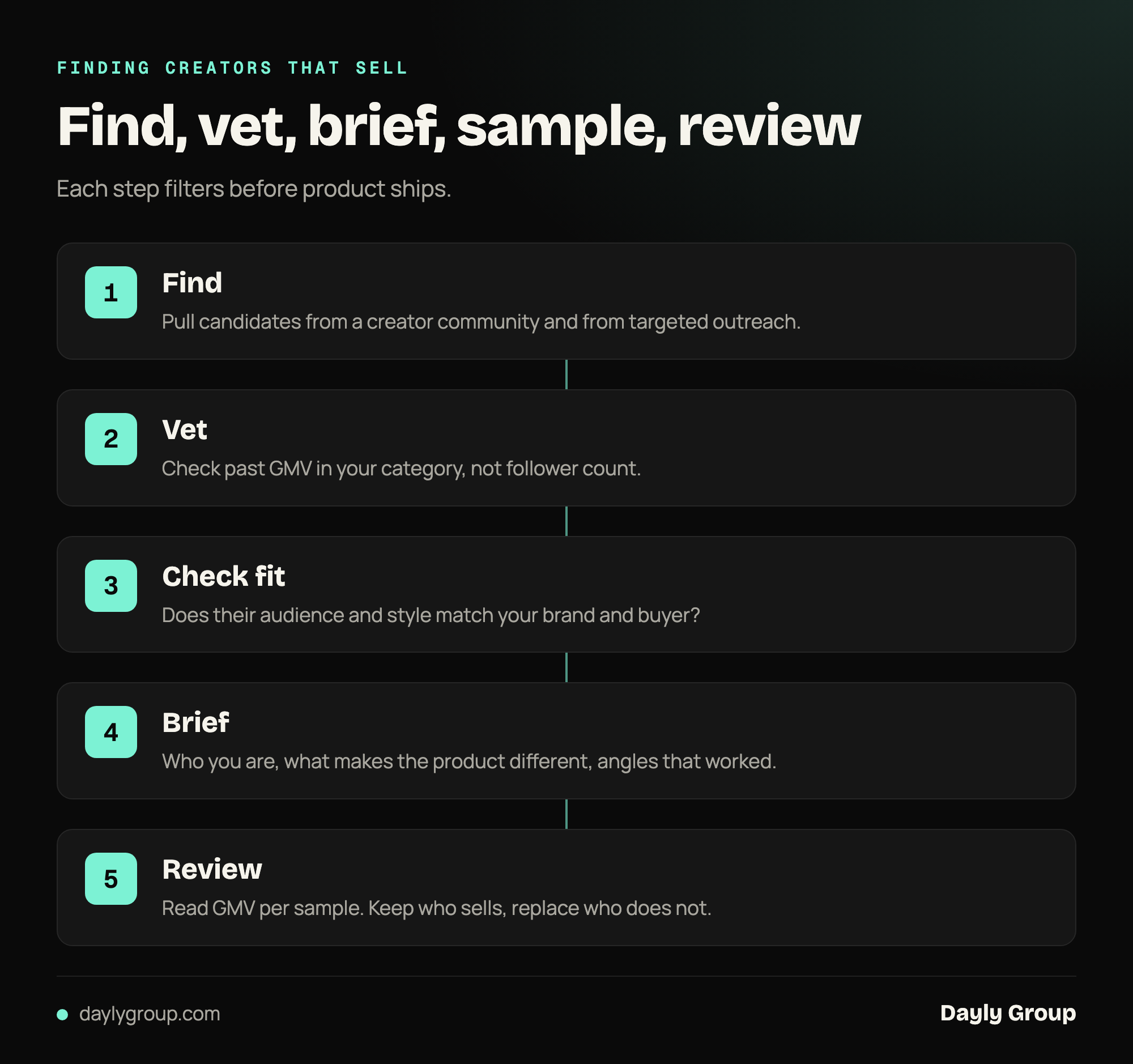
Find creators that sell by sourcing from a creator community and targeted outreach, then vetting on past GMV in your category and fit with your brand. Give them a real brief.
You find TikTok Shop creators that generate revenue by sourcing from two places, a creator community and targeted outreach, then vetting each one on past GMV in your category and on fit with your brand. After that, you give them a real brief. Follower count is not the filter. Sales history is.
This is the written version of our short video answer. Watch it above, then read the full answer below.
GMV, gross merchandise value, is the total order value that goes through your shop. This post covers one narrow job: finding and vetting the people you send product to. The general mechanics of the program are in our guide to the TikTok Shop affiliate program for brands.
Where do you actually find TikTok Shop creators?
You find them in two places: creator communities and outreach tools. A creator community is a group of creators who work with brands on TikTok Shop and already have sales history. Outreach tools let you search the wider creator pool and contact people directly.
Neither source is magic. They do different jobs.
A creator community is where the quality tends to sit. Creators in a good community have already sold product for other brands, so you start from people with a track record instead of a cold list. In our experience that is the fastest route to a short list of creators worth sending product to.
Outreach tools such as Euka and Reacher give you reach. You can search by category, filter by past results and contact creators who sit outside any network. That matters when your product is specific and a community may not have the right person in it.
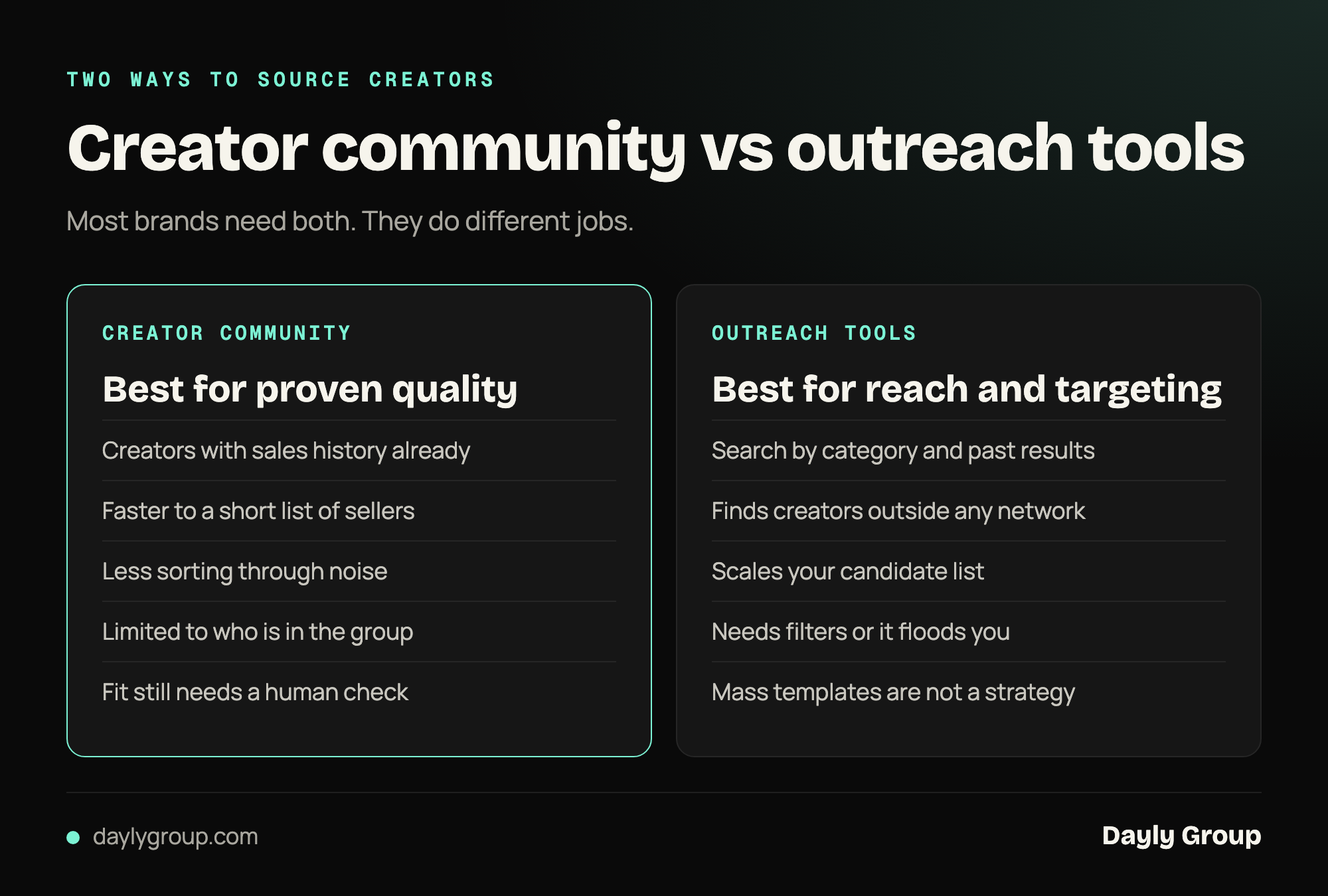
Our view is that you want both running at once. The community gives you a reliable base of sellers. Outreach fills the gaps for your category and finds the creator nobody has pointed you to yet.
One rule applies to both. Software is a fine tool, but mass templates sent to every eligible creator are not a strategy. We nurture the relationships that matter by hand, and we use tools to build the candidate list, not to replace the conversation. The same point comes up in how we judge agencies in how to choose a TikTok Shop agency.
How do you vet a creator before you send product?
You vet a creator by checking what they have sold before, in your category, and whether their content fits your brand. Past GMV is the strongest signal you can get before a sample ships. Everything else is a guess.
Run every candidate through the same short list.
- Past GMV. Has this creator generated real sales on TikTok Shop? Look for a track record, not one lucky post.
- Category relevance. Sales in a different category do not transfer. A creator who sells kitchen gadgets well may do nothing for a skincare-adjacent or apparel product.
- Brand fit. Would their audience buy from you? Would you be comfortable with how they present products?
- Consistency. Do they post regularly, or did they sell once and disappear?
- Content style. Can they make the kind of video your product needs, whether that is a demo, a before and after, or a try-on?
In the video, Noah points to creators who have already generated GMV at a meaningful level as the group to look at first. That is the tier that has proven it can move product on this platform. The exact thresholds you use should come from your own category and your own margin, because a creator who is great for a $15 product may not suit a $150 one.
Past GMV tells you what a creator can do. Relevance tells you whether they can do it for you. You need both before you spend a sample.
Why does fit with your brand matter as much as sales history?
Fit matters because a creator with a big sales record in the wrong category will not sell your product. Their audience came for something else. A smaller creator whose audience matches your buyer can outsell a bigger one whose audience does not.
Fit has three parts.
- Audience. Who watches this creator, and do they look like your customer? If your product is for new parents, a creator whose audience is mostly single people in their early twenties is a weak match, whatever their numbers.
- Product category. Have they sold something near yours? Adjacent sales are a useful proxy. Unrelated sales are not.
- Brand standards. Do they present products the way you want yours presented? You are lending them your name. Read their recent videos before you send anything.
If your product is in health or wellness, claims in creator content must follow TikTok's category rules. Vet for that too. A creator who makes claims you cannot support is a liability, however well they sell.
This is also where brands lose money without noticing. They send product to anyone who says yes, because a yes feels like progress. It is not. A sample sent to the wrong creator is cost with no path to a sale. We cover what that looks like in practice in TikTok Shop samples but no sales.
What goes in a creator brief?
A creator brief tells the creator who you are, what makes your product different and which angles have worked for you before. Three parts, kept short. A creator who gets a clear brief makes better content faster. A creator who gets nothing guesses.
Here is what each part should hold.
Who you are
Two or three sentences on the brand. What you make, who it is for and what you stand for. Include the one thing a shopper should remember after watching. This is what stops a creator from describing your product as a generic version of itself.
Your unique selling features
The specific things that make your product better than the alternative a shopper could click on. Not adjectives. Features and facts: the ingredient, the material, the design choice, the problem it solves that others do not. If you cannot say it in a sentence, a creator cannot say it in a video.
Angles that have worked
This is the part most brands skip, and it is the most useful. If a certain hook, demo or claim has sold for you on Amazon, on your own site or in earlier TikTok Shop content, say so. Creators are not guessing at what your buyer cares about. They are building on evidence.
A brief is not a script. Creators know their audience and the platform better than you do. Give them the facts and the angles, then let them make the video their way. Add the rules they must follow, such as claims you cannot make and disclosure requirements, and leave the rest alone.
How do you tell if a creator is actually working?
You tell by measuring what each sample produces, not by counting posts. After a creator posts, read the GMV that content drives and compare it with what the sample cost you. A few creators will drive most of your GMV, so you want to find them early.
Track these on a simple weekly review:
- Sample-to-post rate. Of the creators who got product, how many posted? Chase the ones who went quiet.
- GMV per creator. Which creators drove sales, and how much?
- GMV per sample. What did a sample return? This is the number that tells you whether your vetting is working.
- Repeat posters. Who made a second video? Those are the relationships to deepen.
Over time, this data improves your vetting. You will see which signals predicted a seller and which did not, and you will adjust the short list. Our view is that this loop matters more than any one source. The brand that reviews and tightens its filter every week ends up with a better creator base than the brand that sent more samples.
The strongest creators are worth keeping, so treat them as partners. Give your best performers better terms, early access to new products and a named contact on your side. Creator incentive programs such as contests, milestone bonuses, sales challenges and leaderboards can keep a good creator interested. Keep any incentive inside TikTok's rules and inside your margin. Model it first, as we explain in the TikTok Shop fees guide.
What mistakes make creator search fail?
Most failed creator programs share the same few mistakes. They are easy to avoid once you know them.
- Choosing by follower count. Followers measure reach. Sales history measures revenue. Vet for the second one.
- Sending product to everyone. Mass sampling with no filter fills your inbox with cost. Be selective, then be generous with the ones who prove out.
- Skipping the brief. A creator with no context makes generic content. Generic content does not sell.
- Ignoring category fit. Sales in another category do not carry over.
- Never reviewing results. If you do not read GMV per sample, you cannot improve the filter.
Brands that tried the channel, saw samples go out and got little back usually made one or more of these mistakes, not a mistake about TikTok Shop itself. We look at that pattern in we tried TikTok Shop and it didn't work. If an agency is running this for you, the same discipline applies to them, and the TikTok Shop agency red flags post lists what to watch for.
One more point. Finding creators is one part of a larger operation. Content, listings, paid amplification and reporting all feed the result. You can see the full list of questions brands ask in our TikTok Shop Q&A hub, and the work behind it is described on our TikTok Shop service page.
What does Noah say in the video?
Transcript as spoken. Only spelling, capitalization and punctuation were edited.
"How do you find the right creators that will generate revenue? You find the right creators by tapping into creator communities or by doing outreach through tools like Euka and Reacher. These creator communities are typically the highest quality creators. In our creator community, for example, we have over 1,000 creators that have generated GMV. And so you wanna take a look at some creators that have generated between five to 25 plus GMV. Those are typically the highest quality creators. Now, obviously, you wanna take a look and see if they're relevant that make sense for the brand that you're working for. You also wanna provide them with a brief of who you guys are and what some unique selling features as well as some angles that have worked well for you in the past."
FAQ
Q: How do you find TikTok Shop creators that sell? A: You source from a creator community and from targeted outreach, then vet each creator on past GMV in your category and on fit with your brand. Sales history is the filter, not follower count. Review GMV per sample after each round and tighten the list.
Q: What is a creator community on TikTok Shop? A: A creator community is a group of creators who work with brands on TikTok Shop and usually have sales history. It gives a brand a faster route to creators who have already sold. It does not replace a fit check, so you still review each creator before you send product.
Q: Should I use outreach tools or a creator community? A: Use both. A creator community gives you a base of proven sellers, and outreach tools reach creators outside any network, which helps when your product is specific. Outreach tools work best with filters and personal follow-up, not mass templates.
Q: What should a TikTok Shop creator brief include? A: A TikTok Shop creator brief should say who your brand is, what your unique selling features are and which angles have worked for you before. Add the rules the creator must follow, such as claims you cannot make. Do not script the video, because creators know their audience.
Q: How do I know if a creator is a good fit for my brand? A: Check that their audience looks like your buyer, that they have sold in or near your category and that their content meets your brand standards. Read their recent videos before you send a sample. A smaller, well matched creator can outsell a larger one whose audience does not fit.
Q: Does follower count matter on TikTok Shop? A: It matters far less than sales history. Followers measure reach, while past GMV shows whether a creator can turn viewers into orders. Vet on GMV in your category first and treat follower count as a minor detail.
If you want to see where your shop stands against the top sellers in your category, we build a free TikTok Shop Gap Report before the first call. It shows the GMV you are missing and the first moves we would rank. You can also watch the rest of this series at Noah Dayan on YouTube.
Keep reading
Book a free Gap Analysis. We'll tell you what's leaking, what's scaling, and where the next 30% lives.
Book a Gap Analysis →