Amazon PPC Management: Campaign Structure, Bid Strategy and Scaling Profitably
Why most Amazon PPC accounts stall, how to structure campaigns so the data is usable, and how to manage bids toward profit instead of a vanity ACoS number.
Most Amazon PPC accounts we take over aren't broken because of bad bids. They're broken because of structure.
Forty campaigns with overlapping keywords, auto campaigns competing against exact match on the same term, ad groups holding twelve unrelated ASINs, and a spend line nobody can attribute. In that account you can't tell what's working, so every optimization is a guess. The bids aren't the problem — the fact that the data is unreadable is the problem.
Fix structure first. Then bids become obvious.
Why Amazon PPC Campaigns Stall
Four failure patterns account for nearly everything we see:
Structure that hides the signal. Multiple ASINs per ad group, match types blended together, no separation between discovery and harvest. You end up with an average that describes nothing.
Optimizing to a target ACoS with no basis. A brand decides 25% ACoS is "good," cuts everything above it, and cuts the campaign carrying its organic rank on its main keyword. Revenue drops. ACoS looks great.
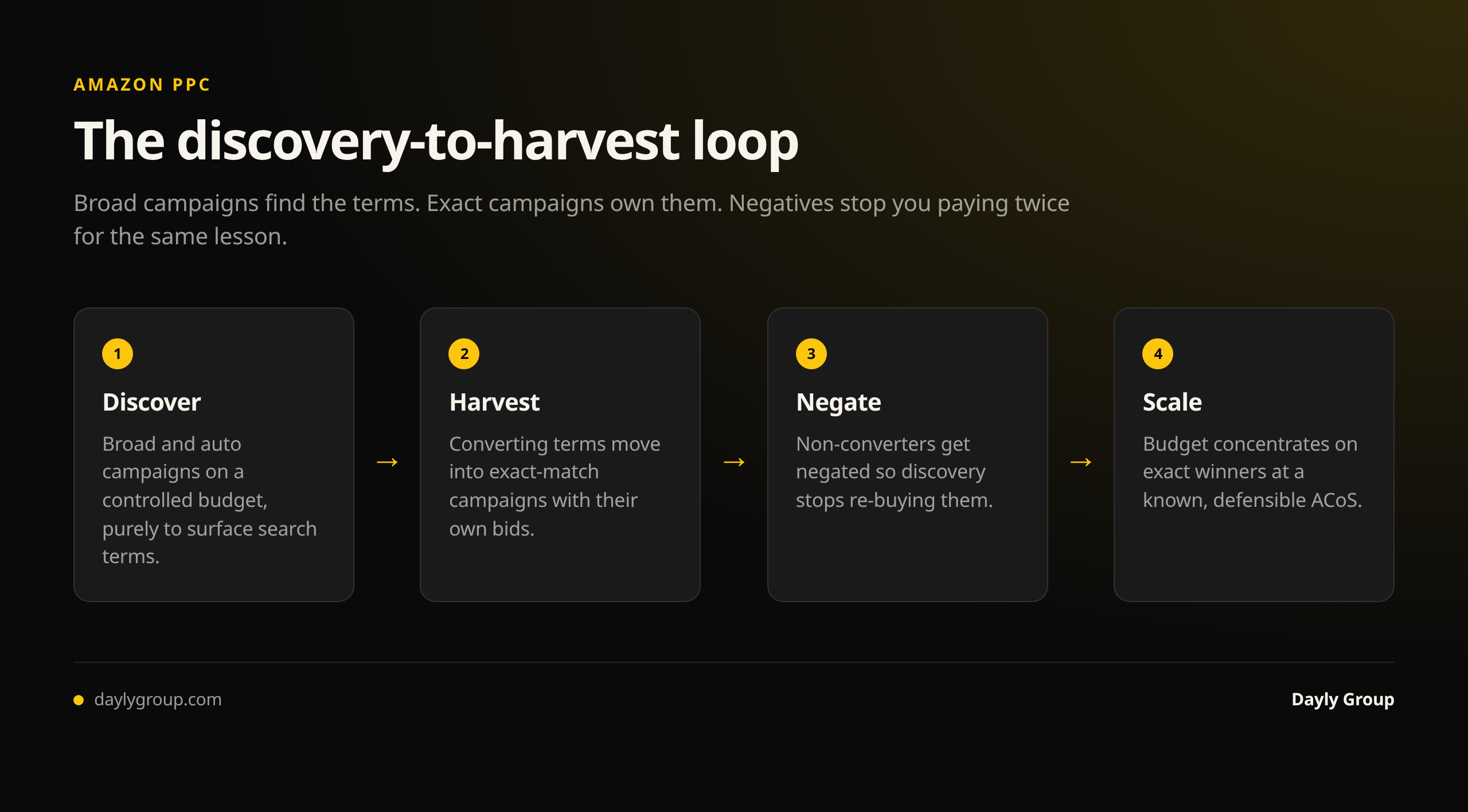
Never harvesting. Auto campaigns are a discovery engine. If converting search terms never get promoted into exact-match campaigns with dedicated bids, you're paying for the same discovery repeatedly.
Bid changes made too often, or never. Daily bid tinkering means you never accumulate enough data for a decision. Quarterly bid reviews mean you sat through two months of a broken auction.
Campaign Structure That Produces Readable Data
The goal of structure is attribution: every dollar of spend should map to a decision you can make. The architecture we use:
One ASIN per ad group. Non-negotiable. Product-level performance is the unit you actually manage, and blending ASINs destroys it.
Separate campaigns by match type and by function. Three layers:
- Discovery — automatic campaigns and broad match. Job: find search terms. Modest budget, deliberately looser targeting, measured on new converting terms found rather than ACoS.
- Harvest — exact-match campaigns for terms proven to convert. Job: own those keywords profitably. This is where the majority of budget lives and where tight ACoS targets belong.
- Defensive and expansion — branded terms, competitor conquesting, Sponsored Display retargeting, product targeting on complementary ASINs.
Separate top-of-funnel from bottom. Sponsored Brands and Sponsored Brands Video generate awareness and category discovery; Sponsored Products captures existing intent. Holding them to the same ACoS target guarantees you cut the awareness spend that feeds the intent.
Negative keywords flowing continuously. Every term you promote to a harvest campaign gets negated in the discovery campaign that found it. Otherwise your own campaigns bid against each other and inflate your CPCs.
Bid Management: Rules, Not Vibes
Bids should follow a rule you wrote in advance, applied on a fixed cadence with enough data behind each decision.
Wait for statistical significance. No bid change on fewer than ~10 clicks. On low-volume keywords that can mean a two-week window. Acting on three clicks is noise-chasing.
Weekly cadence, not daily. Weekly is frequent enough to respond to real shifts and slow enough to accumulate signal.
Directional rules that respect the goal of the campaign:
- Converting at or below target ACoS → raise bid 10–15% and check placement
- Above target with meaningful order volume → lower bid 10–15% before pausing; the keyword may be profitable at a different price
- Clicks with zero conversions after 15+ clicks → pause or negate, then check whether the problem is actually the listing
- High impressions, low click-through rate → the auction isn't the issue; your main image and price are
Use placement modifiers. Top-of-search converts materially better than rest-of-search in most categories and deserves a premium. This is one of the most consistently underused levers in Amazon advertising.
Choose the bidding strategy deliberately. Dynamic bids down-only is the safe default for a new campaign. Down-and-up is right for proven, high-converting keywords where you want to win top placement. Fixed bids belong in controlled tests.
Manage TACoS, Not Just ACoS
ACoS tells you how a campaign performed. TACoS tells you whether your business is getting healthier.
TACoS = total ad spend ÷ total revenue (ad + organic)
Falling TACoS with rising revenue means organic rank is picking up the load — that's the shape of real scaling. Flat TACoS with rising revenue means you're buying growth. Rising TACoS with flat revenue means something is wrong: an eroding listing, a new competitor, or lost organic rank.
This is why cutting ad spend to hit a target ACoS so often backfires. The spend was generating the velocity holding your organic rank. Cut it and organic decays a few weeks later, at which point you need more ad spend to hold the same revenue. Full breakdown in ACoS vs TACoS.
Judge campaigns on ACoS. Judge the account on TACoS.
The Keyword Harvesting Loop
This is the engine of a compounding PPC account, run monthly:
- Pull the search term report from discovery campaigns
- Identify terms with 2+ orders at acceptable ACoS
- Create exact-match keywords for them in a harvest campaign with a bid based on their proven conversion rate
- Negate those terms in the discovery campaign
- Identify terms with 15+ clicks and no orders; negate them everywhere
- Feed the winners into your listing and backend keywords so organic starts earning them too
Each cycle narrows waste and widens the set of keywords you own. Skip it and your account stops improving no matter how carefully you manage bids.
When PPC Isn't the Problem
The most expensive mistake in Amazon advertising is optimizing ads against a listing that doesn't convert.
If your click-through rate is healthy and your conversion rate is well below category benchmark, no bid strategy will save the account — you're paying market rate for clicks that were never going to buy. Before another optimization round, check:
- Conversion rate vs. category benchmark
- Main image click-through rate vs. category
- Review count and rating vs. the top three competitors
- Price competitiveness
- In-stock rate over the last 90 days
- Whether you're indexed for the terms you're bidding on
More than half the "PPC problems" we're brought in to fix are conversion problems wearing a PPC costume.
What Good Looks Like After 90 Days
A properly restructured account, in our experience:
- Wasted spend down 20–40% in the first 30 days, almost entirely from negatives and structural de-duplication
- CPCs on core terms down, because your own campaigns stopped competing with each other
- TACoS trending down over 60–90 days as organic rank absorbs volume
- Revenue up, not just efficiency up — efficiency alone usually means you shrank
Frequently Asked Questions
Q: What's a good ACoS on Amazon? A: There's no universal number — it depends on margin, and on the campaign's job. A useful anchor is break-even ACoS, which equals your contribution margin percentage before ad spend. Harvest campaigns on proven keywords should run comfortably below it; discovery campaigns and launch pushes are often deliberately run above it because you're buying data and rank.
Q: How often should I adjust Amazon PPC bids? A: Weekly, with a minimum data threshold of about 10 clicks per keyword before acting. Daily adjustments react to noise; monthly or quarterly reviews leave broken auctions running for weeks.
Q: Should I use automatic or manual campaigns? A: Both, with different jobs. Automatic campaigns are your discovery engine for finding converting search terms. Manual exact-match campaigns are where you own and optimize the terms discovery proved out. Running only auto means you never build efficiency; running only manual means you stop finding new keywords.
Q: Why did my sales drop after I lowered my ad spend? A: Ad-driven sales feed the velocity and conversion signals that hold your organic rank. Cut spend and organic rank typically decays over the following two to four weeks, taking organic sales with it. This is exactly what TACoS is for — it exposes the dependency that ACoS hides.
Q: How many keywords should one campaign have? A: Few enough that each one has a bid you chose on purpose. In harvest campaigns we often run single-keyword or small tightly-themed ad groups so bids and budgets are truly keyword-level. Sprawling campaigns with hundreds of keywords produce averages, and averages aren't actionable.
If your PPC spend is growing faster than your revenue, the structure is usually the reason. Book a 45-minute gap analysis — we'll pull your search term and placement data and show you exactly where the waste is before you spend another dollar. Or see how we run Amazon PPC management for brands scaling past seven figures.
If you want to pressure-test an existing account against this, work through our 12-point Amazon PPC audit checklist.
Keep reading
Book a free Gap Analysis. We'll tell you what's leaking, what's scaling, and where the next 30% lives.
Book a Gap Analysis →