
Amazon PPC Audit: The 12-Point Checklist We Run on Every Account
A step-by-step Amazon PPC audit you can run yourself — the twelve checks that find where spend leaks, in the order that finds the biggest problems first.
We audit a lot of Amazon ad accounts. The same problems appear in most of them, in roughly the same proportions, and almost none of them are exotic. The money is rarely lost to a clever mistake — it's lost to structure nobody revisited and reports nobody read.
This is the checklist we actually run, ordered so the biggest problems surface first. You can do all of it yourself with Campaign Manager, the search term report and a spreadsheet.
Before you start: fix your denominator
Decide what "good" means before you look at anything. Two numbers:
Your break-even ACoS — your contribution margin after Amazon fees, COGS and shipping. If you keep 30% of revenue after all product costs, break-even ACoS is 30%. Any campaign above that loses money on the marginal sale.
Your target TACoS — total ad spend divided by total revenue, the number that tells you whether advertising is buying growth or just buying sales you'd have made anyway.
Without these, an audit becomes an opinion contest. ACoS and TACoS explained covers the maths if you need it.
The 12 checks
1. Is spend concentrated in the campaigns you'd choose?
Sort campaigns by spend, descending. Look at the top ten. In most accounts we audit, the top ten campaigns are not the ten a strategist would pick — they're the ten that happen to have the highest budgets from a decision made a year ago. If your top spender isn't a campaign you'd deliberately fund today, that's your first move.
2. Are ad groups readable?
Open your largest campaigns. If a single campaign contains many ad groups spanning unrelated products, every metric you see is an average of things that shouldn't be averaged, and no bid decision you make from it can be correct. This is the single most common structural fault we find, and fixing it usually unlocks more than any bid change.
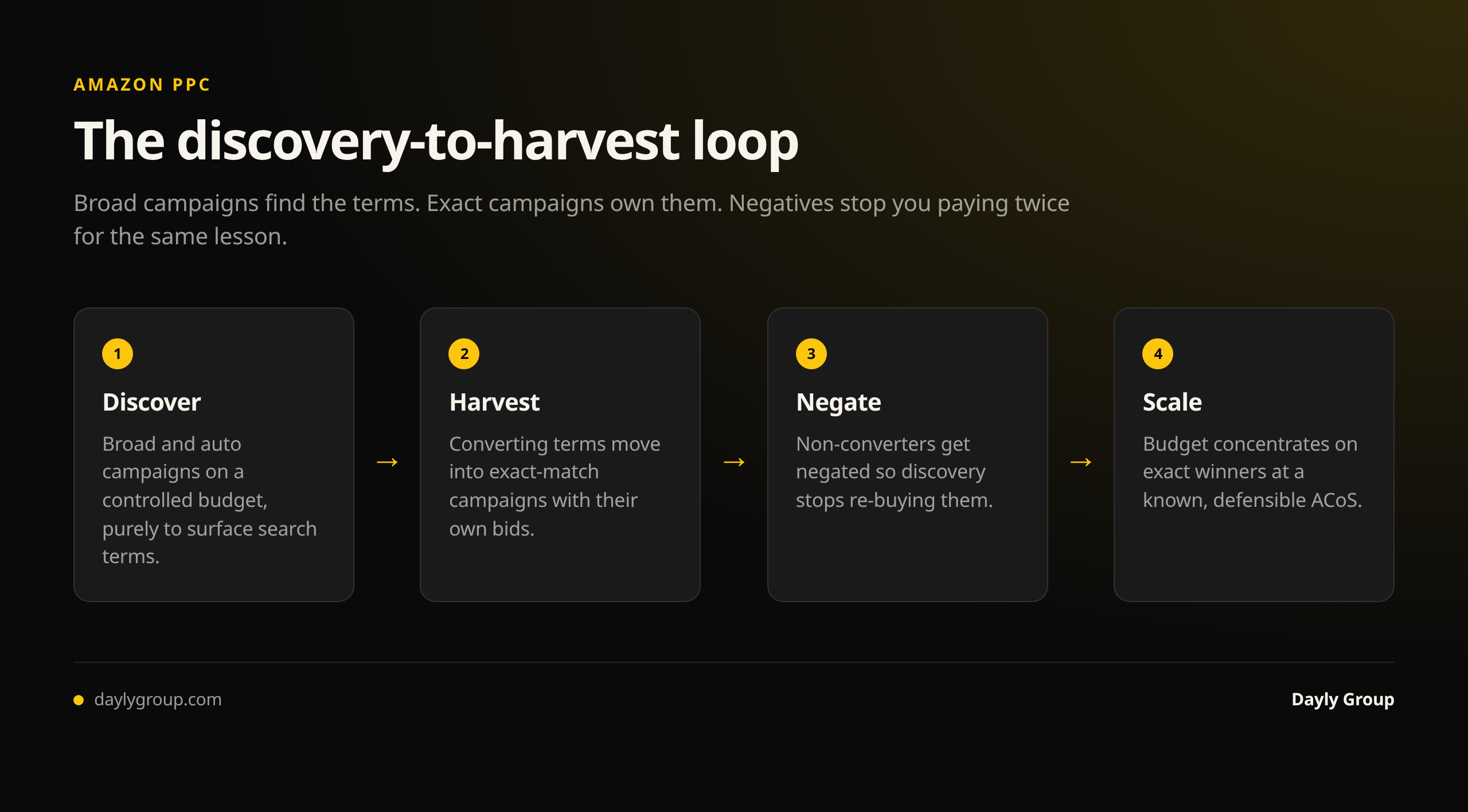
3. Is there a discovery-to-harvest loop, or just broad match?
Healthy accounts run broad and auto campaigns on a deliberate, capped budget purely to find search terms, then move winners into exact-match campaigns with their own bids and negate them out of discovery. Accounts without this loop pay discovery prices forever for terms they already know convert.
4. When was the last negative keyword added?
Pull the search term report for the last 60 days. Filter to terms with meaningful spend and zero orders. Sum that spend. That number is your annualized leak, and in accounts without a negation cadence it is routinely 10–20% of total spend. If the last negative was added months ago, this is the fastest money on the list.
5. Are you paying for your own brand unnecessarily — or not defending it at all?
Both errors are common and they look identical in a report. Check branded search separately from everything else. If competitors are bidding on your brand and converting, defending is cheap and correct. If nobody is, high branded spend may be buying clicks you'd have won free. Never let branded performance sit blended in with non-branded — it flatters your overall ACoS and hides the real number.
6. Are placement adjustments in use?
Top-of-search typically converts far better than rest-of-search or product pages, at a higher CPC. If your placement modifiers are all at zero, you're bidding the same for positions with materially different value. This is a fifteen-minute fix with an immediate effect.
7. Are you running all three ad types with a reason?
Sponsored Products, Sponsored Brands, Sponsored Display. Each has a distinct job: capture existing intent, own category-level searches, retarget viewers. Most accounts run only Sponsored Products — which usually means the top of the funnel is unbuilt. The reverse error exists too: running all three because they exist, with no thesis for what Display is for.
8. Are budgets capping your winners?
Filter campaigns by budget utilization. Any campaign consistently hitting its cap while performing above target is being throttled by a number, not by the market. Meanwhile, look for the opposite: campaigns with large budgets and low spend, which distort your planning.
9. Are bids differentiated at all?
If most keywords share the same bid, no bidding strategy is in place. Bids should reflect the conversion rate and margin of the specific term. Uniform bids are a strong signal an account is being maintained rather than managed.
10. Is dayparting or seasonality reflected anywhere?
Does the account behave differently in its peak weeks than in flat periods? For seasonal or occasion-driven categories this is enormous — one of our accounts found roughly half its efficiency gain purely from separating campaigns by holiday window so bids could move independently.
11. Do your best-selling ASINs actually have coverage?
Cross-reference your top revenue ASINs against advertised ASINs. Products that sell well organically are often under-advertised because nobody revisited the list after launch. Conversely, look for spend on ASINs that are out of stock, unprofitable, or being discontinued — spend on an out-of-stock ASIN is pure waste and it happens constantly.
12. Does the traffic land on a listing that converts?
The audit's last question is the one that invalidates everything above if you skip it. Pull the conversion rate of the listings receiving the most ad spend. If a listing converts poorly, no bid work will save it — you're optimizing the price you pay for a leaky bucket. Fix the listing first, then buy traffic into it.
What to do with the output
Rank every finding by money at stake, not by effort. In practice the order usually lands:
- Negation backlog and out-of-stock spend — days to fix, immediate saving
- Campaign structure and ad group consolidation — weeks, largest long-term effect
- Placement modifiers and budget caps on winners — hours, quick wins
- Listing conversion rate on top spend — slowest, highest ceiling
Then re-run the whole checklist quarterly. An audit is not a one-time event; accounts drift back toward disorder as products, seasons and competitors change.
FAQ
Q: How often should I audit my Amazon PPC? A: A full pass quarterly, with the search term report and negation review monthly. The structural items (checks 1–3) only need revisiting when the catalogue changes materially; the leak items (4, 11) need a standing cadence or they silently rebuild.
Q: What's a good ACoS? A: There is no universal good ACoS — only ACoS relative to your break-even and your goal. A 45% ACoS is excellent on a launch you're deliberately buying rank for, and catastrophic on a mature product with a 25% margin. Anyone quoting a target without asking your margin is guessing.
Q: Can I run this audit myself? A: Yes — every check above uses data available in Campaign Manager and the search term report. What takes experience is the judgment calls: which structure to consolidate into, how aggressive to be on a launch, whether a term is worth contesting. The findings are mechanical; the prioritization is not.
Q: How long until an audit's fixes show results? A: Negation and budget fixes show within days. Structural changes usually take 3–4 weeks to stabilize, because rebuilt campaigns need to re-accumulate performance data before their numbers mean anything. Judge a restructure at 30 days, not at 7.
If you'd rather have this done than do it, our Amazon PPC management service starts with exactly this audit — or book a Gap Analysis and we'll run the twelve points on your account and tell you what we find.
Keep reading
Book a free Gap Analysis. We'll tell you what's leaking, what's scaling, and where the next 30% lives.
Book a Gap Analysis →