
Sponsored Brands vs. Sponsored Products: How to Split the Budget
The two ad types do different jobs, so judging them on the same ACoS target wastes money. How to allocate between them, and how to measure each one honestly.
The mistake isn't choosing wrong between Sponsored Products and Sponsored Brands. It's running both, comparing their ACoS, and cutting the one that looks worse — which is almost always Sponsored Brands, and often the wrong call.
They do different jobs. Compared on the same metric, the one doing the harder job loses.
What each one actually does
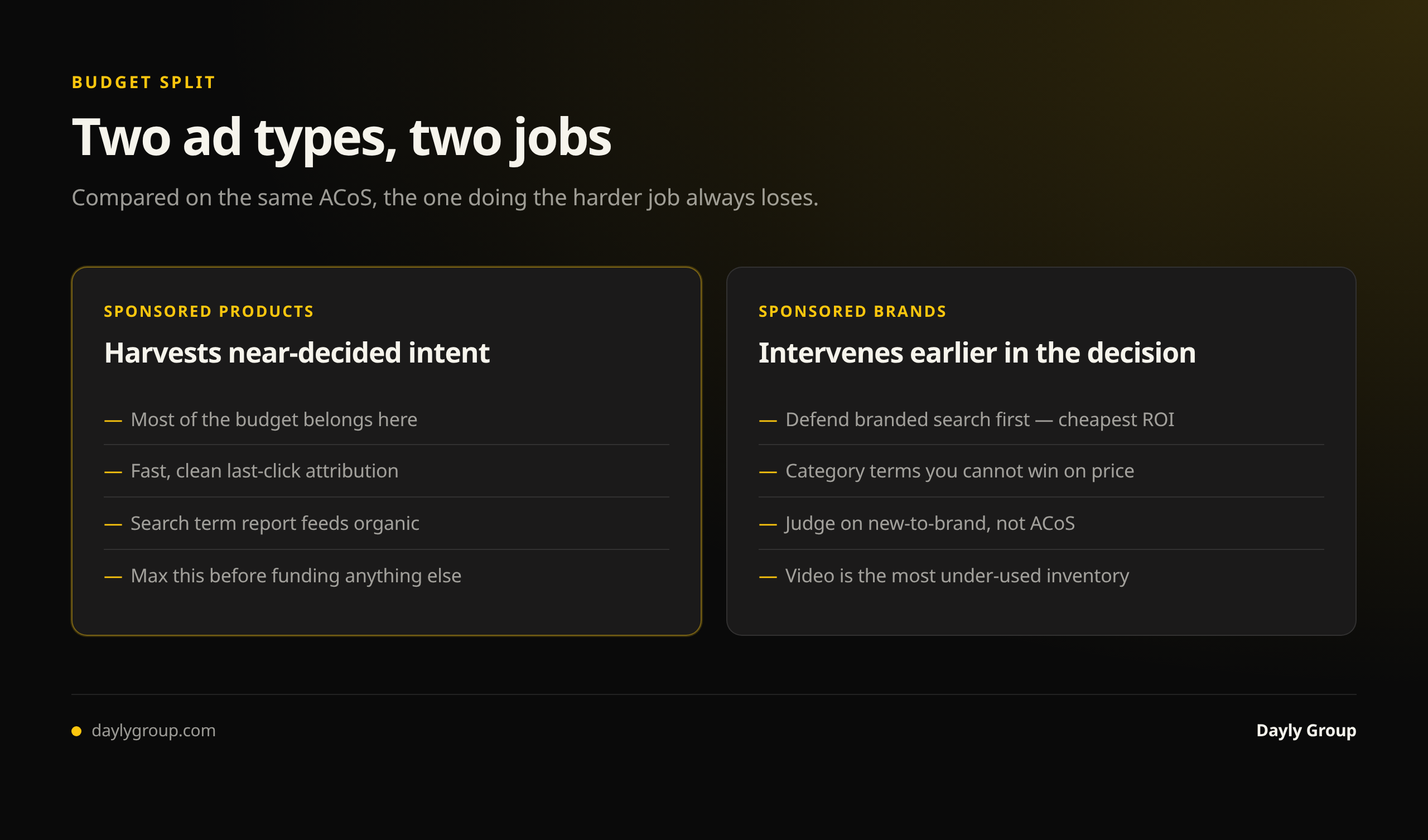
Sponsored Products places individual product ads in search results and on product pages. The shopper is already searching for something close to what you sell, and the ad harvests that intent. Attribution is quick and clean, ACoS is usually the best in the account, and this is where the majority of most brands' spend belongs.
Sponsored Brands places brand-level ads — headline banners, product collections, and video — usually above the results. It sells the brand and a set of products rather than one item, and it's the only format that can send a click to your storefront.
The structural difference: Sponsored Products captures a decision that's nearly made. Sponsored Brands intervenes earlier, when the shopper is still deciding which brand. Earlier intervention means longer paths to purchase and worse last-click numbers, for the same reason a billboard measures worse than a checkout coupon.
Where Sponsored Brands genuinely earns its budget
Defending your branded search. If competitors bid on your brand name, the top banner is the cheapest defense available. This is usually the highest-ROI Sponsored Brands spend in the account, and it's often mistakenly cut for looking "too easy" — the sales look like they'd have happened anyway. Some would. The ones a competitor's banner would have intercepted would not.
Broad category terms. On high-volume category terms where you'll lose an efficiency race against entrenched sellers, a brand banner offering three products converts better than a single product competing on price.
Driving to a storefront. The only format that can, which matters when the shopper needs to browse rather than buy one variant.
Video. Sponsored Brands video routinely outperforms static on click-through, because it demonstrates a product rather than describing it. It's the most under-used inventory in most accounts.
New product launches. A brand banner attaches a new product to an established name.
How to split the budget
There's no universal ratio, but the logic is consistent:
Start with Sponsored Products taking the clear majority. It's the most efficient inventory and the foundation. Before spending on Sponsored Brands, make sure Sponsored Products has no efficient headroom left — unspent efficient budget there is cheaper growth than anything else.
Fund branded defense first within Sponsored Brands. It's small, cheap and protects revenue you already earned.
Then category terms, sized to what you can afford to run at a worse ACoS while measuring new-to-brand.
Then video, tested properly with enough budget to reach significance rather than starved into ambiguity.
Judge the total, not the parts. The right question is whether total revenue grew more than total spend across both formats — account TACoS, not per-format ACoS.
Measuring each one honestly
Sponsored Products: ACoS and conversion rate are fair. Also watch which search terms it's discovering — the search term report is your best keyword research and directly feeds organic work.
Sponsored Brands: last-click ACoS understates it structurally. Use new-to-brand orders and their share of total as the primary metric, since introducing new customers is the job. Also watch branded search volume over time — successful upper-funnel advertising shows up as more people searching your name, which then converts cheaply elsewhere.
The practical test that settles arguments: pause Sponsored Brands for a defined period and watch total account revenue and branded search volume, not the Sponsored Brands line. If total revenue holds and branded search is flat, it wasn't working. If total revenue drops by more than the spend you saved, it was doing more than its ACoS suggested.
That test takes a few weeks and beats any theoretical argument about attribution.
The common mistakes
- Cutting Sponsored Brands for a worse ACoS. Expected, structural, not evidence of failure.
- Never defending branded search. Cheapest protection in the account.
- One creative, never refreshed. Sponsored Brands creative fatigues; Sponsored Products doesn't have creative to fatigue.
- Sending every click to the storefront homepage. Match the destination to the search intent.
- Starving a video test. Not enough budget to reach significance means you learn nothing and conclude it doesn't work.
- Running Sponsored Brands before Sponsored Products is maxed. Buying harder demand while easier demand goes unbought.
The simple version
Sponsored Products is how you harvest demand efficiently and should carry most of the budget. Sponsored Brands is how you defend your name, compete on terms you can't win on price, and introduce new customers — judged on new-to-brand and total account TACoS rather than its own ACoS.
Run both. Measure each on the job it's doing. The PPC management guide covers structure, and the PPC audit checklist is what to check when performance slips.
If you want an outside read on how your budget is split, see what we've done for other brands and book a Gap Analysis call.
FAQ
Q: What is the difference between Sponsored Products and Sponsored Brands? A: Sponsored Products advertises individual products in search results and on product pages, harvesting shoppers whose decision is nearly made. Sponsored Brands runs brand-level banners, product collections and video, usually above the results, intervening earlier when the shopper is still choosing a brand — and it's the only format that can send clicks to your storefront.
Q: How should I split budget between Sponsored Products and Sponsored Brands? A: Sponsored Products should take the clear majority, and you shouldn't add Sponsored Brands budget until Sponsored Products has no efficient headroom left. Within Sponsored Brands, fund branded-search defense first, then broad category terms, then video tests. Judge the split on total account TACoS rather than each format's ACoS.
Q: Why is my Sponsored Brands ACoS worse than Sponsored Products? A: Because it's structural, not a failure. Sponsored Brands intervenes earlier in the decision, so paths to purchase are longer and last-click attribution credits it less. Measure it on new-to-brand orders and their share of total, plus branded search volume over time.
Q: Should I bid on my own brand name on Amazon? A: Generally yes, if competitors are bidding on it. It's the cheapest defense available and usually the highest-ROI Sponsored Brands spend in the account. Some of those sales would have happened anyway, but the ones a competitor's banner would have intercepted would not.
Q: Is Sponsored Brands video worth testing? A: Yes — it typically outperforms static creative on click-through because it demonstrates the product, and it's the most under-used inventory in most accounts. Give the test enough budget to reach significance; a starved video test teaches you nothing and gets wrongly written off.
Keep reading
Book a free Gap Analysis. We'll tell you what's leaking, what's scaling, and where the next 30% lives.
Book a Gap Analysis →