
Why Is My ACoS Climbing? (And What a Good TACoS Actually Looks Like)
The seven real causes of rising Amazon ad costs, why ACoS is the wrong number to manage, and the TACoS benchmarks we use to judge whether an account is actually healthy.
Two things are usually true when a brand tells us their ACoS is out of control.
First, the cause isn't advertising. Rising ACoS is a symptom, and roughly half the time the disease is a conversion-rate problem that has nothing to do with campaigns.
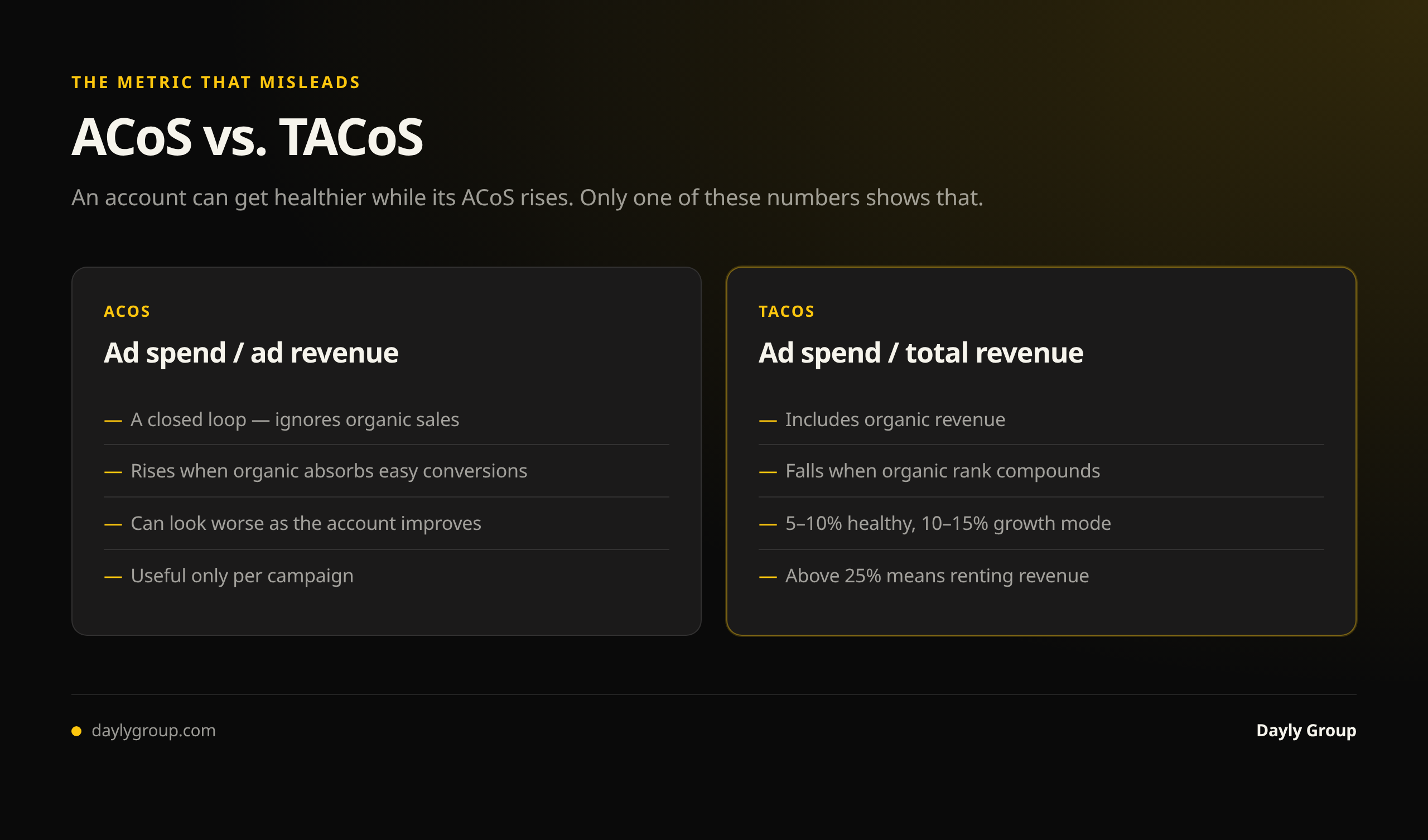
Second, they're managing the wrong number. ACoS measures ad spend against ad revenue — a closed loop that tells you nothing about whether the channel is profitable overall. TACoS measures ad spend against total revenue, and that's the number that reveals whether advertising is building a business or renting one.
Here's how to diagnose the climb, and what good actually looks like.
First: why ACoS misleads
ACoS = ad spend ÷ ad revenue. It ignores organic sales entirely.
Which produces a genuinely perverse outcome: a brand whose organic rank is improving will often see ACoS rise, because organic is absorbing the easy conversions while ads pick up the harder, colder traffic. The account is getting healthier and the headline metric is getting worse.
TACoS = ad spend ÷ total revenue. When TACoS falls while revenue grows, organic is compounding and advertising is doing its actual job. When TACoS rises while revenue is flat, you're buying sales you used to get free. That's the number to manage. Our full ACoS vs TACoS breakdown covers the mechanics.
What a good TACoS looks like
Benchmarks are category-dependent, so treat these as bands rather than targets:
- Under 5% — either exceptional organic strength, or you're underinvesting and leaving growth on the table. Check which before congratulating yourself.
- 5–10% — healthy for an established brand with real organic rank. This is where most well-run accounts sit.
- 10–15% — normal for growth mode, new launches, or competitive categories. Acceptable if revenue is climbing.
- 15–25% — sustainable only during a launch or a deliberate share grab. Needs a defined end date.
- Above 25% — you're renting revenue. Either the product economics don't work or organic rank isn't developing.
The direction matters more than the level. A TACoS of 14% falling steadily while revenue grows is a better account than a TACoS of 8% that's been creeping up for two quarters.
The seven causes of rising ACoS
1. Your conversion rate fell
This is the first thing to check and the most common answer. ACoS is inversely proportional to conversion rate — same clicks, same CPC, fewer orders, higher ACoS. Nothing changed in your campaigns at all.
Causes: price increase, competitor undercut, Buy Box loss, negative review cluster, suppressed main image, lost badge, slower delivery promise, out-of-stock variation. Check your unit session percentage before you touch a single bid.
2. CPCs rose in your category
Competitive auctions inflate. A new well-funded entrant, a competitor's Q4 push, or general category maturation raises the price of the same click. Your ACoS rises at identical performance.
Check average CPC over time in your campaign reports. If CPC is up 30% and conversion is flat, that's the whole story and the fix is bidding strategy, not listing work.
3. You expanded into colder traffic
Broad match, auto campaigns and category targeting reach shoppers earlier in their decision. That traffic converts worse by design. If you scaled budget into discovery campaigns, blended ACoS rises even though each campaign is performing as intended.
This is only a problem if you're measuring it wrong. Segment discovery from harvest campaigns and judge them against different targets.
4. Your search terms drifted
Broad and phrase campaigns accumulate irrelevant matches over time. Without regular negation, you're paying for clicks that were never going to convert. Pull the search term report and check what share of spend went to terms with zero orders — in neglected accounts it's routinely 20–30%.
5. Campaign structure collapsed under its own weight
Duplicate keywords across campaigns bidding against each other. Auto campaigns competing with exact-match. Ad groups with fifty keywords sharing one bid. All of it raises effective CPC and muddies attribution.
The PPC audit checklist is the fastest way to find this.
6. You cut spend and lost velocity
Counterintuitive but common. Reducing spend on converting terms costs you sales velocity, which costs organic rank, which shifts more of the total burden back onto ads — raising both ACoS and TACoS a month or two later.
7. Seasonality
Categories have expensive and cheap periods. Q4 CPCs rise across almost every category. Compare against the same period last year, not last month, before concluding anything is broken.
The diagnostic order that works
- Conversion rate first. If it fell, stop — that's your answer, and it's a listing problem.
- Then CPC. Rising CPC at flat conversion is an auction problem, not a listing problem.
- Then search terms. How much spend went to zero-order terms?
- Then structure. Duplicates, self-competition, bloated ad groups.
- Then TACoS trend. Zoom out. If TACoS is falling while ACoS rises, your account is fine and you were reading the wrong number.
- Only then adjust bids. Bids are the last lever, not the first.
Most brands run this list backwards, starting with bids because that's the knob closest to hand. It's why the problem keeps returning.
The uncomfortable possibility
Sometimes rising ACoS means the product economics don't support paid acquisition at current prices. If your contribution margin after referral fees, FBA fees and returns can't absorb a realistic CPC, no amount of campaign optimization fixes it. The answer is pricing, packaging, cost of goods, or a different channel.
Good operators say this out loud early. It's cheaper than a year of optimization against arithmetic that was never going to work.
If you want an independent read on which of the seven is actually driving your numbers, see what we've done for other brands and book a Gap Analysis call.
FAQ
Q: Why is my Amazon ACoS increasing? A: Check in this order: your conversion rate (if it fell, that's the cause and it's a listing problem, not an ads problem), category CPC inflation, expansion into colder discovery traffic, search-term drift without negation, campaign structure problems like duplicate keywords competing, a spend cut that cost you velocity, and seasonality. Bids should be the last thing you adjust, not the first.
Q: What is a good TACoS on Amazon? A: For an established brand with real organic rank, 5–10% is healthy. 10–15% is normal in growth mode or competitive categories. 15–25% is defensible during a launch with a defined end date. Above 25% usually means you're renting revenue rather than building it. Under 5% can mean underinvestment as easily as it means strength.
Q: Is a rising ACoS always bad? A: No. If organic rank is improving, organic absorbs the easier conversions and ads pick up colder traffic, so ACoS can rise while the account gets healthier. That's why TACoS matters more: if TACoS is falling as revenue grows, rising ACoS is a sign of progress, not a problem.
Q: What's the difference between ACoS and TACoS? A: ACoS is ad spend divided by ad-attributed revenue — a closed loop that ignores organic sales. TACoS is ad spend divided by total revenue, including organic. TACoS shows whether advertising is building compounding organic strength or substituting for it, which is the question that actually matters.
Q: Does lowering my Amazon ad spend lower my ACoS? A: Often only briefly. Cutting spend on converting terms reduces sales velocity, which erodes organic rank, which pushes more of the revenue burden back onto ads — so ACoS and TACoS both rise again a month or two later. Cut spend on non-converting terms instead; that lowers ACoS without costing velocity.
Keep reading
Book a free Gap Analysis. We'll tell you what's leaking, what's scaling, and where the next 30% lives.
Book a Gap Analysis →