
Why Are My Amazon Sales Down This Month? How to Find the Actual Cause
A structured way to diagnose an Amazon revenue drop — isolating whether you lost traffic, lost conversion, or lost neither and just lost margin.
"Sales are down" is not a diagnosis. It's three completely different problems wearing the same costume, and the fix for one is useless against the others.
Amazon revenue is roughly sessions × conversion rate × average order value. A drop has to come from one of those three, and your first job is to find out which — before anyone touches a listing or a bid.
Most brands skip this step, start optimizing, and end up unable to tell whether anything worked. Ten minutes of isolation saves a month of guessing.
Step 1: Isolate the variable (10 minutes)
Open Business Reports in Seller Central, set it to the drop period versus the same length of time before it, and read three numbers per ASIN: sessions, unit session percentage (that's your conversion rate), and average selling price.
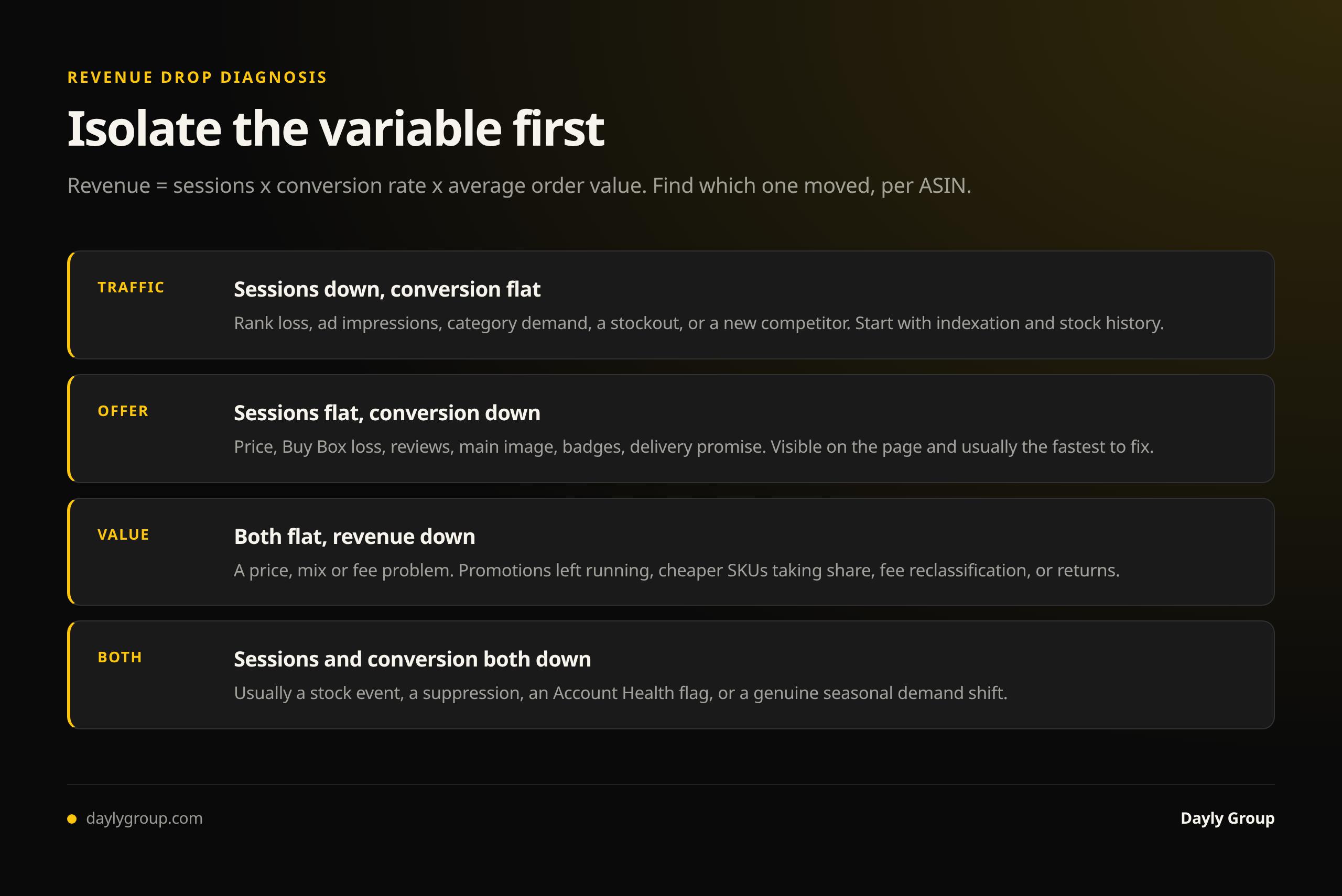
- Sessions down, conversion flat → a traffic problem. Rank, ads, or category demand.
- Sessions flat, conversion down → a listing or offer problem. Price, images, reviews, Buy Box.
- Both flat, revenue down → a price or mix problem. You're selling the same units at lower value, or your mix shifted to cheaper SKUs.
- Both down → usually a stock event, a suppression, or a genuine demand shift.
Do this per ASIN, not at account level. Account-level totals hide the most common pattern of all: one hero SKU declining while everything else holds steady.
If it's a traffic problem
Traffic loss has a short list of causes, in order of how often they're the answer:
You lost organic rank. Check your position on your top terms and confirm you're still indexed. The rank drop checklist walks through the nine causes properly.
You lost ad impressions. Check whether budgets capped out earlier, bids stopped clearing the auction, or a campaign got paused. Rising CPCs in your category will quietly reduce impressions at the same budget — same spend, less traffic.
Category demand fell. Brand Analytics shows query volume for your head terms. If total category searches dropped, your sessions fall with your position unchanged. Seasonality is real and often the entire explanation.
You went out of stock. Even briefly. Sessions collapse immediately and rank recovery lags the restock by weeks.
A competitor entered or escalated. Someone new taking the top slots on your head terms takes your sessions with them.
If it's a conversion problem
Conversion drops are usually the fastest to fix, because the causes are visible on the page:
- Price — yours rose, or a competitor undercut you. Check the delta, not just your own price.
- Buy Box — confirm you still hold it. Losing it while keeping your rank produces exactly this pattern.
- Reviews — a cluster of negatives or a rating crossing below 4.0 has an outsized effect.
- Main image — a suppressed, replaced or compressed image damages click-through and conversion together.
- Badges — losing Best Seller, Amazon's Choice or Prime eligibility removes trust signals you didn't know you were relying on.
- Delivery promise — a slower promise than competitors suppresses conversion on identical listings.
- Out-of-stock variations — if a size or color is unavailable, the whole family converts worse.
Brand Analytics Search Query Performance narrows this further by telling you whether you lost click share or purchase share — passed over in results, or arrived and left.
If it's a price or mix problem
Sometimes units are flat and revenue isn't. Check:
- Promotions running longer than intended. Coupons and deals that were never switched off.
- Mix shift. Cheaper SKUs taking a larger share of the same total units.
- Fee changes. Revenue looks flat but net doesn't — an FBA dimension reclassification, a storage-fee period, or a referral-fee change on a category.
- Returns and refunds. Gross sales hold while net falls.
This is the category most often missed, because top-line dashboards look fine.
The things nobody checks but should
Your own operational calendar. What did you change five to six weeks ago? Rank effects lag their causes badly. The change that caused this month's drop usually happened last month.
Account Health. A policy flag, IP complaint or compliance hold can suppress visibility without any obvious signal on the listing itself.
Same period last year. Not last month — last year. Many "drops" are annual seasonality that looks alarming month-over-month and completely normal year-over-year.
Whether the drop is real. A month with fewer weekend days, a Prime Day comparison period, or a promotional spike in the prior period can all manufacture a decline that isn't one.
What not to do first
Don't rewrite the listing. Don't raise every bid. Don't run a big coupon. All three feel productive, all three change several variables at once, and all three destroy your ability to know what the problem was — meaning it'll happen again and you'll be equally blind next time.
Diagnose, change one thing, measure, then move to the next.
If you want a second pair of eyes on where the drop came from, see what we've done for other brands and book a Gap Analysis call. For the underlying levers, how to increase Amazon sales covers the growth side of the same math.
FAQ
Q: Why are my Amazon sales suddenly down? A: Start by isolating which variable moved. In Business Reports, compare sessions, unit session percentage (conversion rate) and average selling price for the drop period against the period before. Sessions down means a traffic problem — rank, ads or demand. Conversion down means a listing or offer problem — price, Buy Box, reviews or images. Both flat with revenue down means a price, mix or fee problem.
Q: Why did my Amazon sales drop but my ranking stayed the same? A: That points to conversion rather than visibility. The usual causes are a price increase, losing the Buy Box, a new negative review cluster, a suppressed main image, a lost badge, or a slower delivery promise than competitors. It can also be a category-wide demand drop, in which case your position holds while total impressions fall.
Q: How long does it take Amazon sales to recover after a stockout? A: Sessions return quickly once you restock, but rank and velocity typically take two to six weeks to rebuild, because Amazon re-ranks on accumulated sales history. Competitive terms take longer. Expect a gradual recovery rather than a snap back.
Q: Is a monthly Amazon sales drop normal? A: Month-to-month variance is normal and often seasonal. Always compare against the same period last year, not just last month — and check for calendar artefacts like a Prime Day in the comparison window or a promotion that inflated the prior period. Judge a genuine decline over a rolling trend, not a single month.
Q: How do I tell whether an Amazon sales drop is my fault or the market's? A: Check whether category query volume fell in Brand Analytics, and whether the competitors above you also lost ground. If total category demand dropped, it's the market. If demand held and only your sessions fell, it's your rank, your ads or your stock — and your own change log from four to six weeks ago is usually where the answer is.
Keep reading
Book a free Gap Analysis. We'll tell you what's leaking, what's scaling, and where the next 30% lives.
Book a Gap Analysis →