
How to Increase Amazon Sales: 7 Proven Strategies for Brand Owners
Struggling to grow on Amazon? Here are 7 proven strategies that consistently drive revenue for 7 and 8-figure Amazon brands.
How to Increase Amazon Sales: 7 Proven Strategies for Brand Owners
Most Amazon brands hit a ceiling not because the market dried up — but because they're scaling in the wrong order. They pour money into ads before the listing is ready to convert. They chase top-line revenue while their TACoS quietly bleeds margin. They run 20% promo coupons every week and wonder why their brand feels cheap.
I've audited over 300 Amazon accounts. The same patterns show up constantly. What follows are the seven strategies that move the needle for 7 and 8-figure brands — in the order they actually matter.
1. Fix Your Conversion Rate Before Scaling Ad Spend
Pouring ad spend into a listing with a 6% conversion rate is like filling a leaky bucket. Every dollar you spend amplifies the leak.
Before you touch your bids, audit your listing from the buyer's perspective. Your main image needs to win the click. Your title should front-load the most important keyword and the clearest benefit. Your bullets should answer objections, not just list features. Your A+ content should close the sale.
A realistic benchmark: a well-optimized listing in most categories should convert at 12–18%. If you're below that, no amount of ad spend will fix it — it will only make the problem more expensive. Nail conversion first. Then scale.
2. Own Your Keyword Ranking With a TACoS-First Approach
ACoS tells you how efficient your ads are. TACoS tells you if your ads are actually working.
TACoS = total ad spend / total revenue (organic + paid). A brand that's growing organically will see TACoS decline over time even as ad spend stays flat, because organic sales are increasing the denominator. That's the goal.
Structure your Amazon PPC campaigns to push high-converting keywords toward organic rank. That means running aggressive bids on a small set of exact-match priority keywords, tracking weekly rank movement, and being willing to run negative margins short-term to capture organic position. Once a keyword ranks organically in the top 10, you've bought a compounding asset. The ad spend to maintain rank is a fraction of what it cost to earn it.
Target a TACoS of 8–12% for a mature, growing brand. If you're above 20%, your organic rank is stalling and you're subsidizing sales rather than building equity.
3. Use DSP to Re-Engage Lost Buyers
Most brands live and die by Sponsored Ads. The brands that dominate use the full funnel.
Amazon DSP advertising lets you reach audiences you can't touch inside the Seller Central ad console — shoppers who viewed your product but didn't buy, lapsed customers, competitors' buyers, and lookalike audiences built from your own purchaser data. These are warm signals. The conversion economics are fundamentally different from cold prospecting.
A retargeting campaign targeting product detail page viewers in a 14-day window typically runs at 5–10x the efficiency of cold traffic. If you're running over $50K/month in revenue and you're not running DSP retargeting, you're leaving a significant chunk of revenue in the hands of your competitors who are.
DSP also gives you access to off-Amazon display and video inventory — meaning you can reach your audience on third-party sites, apps, and streaming services, then close them back on Amazon where the purchase friction is lowest.
4. Stack Reviews Systematically
Reviews are a conversion asset, not an afterthought. A product at 4.2 stars with 80 reviews will underperform a competitor at 4.5 stars with 400 reviews — almost every time, regardless of price.
Two mechanisms that work:
Amazon Vine is the fastest path to early review velocity on new ASINs. You're enrolling verified purchasers who are incentivized to leave honest reviews. For new products, targeting 30+ Vine reviews before spending aggressively on ads is the right sequence.
Follow-up sequences via the Buyer-Seller Messaging tool (compliant with Amazon's guidelines) can meaningfully increase organic review rate. The message needs to be genuinely helpful — troubleshooting tips, usage guidance, how to get the most from the product — with a soft prompt to share feedback if they're happy. Sellers who send no post-purchase communication leave review rate entirely to chance.
Compound this over 6–12 months and the review gap between you and competitors becomes a moat.
5. Expand Into Adjacent ASINs Your Competitors Ignore
Keyword research is table stakes. The real opportunity is in adjacent search demand that your category leaders haven't captured.
Pull your competitors' reverse-ASIN keyword data. Look for high-volume, lower-competition terms — usually long-tail, use-case specific, or problem-aware queries — where the top organic results are mediocre listings with weak images or thin reviews. Those are gaps.
Build or bundle a product that directly targets that search intent, with a listing engineered around those specific keywords. You're not trying to beat the category leader at their own game. You're finding the adjacent territory they're not defending.
Many 8-figure brands have found that 20–30% of their revenue eventually comes from "second-tier" ASINs they launched based on competitor gap analysis. Each one that earns organic rank becomes a self-funding revenue stream.
6. Leverage Promotions Strategically, Not Desperately
A coupon running every day is not a promotion. It's a discount policy — and buyers start to expect it, which means your effective price is permanently lower with no incremental lift.
Promotions work when they're tied to a specific objective: ranking a new keyword, clearing overstock to maintain IPI, or driving a velocity spike before a key shopping event (Prime Day, Black Friday). Outside of those contexts, they should be rare.
When you do run a promotion, treat it like a media buy. What does rank movement look like before vs. after? Did the units sold translate into a review? Did BSR improve in a meaningful subcategory? Measure the downstream effects, not just the immediate sales.
The brands that use promotions surgically protect their price integrity and use the spend efficiently. The brands that run them constantly condition buyers to wait for deals.
7. Build a Retention Moat With Subscribe & Save
Acquiring an Amazon customer is expensive. Keeping them costs almost nothing by comparison.
Subscribe & Save is one of the highest-leverage retention tools on the platform for replenishable products. Enrolled subscribers convert at significantly higher rates on subsequent orders, they're protected from competitor conquest ads, and they generate predictable recurring revenue that smooths out your cash flow.
The goal isn't just to enroll subscribers — it's to optimize retention within the program. Audit your subscribe rate by ASIN. Look at cancellation timing. Often subscribers drop off at months 2–3 because the replenishment interval doesn't match actual usage. Adjusting default intervals, testing messaging, and building bundles specifically for S&S enrollees can dramatically improve LTV.
For brands with replenishable products doing $100K+/month, a 10-percentage-point improvement in S&S enrollment can compound into hundreds of thousands of dollars in annual recurring revenue with no incremental ad spend.
Growing on Amazon is not complicated. But it is disciplined. It requires doing the fundamentals — conversion, rank, retention — better than your competitors, in the right sequence, with real data driving decisions. Every brand we work with that moves the needle does so by fixing the foundation before scaling the spend.
If you want a clear picture of where your account is leaking revenue, start with an honest audit of these seven areas. The gaps are almost always visible within the first hour of analysis.
Most of the decisions above get sharper with first-party data — see which Brand Analytics reports actually change decisions.
FAQ
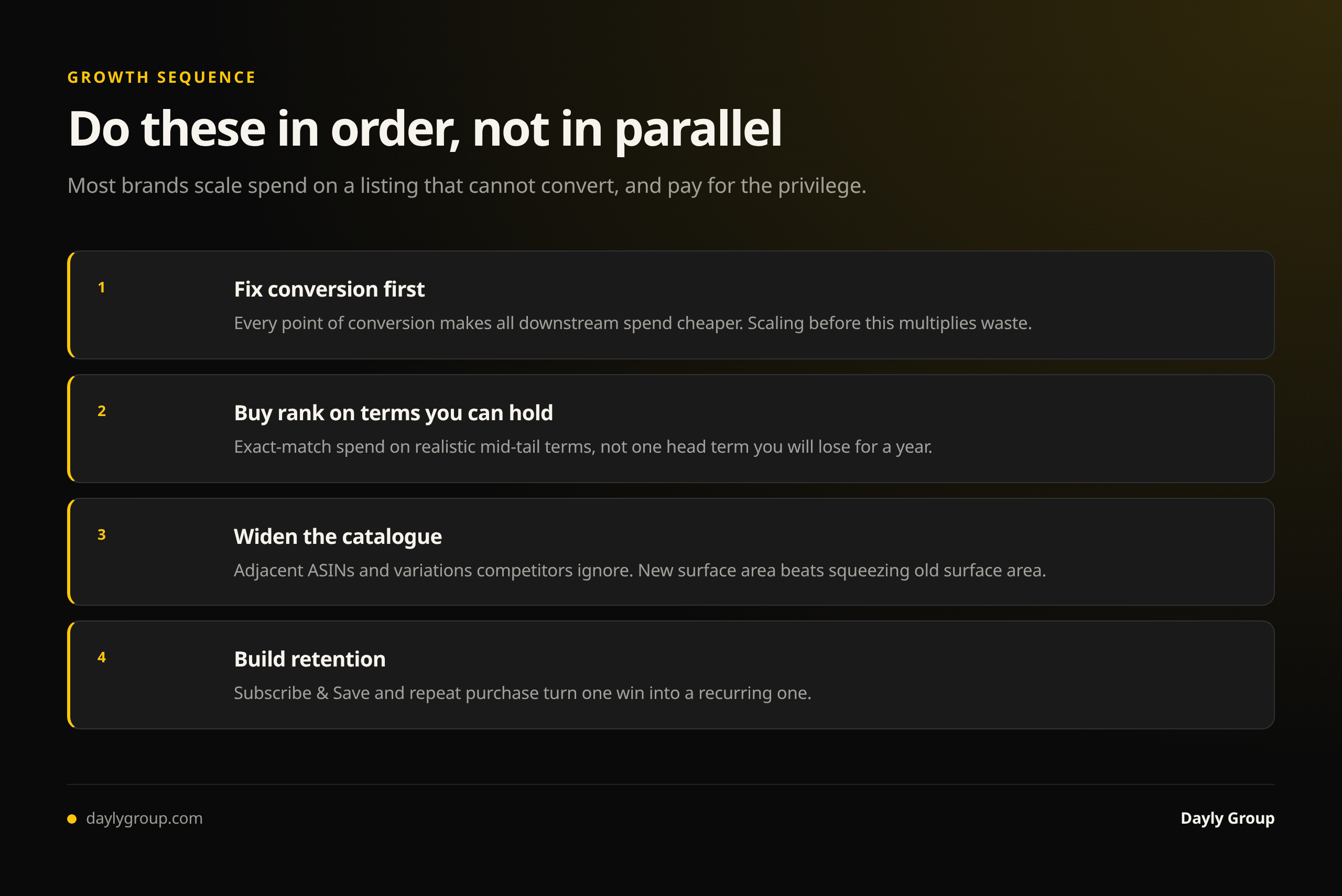
Q: How can I increase my Amazon sales? A: In sequence, not in parallel: fix conversion rate first so all downstream spend works harder, then buy rank on mid-tail terms you can realistically hold, then widen the catalogue with adjacent ASINs and variations, then build retention through Subscribe & Save and repeat purchase. Most brands scale ad spend on a listing that can't convert and pay for the privilege.
Q: Why are my Amazon sales not growing even though I increased ad spend? A: Because ad spend multiplies whatever your listing already does. If conversion is weak, more traffic means more wasted clicks at a worse ACoS. Check unit session percentage per child ASIN first — if it's below your category norm, the constraint is the page, not the budget. Why your sales are down walks the full diagnosis.
Q: What is the fastest way to increase Amazon sales? A: Conversion changes — main image, price, bullets, A+ content — move buyer behavior within days, making them the fastest genuine lever. Rank takes weeks to months. So the fastest real win is almost always improving the page rather than buying more traffic.
Q: How long does it take to grow Amazon sales? A: Conversion improvements show within one to two weeks. Rank-driven organic growth shows meaningfully at six to twelve weeks, with competitive head terms taking three to six months. How long Amazon SEO takes sets out the full timeline.
Q: Do promotions increase Amazon sales long term? A: Used strategically, yes — a promotion that generates velocity on a target keyword can lift organic rank and leave you higher than you started. Used out of desperation, no: it trains customers to a lower price, compresses margin, and the rank gained decays once the deal ends.
Keep reading
Book a free Gap Analysis. We'll tell you what's leaking, what's scaling, and where the next 30% lives.
Book a Gap Analysis →