
Scaling an Amazon Brand from 6 to 7 Figures: What Actually Changes
The tactics that get you to $1M are not the ones that get you past it. What breaks at seven figures, and the four shifts that matter.
Most brands that stall under $1M on Amazon aren't doing anything wrong. They're doing the six-figure playbook extremely well, and the six-figure playbook has a ceiling.
Six figures is usually one or two products, one keyword cluster, one person making every decision, and cash tight enough that inventory is the constraint. That's a workable machine. It just doesn't extend, because everything that got you there is single-threaded.
Here's what actually changes.
Shift 1: from one hero product to a catalogue
At six figures, one product carries the business. It's the fastest path early and the most fragile position later — one listing suspension, one competitor undercutting you, one stockout, and revenue halves.
Seven figures almost always comes from more surface area, not from squeezing more out of the hero SKU. Variations that capture adjacent search terms, bundles and multipacks that raise average order value without new manufacturing, sizes and formats competitors ignore, and genuinely adjacent products your existing buyer already needs.
The strategic reason matters more than the diversification: each new ASIN is a new set of keywords you can rank for. You're not just adding products, you're adding entry points.
The mistake is launching adjacent products before the hero is fully optimized. If your main listing converts at 8% when the category does 14%, a second product just gives you two underperforming listings.
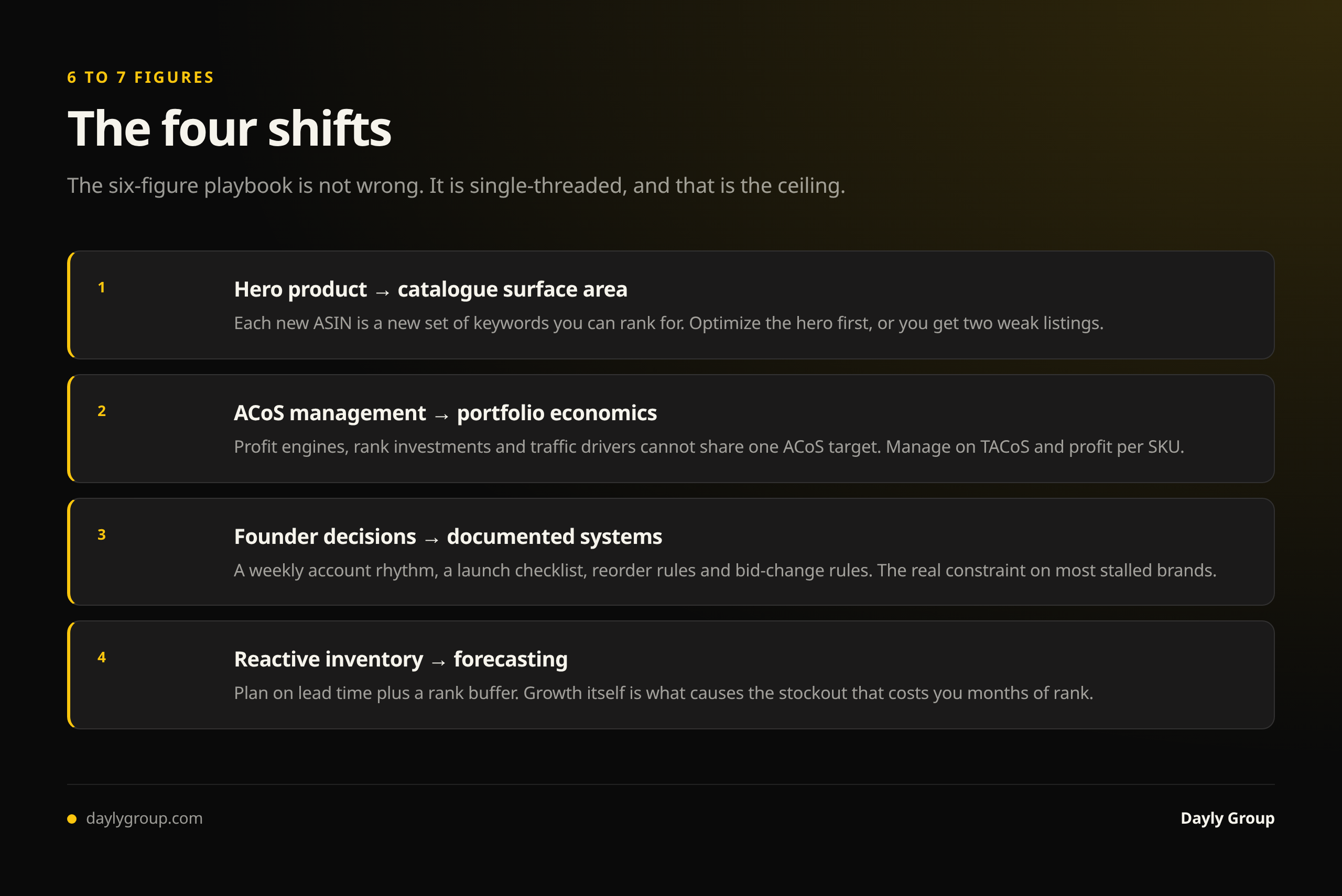
Shift 2: from ACoS management to portfolio economics
Six-figure advertising is one question: is this campaign profitable? Seven-figure advertising is a portfolio question, because different SKUs should have different jobs.
Some products are profit engines — mature, well-ranked, run at tight efficiency. Some are rank investments — new launches deliberately run at bad ACoS for a defined window to buy position. Some are traffic drivers that may barely break even themselves but bring buyers into a catalogue that monetizes them elsewhere.
Judging all three on the same ACoS target is the single most common seven-figure mistake. It kills launches before they can rank and starves the products that would compound.
This is where TACoS becomes the operating metric rather than an interesting one: it tells you whether total ad spend is building total revenue, which is the only question that spans a portfolio. ACoS vs TACoS covers the mechanics.
You also need contribution profit per SKU — revenue minus COGS, Amazon fees and ad spend. At six figures you can hold this in your head. At seven, with a dozen SKUs and real fee complexity, you cannot, and the SKUs quietly losing money are invisible without it.
Shift 3: from founder decisions to documented systems
This is the shift founders resist most, and it's the actual constraint on most stalled brands.
At six figures the founder does everything: keyword research, listing copy, bid adjustments, reorders, customer service. It works because volume is low enough. Past $1M, the same person is now the bottleneck on twenty decisions a day, and the ones that get dropped are the compounding ones — Search Query Performance never gets reviewed, reimbursement claims never get filed, listings never get retested.
What has to exist in writing:
- A weekly account rhythm. Which reports get checked, on what day, by whom. Most valuable single change here.
- A launch checklist. Keyword research, listing build, indexation confirmation, review generation, ad structure, and what "launched successfully" means.
- Reorder rules. Trigger points and lead times, so inventory decisions stop being a monthly panic.
- Rules for bid changes. What triggers a change, how much, and how long before you judge it.
None of that is glamorous. All of it is what lets you add a person, an agency, or a SKU without quality collapsing.
Shift 4: from reactive inventory to forecasting
At six figures, stockouts are annoying. At seven, they're the most expensive thing that happens to you, because you lose rank built over months and rebuild takes weeks after restocking.
The shift is planning on lead time plus a rank-protection buffer rather than on current sell-through, and accounting for the fact that growth is what causes stockouts. A product growing 40% quarter over quarter will run out on a forecast built from last quarter's velocity.
This is also where cash flow becomes strategy rather than accounting. Growth consumes cash — inventory is paid for before it sells — so brands frequently hit a cash ceiling before a demand ceiling. Knowing which of the two is actually constraining you determines whether you should be spending on ads at all this month.
What doesn't change
Being fair about this matters, because plenty of seven-figure advice is just added complexity:
Conversion rate is still the whole game. It's the multiplier on everything, at every size.
Indexation is still binary. Bigger brands are not exempt; large catalogues just have more unindexed ASINs nobody has checked.
Reviews still gate conversion. Above four stars, most of the battle is won.
Organic still beats paid over time. Organic gets cheaper as you build it; ads get more expensive as competitors bid.
The tactics don't change. The management of them does.
The honest constraint check
Before adding SKUs, spend or people, work out which single thing is actually capping you:
- Demand-capped? Your terms are maxed and you need new surface area — catalogue expansion.
- Conversion-capped? Traffic is fine, purchases aren't — fix listings before anything else.
- Cash-capped? You can sell more than you can afford to stock — inventory financing and margin, not ads.
- Attention-capped? Everything works but nothing gets done — systems and people.
Most brands guess wrong here, and spend on ads when they're conversion-capped or hire when they're cash-capped. Diagnosing it correctly is worth more than any tactic in this article.
If you want an outside read on which one is capping you, see what we've done for other brands and book a Gap Analysis call.
FAQ
Q: How do you scale an Amazon brand from 6 to 7 figures? A: Four shifts: expand from one hero product into catalogue surface area so you can rank for more keywords, move from single-campaign ACoS management to portfolio economics where different SKUs have different jobs, replace founder-held decisions with documented systems and a weekly account rhythm, and move inventory from reactive reordering to forecasting on lead time plus a rank buffer. First, diagnose which constraint is actually capping you.
Q: Why has my Amazon brand stopped growing? A: Usually one of four constraints: demand (your keyword terms are maxed, so you need new ASINs), conversion (traffic is fine but the page doesn't sell), cash (you can sell more than you can afford to stock), or attention (the founder is the bottleneck on every decision). Brands commonly misdiagnose this and spend on ads when the real limit is conversion or cash.
Q: Should I launch more products or optimize my existing ones? A: Optimize first. If your hero listing converts below category norm, launching a second product gives you two underperforming listings and splits your attention. Once the hero is genuinely optimized, catalogue expansion is the main route to seven figures because each new ASIN is a new set of keywords you can rank for.
Q: What ACoS should I target at seven figures? A: Not one number across the catalogue. Mature profit engines run at tight efficiency, new launches deliberately run at poor ACoS for a defined window to buy rank, and traffic drivers may break even while monetizing elsewhere. Judging all three against a single ACoS target kills launches before they can rank. Manage the portfolio on TACoS and contribution profit per SKU.
Q: How much does a stockout cost an Amazon brand? A: More than the lost sales, because you lose organic rank built over months and rebuilding takes roughly two to six weeks after restocking. At seven figures this is typically the single most expensive operational failure, which is why forecasting should include a rank-protection buffer rather than tracking current sell-through.
Keep reading
Book a free Gap Analysis. We'll tell you what's leaking, what's scaling, and where the next 30% lives.
Book a Gap Analysis →