
Amazon DSP Advertising: What It Is, How It Works, and When to Use It
Amazon DSP lets you reach shoppers on and off Amazon with programmatic ads. Here's what brand owners need to know before investing.
Amazon DSP gets oversold constantly. Agency decks make it sound like the secret weapon every brand needs. In reality, it's a powerful tool — but only for brands at a specific stage. Use it too early and you're lighting money on fire. Use it right and it extends your reach in ways Sponsored Ads simply can't.
Here's the unfiltered version.
What Amazon DSP Actually Is (And How It Differs from Sponsored Ads)
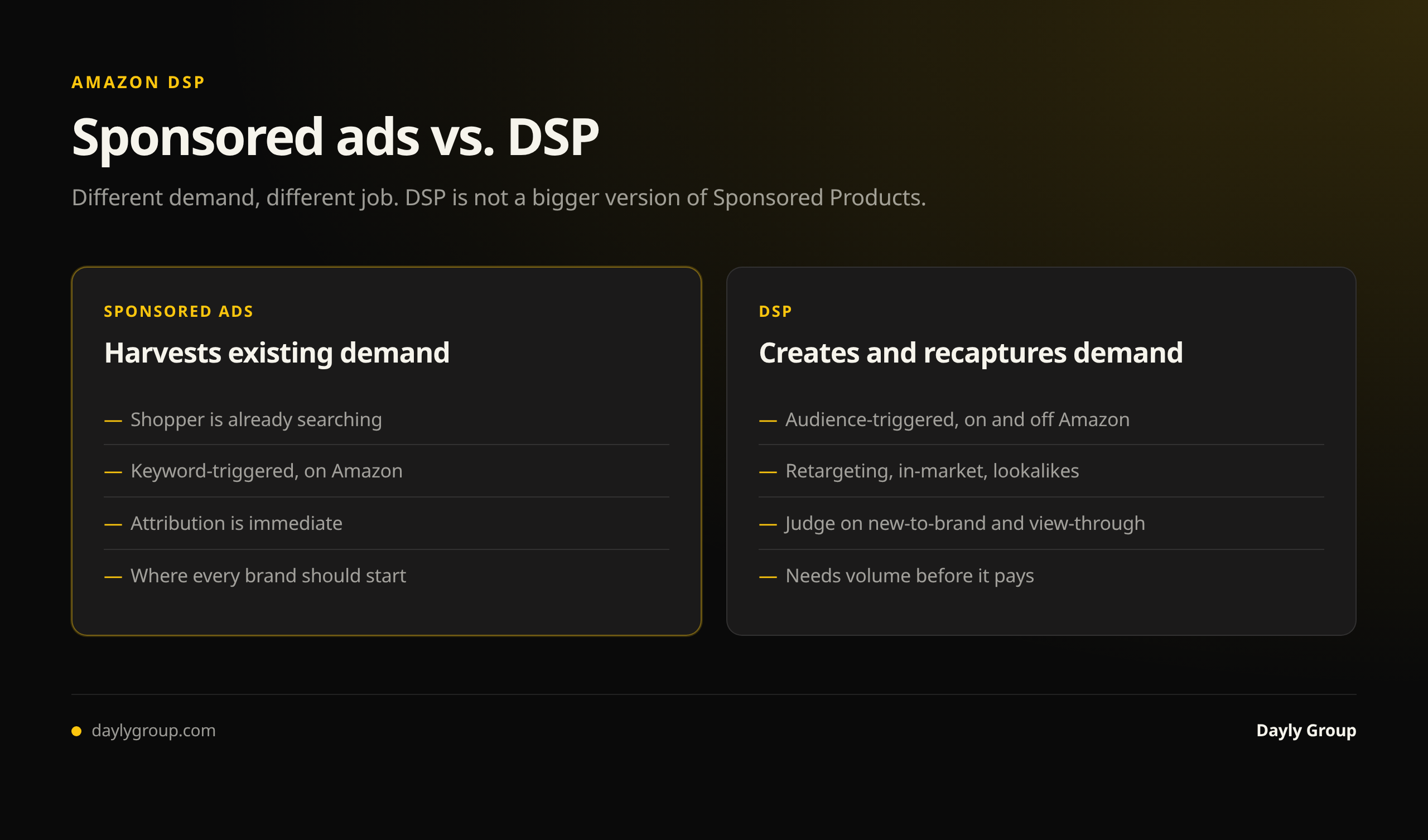
Sponsored Ads — Sponsored Products, Sponsored Brands, Sponsored Display — run inside Amazon's search results and product pages. They're auction-based, keyword or ASIN-targeted, and you only pay when someone clicks. They're the backbone of most Amazon advertising strategies and the right starting point for nearly every brand.
DSP (Demand-Side Platform) is different in almost every way. It's a programmatic advertising platform that lets you buy display and video ad inventory across Amazon's own properties and thousands of third-party websites and apps — think IMDb, Twitch, and a massive network of publisher sites where Amazon has first-party shopper data baked in.
The key distinction: Sponsored Ads reach people who are actively searching on Amazon right now. DSP reaches people based on who they are and how they've behaved — whether they're on Amazon or not. You're buying audiences, not keywords.
DSP is also managed differently. You typically work through Amazon directly (minimums around $50K) or through an agency with DSP access. There's no self-serve bidding dashboard the way there is with Sponsored Ads.
Who DSP Is Actually For
This is where most DSP conversations go sideways. Agencies will pitch it to brands doing $30K a month. Don't bite.
DSP starts making sense when you're generating at least $500K–$1M in annual Amazon revenue and your Sponsored Ads account is already healthy — meaning you have solid conversion rates, optimized listings, and you're not leaving obvious money on the table with basic PPC. If your Amazon PPC management isn't dialed in yet, fix that first. DSP won't save a leaky funnel.
Beyond revenue threshold, DSP fits specific use cases well: brands with a broad product catalog, established brands looking to defend market share, businesses with meaningful off-Amazon audiences they want to retarget, and brands launching into new categories where awareness matters before purchase intent kicks in.
If you're a newer brand still building your review base and refining your conversion rate, DSP is premature. Spend that budget on Sponsored ads where the ROI is more predictable and the feedback loop is faster.
The 3 DSP Campaign Types That Actually Move the Needle
Not all DSP is created equal. Most of the performance comes from three specific approaches.
Retargeting (your highest-intent traffic)
This is where DSP earns its keep most reliably. You're targeting people who visited your product pages, added to cart, or viewed similar products — and then left without buying. These aren't cold audiences. They already know you exist. You're just staying in front of them as they browse elsewhere online.
Retargeting campaigns typically have the tightest return on ad spend and the shortest attribution window. If you run DSP, this is the place to start.
Conquest (stealing market share)
Conquest campaigns target shoppers who've been browsing your competitors' products. You're showing your ads to someone who just looked at a competing ASIN, hasn't bought yet, and is likely still in decision mode. Done right, it's a clean way to intercept buyers before they convert on a competitor. Done sloppily — with weak creative or a listing that doesn't clearly outperform the competitor — it's expensive noise.
Lifestyle and In-Market Audiences
Amazon's first-party data is the real differentiator here. You can target segments like "frequent premium beauty buyers," "pet owners who buy online monthly," or "shoppers who've purchased in your category in the last 90 days." These aren't guesses — they're built from actual purchase behavior at massive scale.
This is where DSP shines for building awareness with genuinely high-fit audiences, not spray-and-pray display advertising.
How to Measure DSP Success
DSP attribution is more nuanced than Sponsored Ads, and if you measure it the wrong way you'll either undervalue it or convince yourself it's working when it isn't.
The metrics that actually matter:
Total ROAS and blended ROAS — Look at what's happening to your account-level return, not just the attributed DSP return in isolation. DSP often influences purchases that get credited elsewhere.
New-to-brand rate — A healthy DSP program should be bringing in customers who haven't bought from you in the last 12 months. If your new-to-brand rate on DSP orders isn't materially higher than your Sponsored Products rate, you may be paying premium CPMs to reach the same buyers twice.
Branded search lift — Run a baseline before you start DSP, then track whether branded search volume increases. This is the clearest signal that your awareness campaigns are working. If no one is searching your brand name after 60 days of DSP, the campaigns aren't generating the awareness you're paying for.
Detail page view rate and add-to-cart rate from DSP traffic — These tell you whether your creative and audience targeting are actually qualifying buyers before they click.
Common DSP Mistakes Brands Make
Treating it like Sponsored Ads. DSP requires more creative iteration, longer measurement windows (30–60 days minimum), and different optimization levers. Brands that expect the same week-to-week feedback loop get frustrated and pull out before the campaigns find their footing.
Weak creative. DSP is a display medium. If your ad creative looks generic or doesn't make an immediate case for why your product is different, you're burning impressions. Static images need strong copy and a clear hook.
No audience suppression. Showing DSP ads to people who just bought from you is wasted spend. Always suppress recent purchasers and existing customers from prospecting campaigns.
Siloing DSP from the rest of the account. The best DSP strategies are built in direct coordination with your Sponsored Ads setup. For brands on full account management, that integration happens naturally — but if DSP and PPC are managed separately, you'll see overlap, attribution confusion, and missed opportunities to reinforce messaging across both channels.
Chasing CPM over outcomes. Low CPMs feel good on a report. They're meaningless if the audience doesn't convert or if the inventory is low-quality. Optimize for business outcomes, not vanity media metrics.
When DSP Is Not Worth It Yet
Be honest with yourself here. DSP is not the right move if:
- Your Sponsored Ads ROAS is below 3x and you're not sure why
- You're under $500K annual Amazon revenue
- Your listings aren't converting above category average
- You don't have the budget to run it consistently for 60–90 days (campaigns need time to optimize)
- Your creative production isn't strong enough to produce multiple ad variations
The brands that get real value from DSP are already winning on the fundamentals. DSP amplifies what's working — it doesn't fix what isn't.
If you're not at that stage yet, the highest-leverage move is to get your Sponsored Ads working harder, clean up your listings, and build the revenue base that makes DSP a smart next step instead of an expensive experiment.
We've been through this with hundreds of Amazon accounts. The brands that rush into DSP before they're ready almost always regret it. The ones who invest in it at the right time — with the right structure — see it become a meaningful growth lever. Know which camp you're in before you commit the budget.
FAQ
Q: What is Amazon DSP? A: Amazon's demand-side platform for programmatic display and video advertising, targeted by audience rather than by keyword, and served both on Amazon and across the web. Unlike Sponsored Products, which harvests shoppers already searching, DSP reaches people before or after the search using Amazon's purchase and browsing data.
Q: How is Amazon DSP different from Sponsored Products? A: Sponsored ads are keyword-triggered, on-Amazon, and attributed almost immediately — they harvest existing demand. DSP is audience-triggered, runs on and off Amazon, and creates or recaptures demand, so it's judged on new-to-brand sales and view-through conversions over longer windows. DSP is not a bigger version of Sponsored Products.
Q: Is Amazon DSP worth it for a smaller brand? A: Usually not yet. DSP needs enough traffic to build meaningful audiences and enough margin to absorb a longer attribution window. If your Sponsored campaigns still have unexploited efficient headroom, spend there first — that's cheaper demand you already have.
Q: How do you measure Amazon DSP success? A: Not on last-click ACoS, which will always look poor. Use new-to-brand sales, view-through conversion, retargeting return, and total account TACoS. The real question is whether total revenue grew more than total spend across both DSP and Sponsored together.
Q: Do you need an agency to run Amazon DSP? A: You need either an agency or an Amazon-managed service, since self-service DSP access has historically required qualification and meaningful minimum spend. More importantly, DSP rewards audience strategy and creative iteration, which is where most in-house teams lack capacity rather than access.
Keep reading
Book a free Gap Analysis. We'll tell you what's leaking, what's scaling, and where the next 30% lives.
Book a Gap Analysis →