
By Noah Dayan, Co-Founder & CEO, Dayly Group
5 TikTok Shop Mistakes Keeping You Under $100K a Month
Most TikTok Shops that stall under $100K a month make one of five mistakes: a commission too small to matter to creators, too few samples, automated creator relationships, no homework on what sells for competitors, and judging the channel in its first months.
If your TikTok Shop is selling but stuck under $100K a month, it is usually one of five mistakes. Your commission pays creators too little per sale. You judged the channel on 100 samples. You automated the creator relationship. You skipped the homework on what sells for competitors. Or you expected month-one results.
This is the written version of our video answer. Watch it above, then read the full answer below.
A few terms first. GMV, gross merchandise value, is the total order value that goes through your shop. An affiliate creator is a creator who earns a commission on each sale their video drives. AOV is average order value. A sample is a free unit you send a creator so they can make a video. If you are still setting up the basics, start with how to launch on TikTok Shop. This post is for brands that are already live and selling, but not breaking through.
The mistakes are counted down from five to one. Number five is the one we see most often.
Mistake 5: is your commission too low for creators to care?
Yes, if creators earn less than about $5 for every unit they sell. Creators do not think in percentages. They think in dollars per sale, and a percentage of a small AOV is a small number.
Here is the math Noah walks through. For example, say your product sells for $20 and you offer 20% commission. The creator makes $4 a sale. Our rule of thumb is a minimum of about $5 per unit sold, and more is better.
Now look at it from the creator's side. To make real money at $4 a sale, they would have to sell hundreds or thousands of units. They get offers from other brands every week. Why would they pick yours?
Competitors make it worse. For example, say a competitor sells at a $40 AOV and also offers 20%. They pay creators $8 a sale while you pay $4. Same percentage, twice the money. The best creators go where the money is.
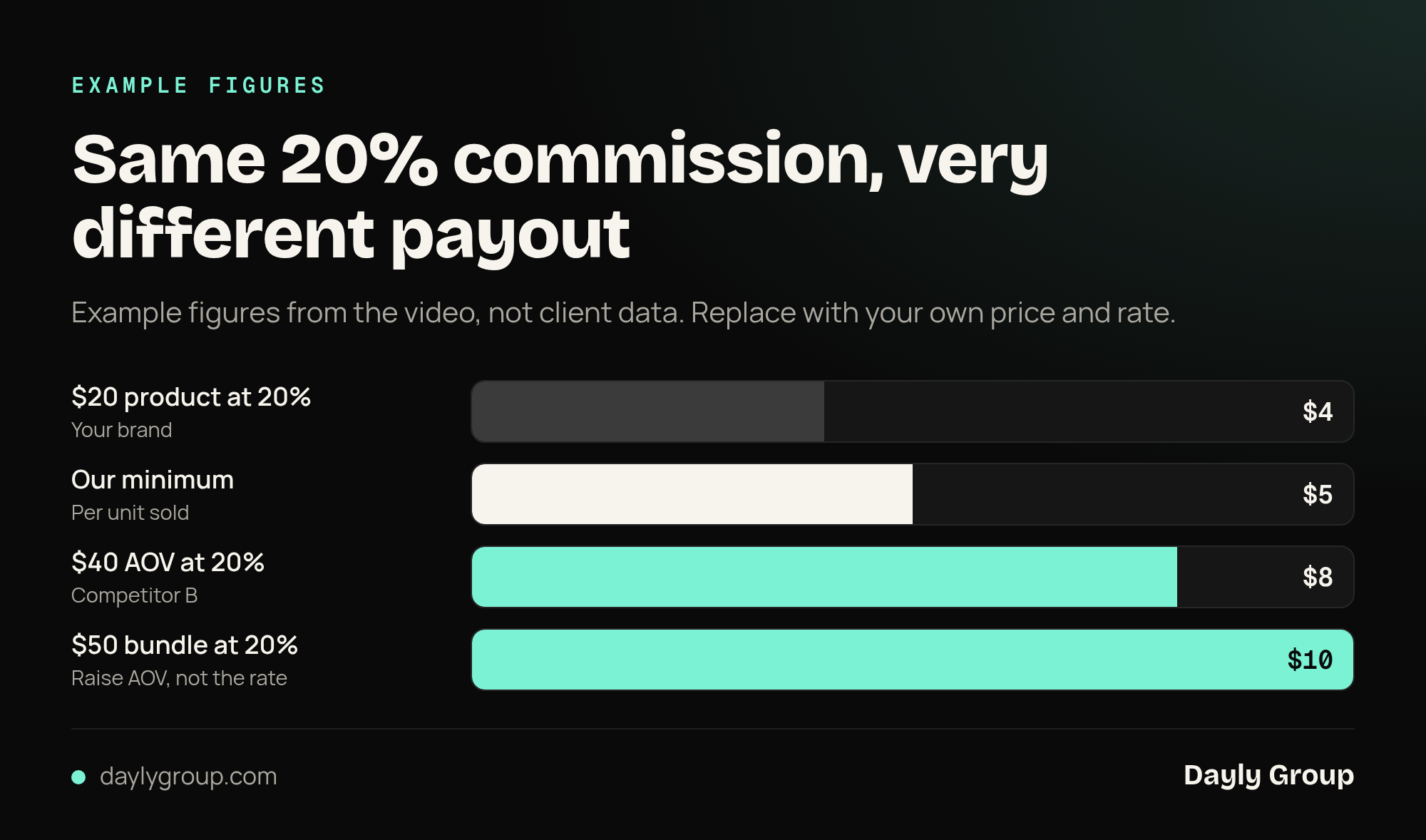
Example figures from the video, not client data. Swap in your own price and commission rate.
The fix is not always a higher rate. Often it is a higher AOV:
- Work out what your creators earn per unit today, in dollars.
- Check what competitors in your category pay per unit: their AOV times their commission.
- If you are under about $5 a unit, bundle. For example, bundle so your AOV is $50 to $60. At 20% of $50, a creator makes $10 a sale instead of $4.
- Check that the new offer still leaves you margin after fees. Our breakdown of TikTok Shop affiliate commission rates covers how to set the rate itself.
Mistake 4: is 100 samples enough to test TikTok Shop?
No. 100 samples is not even a test size. TikTok Shop has a huge amount of content from a lot of creators across a lot of categories, and 100 samples produces too few videos to tell you anything.
Walk through what 100 samples actually gives you. Not every creator posts. If 70 to 80% of them do, you get 70 to 80 videos. Of those, we typically see a 5 to 10% hit rate, meaning a small share of videos actually drive GMV. That leaves a handful of videos that sold. A handful is too small a sample to base any decision on.
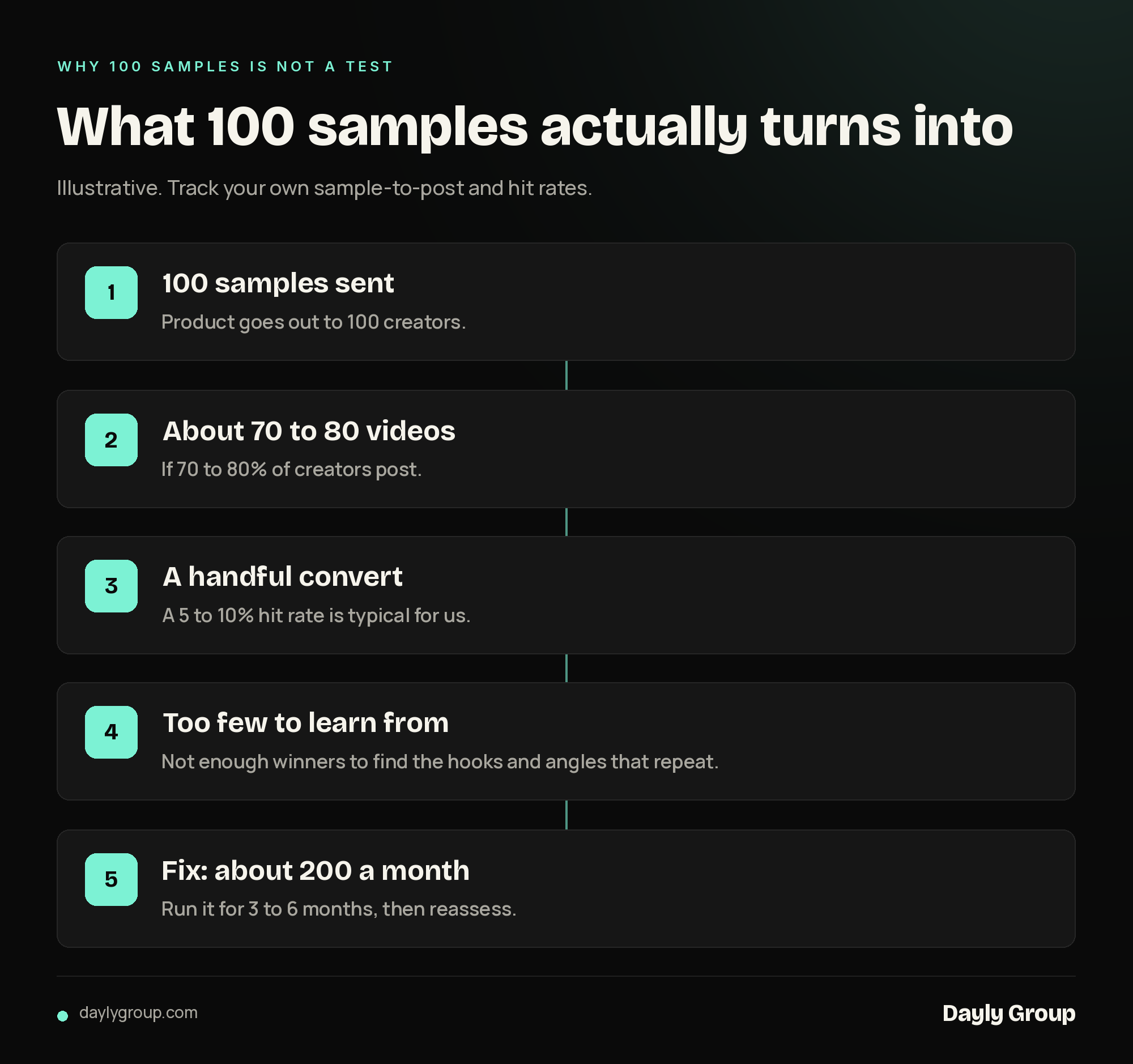
The bigger cost is learning. Sampling is how you find winning hooks, winning creators and top performing angles, so you can repeat them with the next batch of creators. Too few samples means a slow, expensive feedback loop.
How we run it: a baseline of about 200 samples a month, over three to six months, then reassess. Alongside volume, push for more videos per sample from each creator you send product to. If most of your samples never turn into a video, read why TikTok Shop samples are not getting posted first.
Mistake 3: should you automate TikTok Shop creator outreach?
Automate the outreach, not the relationship. Outreach tools are useful for finding and inviting creators at volume. Automated check-ins after that are where brands lose people.
Noah compares automated creator messages to the order confirmation email you get after buying something online. Most of the time you see the subject line and never open it. Creators treat "your sample has shipped" and "your sample was delivered" messages the same way.
What we do instead is build a personal relationship from the first sample to the first video and beyond:
- Before or with the sample, send a winning hook or angle that worked for us or for a competitor, or a short brief.
- When the sample lands, send a friendly, personal nudge.
- When they post, like the video, comment on it and send real feedback on what worked.
- If the creator is a good fit, ask for 3 to 5 more videos.
- Reward the creators who perform.
A lot of creators want to be pointed in the right direction. They want help understanding the product and how to sell it. Treat them as people, and you get more videos per sample, which is how you get more GMV per sample. The broader system for recruiting and keeping creators is in our guide to the TikTok Shop affiliate program for brands.
Mistake 2: are you skipping your homework on competitors?
If you have not studied what already sells in your category, yes. Your competitors have already paid to find out which creators, angles and offers work. Much of it is visible.
Use a TikTok Shop analytics tool to look at the top competitors in your category, then work through this list:
- Which creators sell for them, both top creators and smaller ones that still drive GMV.
- How many times each creator posted for that brand over the whole time they worked together.
- Which types of content and which angles brought in the most GMV.
- What offers and commissions those creators get, and which bundles they pushed.
Then build your version. That might be a unique selling feature you can put a twist on, a better price, or a bundle that works better. Reach out to creators already selling in your category with a better deal. Finding them is covered step by step in how to find TikTok Shop creators that sell.
Noah calls this more of a mentality than a single lever. It is a habit you bring to every launch and every push to scale: do not be afraid to look at what competitors and their creators are doing, and apply it to your brand.
Mistake 1: how long does it take TikTok Shop to start selling?
Longer than one or two months. Expecting to reach $100K a month in month one or two is the mistake we see brands quit on. It is possible with strong brand recognition, but it is not a fair benchmark for most brands.
Many brands come in expecting TikTok Shop to scale like Meta or Google ads, where you put a dollar in and expect a predictable return. TikTok Shop works more like a testing platform. You look at what is working, try to replicate it, and hit some bumps along the way.
How to set the timeline:
- Do not give up in the first two to three months.
- Take the data from each batch of creators and content, and apply it to the next batch.
- Give a new channel the same patience you gave your ads when they were new. Noah's guidance in the video is that it is fine for a new platform to take 6 to 12 months to take off.
- Once you have proven content, scale it with paid. Our GMV Max explainer covers how that works.
Which mistake is your shop making?
Most shops stuck under $100K a month have more than one of these, and they compound. A thin offer means fewer good creators. Fewer creators means fewer videos. Fewer videos means less data and fewer winners. Few winners means nothing for paid to scale.
A quick self-check:
- Do your creators earn at least about $5 per unit sold?
- Are you sending around 200 samples a month, and planning in months, not weeks?
- Does a person talk to every creator after the sample ships?
- Do you know which creators and angles sell for your top three competitors?
- Are you judging results on a timeline longer than two months?
Any "no" is the place to start.
What does Noah say in the video?
Transcript edited for readability.
"If you're starting to get to 100K and above per month, we're going to talk about the top five most common mistakes that we see shops make day to day that prevent them from getting to 100K plus months. Again, we've scaled many brands to 100 plus thousand dollar months, and these are the most common ones we see. Stick around to see the top five, as the last one is pretty, pretty surprising.
This is probably the most common one that I personally see, and it's the offer. A lot of people don't think about this, but for example, your product is a $20 product and you're offering, let's say, 20% commission. The creator is only getting $4. Typically I would like to see a five to six dollar minimum in terms of the dollar amount a creator gets compensated. What people like to do is bundle things so that the average order value is $50 or $60. So they're getting 20% of $50, which would be $10, instead of a $4 commission.
Another thing that bites people is that their competitors run a better offer. For example, brand A, your brand, has a $20 price point and you're offering 20%. Then there's competitor B that has a $40 average order value, also offering 20%. He doubled your AOV, so he's giving twice the amount to creators, which is a lot more attractive. He's giving $8 to his creators and you're giving $4 to yours, which makes the creator want to go to that brand, because they have a more compelling offer. Also, just think about it from the creator's position. You would have to sell hundreds and hundreds, if not thousands, to actually make money off a $4 commission. So that's probably one of the most common reasons I see brands struggle to get high quality creators. Creators won't bother to work with you when you're compensating them a tiny percentage of a tiny AOV.
'We've sent 100 samples and we got nothing.' Is 100 samples enough? TikTok Shop is a platform with a lot of content getting pushed up from a lot of different creators in a lot of different categories. So 100 samples isn't even a test size, I would say. We require at least 200 samples per month on a three to six month timeline to then start to see some kind of return. The main reason it's unrealistic to get anything from 100 samples is that if 70 to 80% of your creators actually post and you're sending to 100 creators, your baseline is 70 to 80 pieces of content. And out of those, we see a five to 10% hit rate in terms of how much GMV is generated. So five to 10% of those 70 to 80 pieces of content will actually get some kind of conversion. That's such a tiny sample size to base yourself off of, which is why 100 samples really isn't enough. We always recommend at least 200 samples for three to six months, then reassess. It also makes the test and learning phase a lot harder, because you're spending all this money on sampling, and the feedback loop from that is getting winning hooks, winning creators and top performing angles, so you can reiterate that with other samples and other creators. That's the main reason you'd want to maximize the number of samples and the number of videos per sample you send out.
Coming in at number three, and this is again very common: a lot of brands just have automated outreach to creators using Euka, Reacher and Cruva. It's great to use those outreach tools, and it's good to do some automated outreach. But automated check-ins with creators, I like to compare to when you make a purchase on a website and get an email confirmation. Nine out of 10 times you're not really looking at that confirmation. You see the subject line and you don't bother opening it. It's a similar concept with creators: all these automated messages for when you ship the sample, when they get it, and all that. They don't really care to see that. Instead, what we like to do is build a personal relationship with them throughout that process. We'll send them a winning angle or winning hook that did well for us or for a competitor, or we'll send them a brief. We'll engage with them once they get the sample and give them a friendly nudge. Once they create the piece of content, we're going to like it, comment on it, and send them feedback telling them we like the content. Then we'll add a few more layers of trying to get them to post three to five additional pieces of content if we like that creator. And also just treating them as human as possible, which is why I don't believe in automating the relationship building part. The relationship building part is what makes the synergy between a brand and a creator work. So again, giving them feedback, rewarding them when they're performing, and building that relationship. A lot of these creators are looking to be pointed in the right direction and want you to help educate them on the product and how to sell it. So that would be my number three.
Quick one: if you want an audit from me and my team on your TikTok Shop, to show you how you can break past 100K a month, click the first link in the description and book a call with me, and we'll show you exactly where those gaps lie.
Number two, I call not skipping your homework. Use Kalodata and FastMoss and take a look at what competitors in your category are doing. More specifically, look at the creators that are working for them. How many times do those creators post for those brands across the whole timeline of working together? Look at what types of content got them the most GMV, and what different angles they tried while working with that brand. Look at some of the top creators, and at some of the smaller creators that have still generated GMV, and see what kind of strategy you can put together to replicate that for your brand. Whether it's a unique selling feature you can add a twist on, or pricing a little better, or a specific bundle that works better, don't be afraid to look at what competitors are doing, look at what creators are doing for your competitors, and apply that to your brand. This is more of a mentality than something you physically change or a lever to pull. It's a mentality when launching or scaling on TikTok Shop and trying to break over 100K a month.
And number one would be trying to force or expect to scale to 100K in one to two months. Again, it is possible if your brand has enough recognition. But if you're giving it everything you have in months one and two and expecting to get there by month three, it's a bit unrealistic. A lot of brands come into it thinking they can scale like it's Meta or Google, where they'll put $1 in and get $3 out. But TikTok Shop is more of a testing platform, where you're looking at what's working and trying to replicate it, and in that process you will have some bumps in the road. So simply not giving up in the first two to three months, and taking the data you got back and applying it to your next batch of creatives and creators, is probably the biggest piece of advice I can give a brand trying to crack above 100K a month.
So there we have it. Those are the top five things I would optimize to get you above 100K a month, and the most common things we see that prevent brands from scaling to 100K plus a month. To recap: pay creators at least $5 a unit or more, and look at what competitors are offering, what their AOV is, what commission they give creators, and how you can give at least $5 per unit sold. At number four: send more than 100 samples. 100 samples for one to two months just won't cut it in terms of learning, generating revenue and getting angles back that have worked. So commit to 200 samples a month, more or less, on a longer timeline. At number three: support creators personally. Don't just blast outreach and have automated agents replying and following up. Actually build relationships with them. Go on their profiles, see what content they post, talk to them, tell them what you like about their content or where they can improve, send them briefs, or give them offers that are unique to them. Do your homework: look at competitors, what's doing well for them and what isn't, the creators that have performed for them, the offers they give creators, and the bundles a specific creator has pushed that worked well through a specific angle. Do your homework on what's working for them and try to replicate it for yourself. And lastly, extend your timeline. Don't try to do things in one to two months. It's okay to launch on a new platform and for it to take six to 12 months to take off. A lot of brands invest tons of money into Meta, and it takes a lot of time for things to get traction there. The same rule should apply to TikTok, when it's a brand new platform that a bunch of brands are trying to get on. That's it for this video. I hope this was valuable. Take a look at the other videos we have, subscribe, and we'll see you in the next one."
FAQ
Q: Is 10% or 20% commission enough on TikTok Shop? A: TikTok Shop commission is enough when it pays creators at least about $5 per unit sold, whatever the percentage. For example, on a $20 product, 20% is only $4 a sale. If your price is low, bundle to raise AOV rather than judging the rate alone.
Q: How many samples do you need to test TikTok Shop? A: A real TikTok Shop sample test is more than 100 samples. Our baseline is about 200 samples a month over three to six months, then reassess. 100 samples usually yields only a handful of converting videos, which is too few to learn from.
Q: Should you automate TikTok Shop creator outreach? A: Automate TikTok Shop creator outreach, not the relationship after it. Automated check-ins get ignored like order confirmation emails. A person should brief creators, nudge them when the sample lands, give feedback on their video and ask the good ones for more.
Q: How do you find what sells for competitors on TikTok Shop? A: Use a TikTok Shop analytics tool to see a competitor's top creators, top videos and angles by GMV. Note how often each creator posted and what offers and bundles they pushed, then build your version and offer those creators a better deal.
Q: How long does it take TikTok Shop to work? A: TikTok Shop usually takes longer than one or two months to work. Do not judge it in the first two to three months. Feed each batch's data into the next, and expect a new channel to take months, not weeks, to take off.
If you want to see which of these five is capping your shop, we build a free TikTok Shop Gap Report before the first call. You can also watch the rest of this series at Noah Dayan on YouTube.
Keep reading
Book a free TikTok Shop strategy call. We’ll tell you what’s leaking and where the next GMV is.
Apply for a strategy call →