
Seasonal Brand
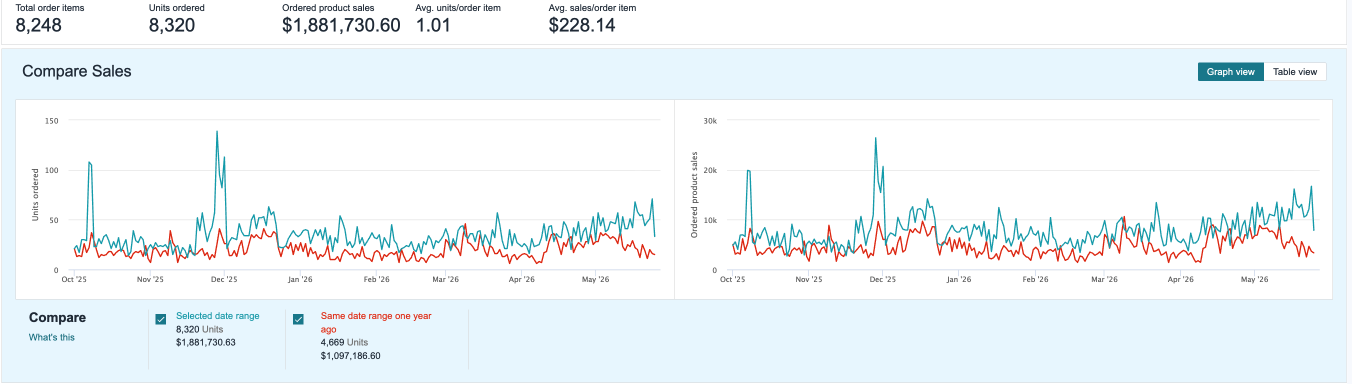
$1.1M → $1.88M revenue year over year — up 71.5%.
Weak buyer intent targeting, unoptimized listing images and A+ content, no dedicated ranking campaigns, and soft SEO across the catalog.
- Built buyer-intent-focused campaign architecture
- Optimized A+ content and listing imagery
- Deployed catch-all + brand-defense campaigns
- SEO overhaul across hero product listings
The starting state
This brand's year is decided in four months. September through December is when the category's demand arrives, and the rest of the year is preparation for it.
The account went into that window with three problems. Its campaigns weren't organized around buyer intent, so bids were being set against terms that looked relevant and converted poorly next to terms that converted well. Its listing images and A+ content hadn't been optimized, meaning traffic arrived at a page that under-converted. And there were no dedicated ranking campaigns on the hero products, so organic position going into peak was whatever the previous year had left behind.
For a seasonal brand, that last one is expensive in a specific way: you cannot fix organic rank in December. Ranking is earned with velocity over weeks, so the work has to be done before demand arrives or it doesn't count that year.
What we changed
Rebuilt the campaign architecture around buyer intent. Instead of grouping by product, campaigns were grouped by what the shopper was actually trying to do — a research-stage query and a ready-to-buy query need different bids and different landing products. This is what makes it possible to pay premium CPCs during peak without lighting money on fire.
Optimized A+ content and listing imagery. Conversion rate is the multiplier on everything else. In a seasonal window, a one-point CVR improvement is worth far more than the same improvement in a flat month, because it applies to compressed demand.
Deployed catch-all and brand-defense campaigns. Catch-all to sweep the long tail that no structured campaign was mapped to; brand defense to stop competitors converting shoppers who were searching for this brand by name during the highest-intent weeks of the year.
SEO overhaul on the hero listings, timed early. Keyword coverage and indexation were rebuilt ahead of the season so ranking campaigns had something to push against.
The numbers
Like-for-like, October through May, one year to the next:
- Revenue: $1,097,187 → $1,881,731 — up 71.5%
- Units ordered: 4,669 → 8,320 — up 78%
The comparison is deliberately the same window against itself a year earlier — spanning the peak season and the quieter months around it. For a brand this seasonal, month-over-month growth in October means nothing; only the year-over-year comparison is honest.
One number that went the other way
Average revenue per unit fell about 4%, from roughly $235 to $226.
That's worth being straight about. Growth here came from volume, not price — 78% more units at a slightly lower average order value. The mix shifted toward more accessible products as the catalog broadened and the campaign structure started catching a wider set of buyer intents.
For this brand that was the right trade: 78% more units at 4% lower AOV is a much larger business. But it's the kind of detail that gets quietly dropped from case studies, and it matters if your own margin structure is thin, because the same trade would land differently.
See how we approach listing optimization, or read how long Amazon SEO takes to understand the timing constraint on seasonal work.
Book a free Gap Analysis. We'll audit your account the same way we audited Seasonal Brand.
Book a Gap Analysis →