
Journal Brand
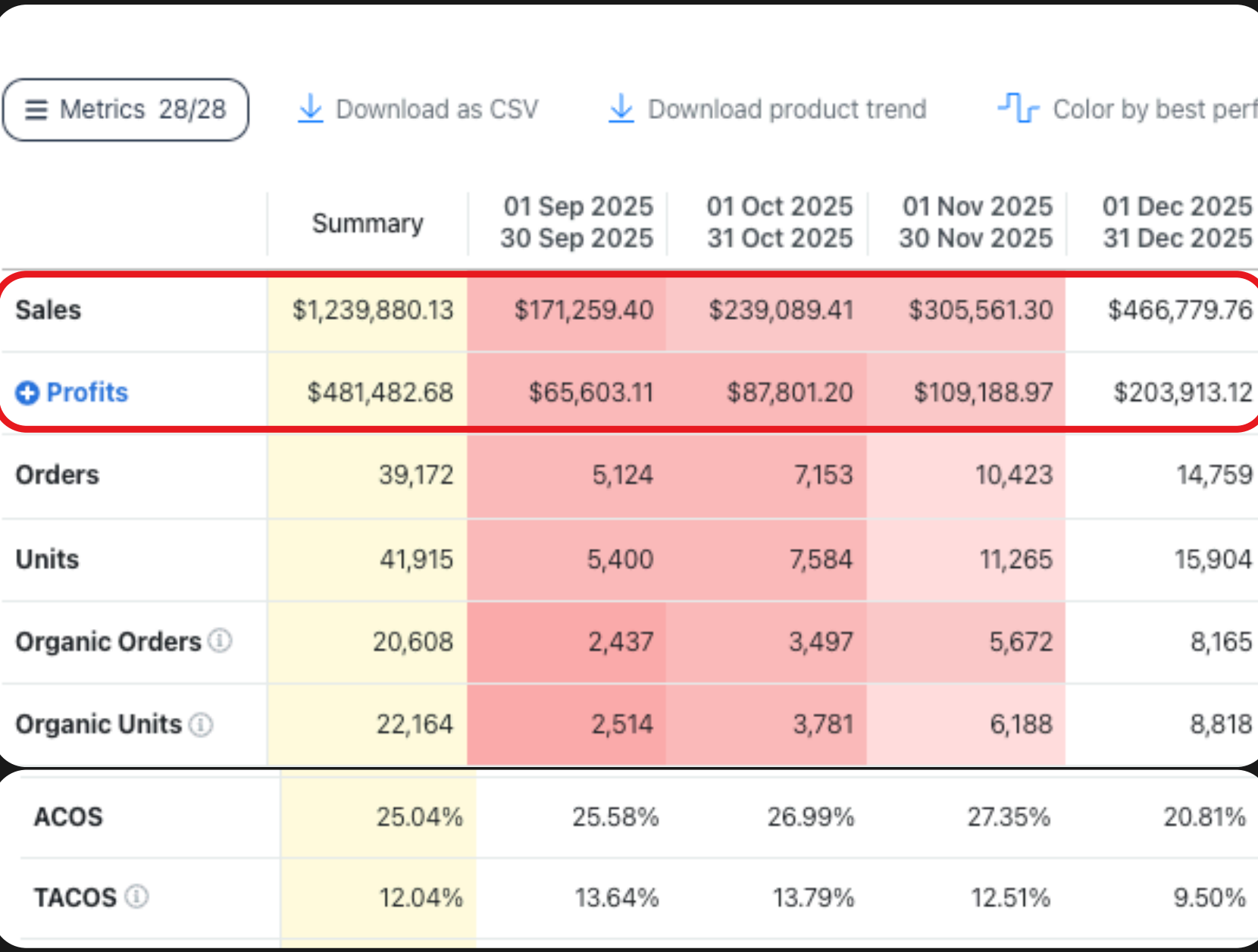
+172% revenue and +210% profit in four months.
Flat sales plateaued with frequent stockouts, over-reliance on one hero product, no ranking campaigns, weak SEO, and no catch-all or brand-defense structure.
- Streamlined inventory forecasting to eliminate stockouts
- Expanded revenue across the full catalog
- Rebuilt ad structure with catch-all + defensive campaigns
- SEO overhaul to unlock new organic rankings
- Raised TACoS targets on higher-margin SKUs that needed more budget
The starting state
This brand was doing about $171,000 a month on Amazon and had been flat for a while. That flatness is the part worth explaining, because the account wasn't neglected. Ads were running, listings existed, someone was watching the numbers.
The problem was that almost all of the revenue came from one hero product, and that product kept going out of stock.
Those two facts compound in a way most operators underestimate. When a single ASIN carries the account, a stockout doesn't just cost you that ASIN's sales for the week — it costs you the sales velocity that drives the ranking, which means when inventory comes back you're not returning to where you left off. You're rebuilding. The account was spending a meaningful part of every quarter recovering from self-inflicted damage.
What we changed
Inventory forecasting first, before anything else. No advertising change survives a stockout, so this came first. Reorder points were rebuilt off actual sell-through velocity with lead time and a real safety buffer rather than eyeballed reorder dates.
Spread revenue across the catalog. The rest of the catalog was effectively unadvertised — the hero product absorbed all the attention because it had the best return. That's locally correct and strategically fragile. We built out the supporting catalog so the account had more than one engine.
Rebuilt the ad structure with catch-all and brand-defense campaigns. Two gaps: no campaign catching the long tail of relevant-but-unmapped search terms, and nothing defending the brand's own name from competitors bidding on it. Brand defense in particular is cheap traffic that converts at the highest rate in the account.
Raised TACoS targets on higher-margin SKUs. This one is counterintuitive. Most accounts run one efficiency target across the whole catalog, which systematically underfunds the products that can most afford traffic. We let the high-margin SKUs spend more, because on those units an extra advertising dollar buys more contribution than it costs.
Rebuilt organic relevance. SEO across the listings was thin, so every incremental sale had to be bought. Fixing keyword coverage and indexation meant the account's growth wasn't rented.
The numbers
Four months, September through December:
- Monthly revenue: $171,259 → $466,780 — up 172%
- Monthly profit: $65,603 → $203,913 — up 210%
- TACoS: 13.64% → 9.50% — 4.1 points more efficient
- Organic units: 2,514 → 8,818 — up 251%
Across the four months the account did $1,239,880 in sales and $481,483 in profit.
Two things are worth pointing out. First, profit grew faster than revenue — 210% against 172%. Growth that comes from buying more traffic shows the opposite pattern. Second, TACoS fell while spend rose in absolute terms. The account got more efficient while getting bigger, which is the signature of structural work rather than harder bidding.
The organic units number is the one we'd actually point to. Tripling organic volume means the growth doesn't disappear the month you pause ads.
The honest part
December should have been bigger. The brand ran out of stock on a key product during the peak window, and we calculate that cost roughly $100,000 in lost sales — the month would have landed near $560,000 instead of $466,780.
We're including that because it's the whole lesson of this account. Inventory forecasting was the first thing we fixed and it was still the thing that capped the best month of the year. On a catalog this concentrated, supply is a growth lever, not a back-office function.
Read the method in our Amazon PPC management guide, or see what full account management covers.
Book a free Gap Analysis. We'll audit your account the same way we audited Journal Brand.
Book a Gap Analysis →