

From You Flowers
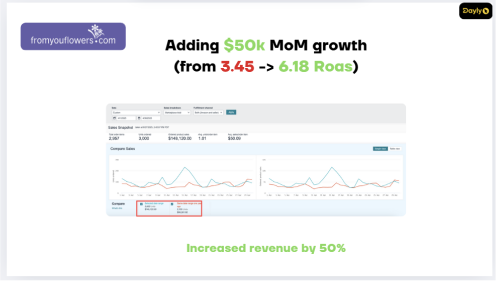
Grew monthly revenue 50% and nearly doubled ROAS.
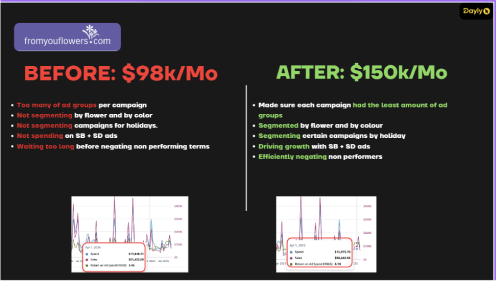
A major gifting brand had too many ad groups per campaign, no holiday segmentation, and no Sponsored Brands / Display presence.
- Consolidated ad groups and restructured campaigns
- Segmented by flower type, color, and holiday window
- Added Sponsored Brands + Sponsored Display for incremental growth
- Efficient non-performer negation on a tight cadence
The starting state
From You Flowers was already a significant Amazon seller doing roughly $98,000 a month. Nothing about the account looked broken from the outside — revenue was steady, ads were running, someone was managing it.
The problem was that the account had grown by accumulation. New campaigns were added as new products and promotions came along, and nothing was ever consolidated. The result was an advertising structure where a single campaign held far too many ad groups, so every performance number was an average of things that had nothing to do with each other. Spend on a Mother's Day bouquet sat in the same bucket as spend on a year-round sympathy arrangement.
When the data is structured like that, you can't make a decision. You can only make a guess.
The constraint that actually mattered
Flowers are a seasonal, occasion-driven category. Demand is not a smooth line — it spikes hard around Valentine's Day, Mother's Day, and the winter holidays, and the shopper's intent changes completely between those windows. Someone buying for Valentine's Day is price-insensitive and deadline-driven. Someone buying a sympathy arrangement is searching entirely different terms.
The account had no holiday segmentation at all. Bids and budgets were being set as though February and August were the same month. That means two guaranteed losses at once: underspending during the windows where every click converts, and overspending in the flat periods where it doesn't.
There was also nothing running beyond Sponsored Products. No Sponsored Brands, no Sponsored Display. In a gifting category where brand trust drives the click, that's a large piece of the funnel simply left unbuilt.
What we changed
Consolidated and restructured the campaigns. Before optimizing a single bid, we rebuilt the architecture so performance could be read at the level we needed to manage it. Fewer ad groups per campaign, tightly themed, one clear job each.
Segmented by flower type, color, and holiday window. This was the decisive change. Separating campaigns by product type and by occasion meant budgets and bids could move independently — pushed hard into a holiday window when conversion rate justified premium CPCs, pulled back in the flat weeks between. Colour segmentation mattered more than expected; red roses and white lilies are effectively different products with different buyers.
Added Sponsored Brands and Sponsored Display. Sponsored Brands captured category-level searches at the top of results where a gifting shopper is still choosing who to buy from. Sponsored Display retargeted shoppers who had viewed a product without converting — a meaningful segment in a category where people browse before committing to an occasion purchase.
Put non-performer negation on a tight cadence. Search term reports reviewed on a fixed schedule, with converting terms harvested into exact-match campaigns and non-converting terms negated. This is unglamorous and it's where a large share of the efficiency gain came from. Every dollar not spent on a term that never converts is a dollar available for one that does.
Tightened up organic relevance. Campaign structure decides what you pay for traffic; listing SEO decides how much traffic you get without paying. Keyword coverage, copy and indexation were reworked so the catalogue was actually eligible to rank for the occasion and product terms the ads were winning — which is what turns a paid gain into a durable one.
The numbers
- Monthly revenue: $98,000 → $150,000 — a 50% increase, adding $50,000 of month-over-month growth
- ROAS: 3.45 → 6.18 — a 79% improvement in advertising efficiency
The second number is the one worth sitting with. Revenue growth and efficiency improvement usually trade off against each other: buy more growth and your ROAS falls, tighten efficiency and revenue shrinks. Getting both at once is the signature of a structural fix rather than a bidding one. The account wasn't underspending or overspending — it was spending against a structure that made good decisions impossible.
Why this worked
Nothing here was exotic. No new tactic, no platform loophole. The account already had demand, a real brand, and products that converted.
What it didn't have was an advertising structure that matched how its customers actually bought, or organic relevance to fall back on. Those were the only two levers pulled here: campaign structure and SEO. Once campaigns were organized around the real variables — occasion, product type, colour — the optimization work that had been happening all along finally landed somewhere useful, and the organic work meant the account kept the ground it gained.
That's the pattern in most accounts we take over at this size. The ceiling isn't demand. It's legibility.
Read the method behind this in our Amazon PPC management guide, or see what full account management covers.
Book a free Gap Analysis. We'll audit your account the same way we audited From You Flowers.
Book a Gap Analysis →